Thomas Carruthers (abt. 1810 – 1883)

https://www.wikitree.com/wiki/Carruthers-1012

Thomas was born in 1810 in Dumfries, Scotland. It is unclear who his parents were. Perhaps John Carruthers and Mary Bell. However, on Familysearch, a Thomas who was supposedly the son of the above is shown with a different wife and many children. At this time (June 2019), Thomas’s origins haven’t been resolved.

However, there is a Scottish marriage record showing Thomas marrying Agnes Granger or Grainger in Dumfries, Dumfries, Scotland on April 10, 1831. The family journeyed from Liverpool to New York on “The Globe.” Thomas’s occupation was “bookbinder.” The young family with a pregnant Agnes arrived in New York on June 5, 1832. Their first child Jenette was born immediately. Their second child Eleanor was born in 1834 in Petersburg, Virginia. No one seems to have any idea of why they ended up there. Perhaps they were visiting other relatives?

The obituary of daughter Jenetta says that “In 1836 her father’s family removed to Ohio….” The Carruthers’ third daughter Sarah was born in 1844 in Chillocothe, Ohio. One wonders how much occupation there was for a bookbinder in the new world. Nevertheless, in 1850 Chillocothe, “bookbinder” is Thomas’s occupation on the census. Chillocothe is also where two more children were born to the family. Then Agnes passed away in 1852. She was originally buried at the First Presbyterian Graveyard which was relocated to Greenlawn Cemetery, Chillicothe, Ross, Ohio.

In 1853 Thomas married Elvira McCune, daughter of Samuel McCune and Rachel Sexton, in Ross County, Ohio. (Ten years later, Elvira’s sister, Mary Jane McCune married the widower Thomas Wilson who was from Garden Plain and came to live in Whiteside). Thomas and Elvira had a daughter Mary who was born in Chillicothe in 1854.

Around 1856 the family had moved to Whiteside, Illinois. The obituary of daughter Sarah said the family moved to Illinois when she was 12 years old. The obituary of daughter Elizabeth says her parents “bought a farm on Stone street near the Stone street school about two miles from Garden Plain.” Thomas was close to 50 years old and now a farmer. What did he know of the farming business? Did he do some farming while he was a bookbinder or was he a complete novice? It must have been helpful that he had his future son-in-law James Burnett living with him who had been raised on a farm. James was to marry Sarah Francis Carruthers in 1862 and the families continued to live close to each other.

Unfortunately Elvira died in 1867. Once again Thomas needed a wife and he returned to Ohio to marry Sarah J. Wallace. More questions! Had Thomas known Sarah before he moved to Whiteside? Why didn’t he just marry one of the many local spinsters? Looking at Sarah’s background, it seems her family had lived in Ross County, Ohio, so that probably is where Thomas and Sarah had made their acquaintance. Sarah is buried with her parents and siblings at the Old Burying Ground, Greenfield, Highland County, Ohio. Her gravestone clearly says”Wife of Thomas B. Carruthers.” That initial “B” could possibly be helpful someday in identifying Thomas in Scottish records. Thomas died in 1883 and Sarah died in 1904. Thomas is buried at the Garden Plain Cemetery in Whiteside, Illinois, where Elvira is also buried.

500px-Carruthers-1012.jpg

Sources

Name: Thomas Carruthers Gender: Male Birth Date: 18 Sep 1810 Birth Place: , Tinwald, Dumfries, Scotland Baptism Place: , Tinwald, Dumfries, Scotland Father: John Carruthers Mother: Mary Bell FHL Film Number: 1067971 Reference ID: – 2:1645TZT Source Information Ancestry.com. Scotland, Select Births and Baptisms, 1564-1950 [database on-line]. Provo, UT, USA: Ancestry.com Operations, Inc., 2014. Original data: Scotland, Births and Baptisms, 1564-1950. Salt Lake City, Utah: FamilySearch, 2013.

Name: Thomas Carruthers Gender: Male Marriage Date: 10 Apr 1831 Marriage Place: Dumfries,Dumfries,Scotland Spouse: Agnes Grainger FHL Film Number: 1067961 Source Information Ancestry.com. Scotland, Select Marriages, 1561-1910 [database on-line]. Provo, UT, USA: Ancestry.com Operations, Inc., 2014. Original data: Scotland, Marriages, 1561-1910. Salt Lake City, Utah: FamilySearch, 2013.

“Public Member Trees”, database, Ancestry.com (https://www.ancestry.com/family-tree/person/tree/83728/person/-2095953753/facts : accessed 11 June 2019), profile for Thomas Carruthers. Name: Thomas Carruthers Arrival Date: 5 Jun 1832 Age: 21 Gender: M (Male) Port of Arrival: New York Port of Departure: Liverpool Place of Origin: England Occupation: Bookbinder Destination: United States of America Ship: Ship Globe Microfilm Serial Number: M237 Microfilm Roll Number: 16 List Number: 367 Source Information Ancestry.com. New York, Passenger and Immigration Lists, 1820-1850 [database on-line]. Provo, UT, USA: Ancestry.com Operations Inc, 2003. Original data: Registers of Vessels Arriving at the Port of New York from Foreign Ports, 1789-1919. Microfilm Publication M237, rolls 1-95. National Archives at Washington, D.C.

Name: Thomas Carruthers Tax Year: 1865 State: Illinois, USA Source Information Ancestry.com. U.S. IRS Tax Assessment Lists, 1862-1918 [database on-line]. Provo, UT, USA: Ancestry.com Operations Inc, 2008. Original data: Records of the Internal Revenue Service. Record Group 58. The National Archives at Washington, DC.

Name: Thomas Carruthers Gender: Male Marriage Date: 13 Sep 1853 Marriage Place: Ross, Ohio, USA Spouse: Elvira Mccune Film Number: 000281653 Source Information Ancestry.com. Ohio, County Marriage Records, 1774-1993 [database on-line]. Lehi, UT, USA: Ancestry.com Operations, Inc., 2016. Original data: Marriage Records. Ohio Marriages. Various Ohio County Courthouses.

Name: Thomas Carothers Enumeration Date: 19 Jun 1880 Place: Garden Plain, Whiteside, Illinois, USA Schedule Type: Agriculture OS Page: 10 Line Number: 9 Source Citation Census Year: 1880; Census Place: Garden Plain, Whiteside, Illinois; Archive Collection Number: T1133; Roll: 55; Page: 10; Line: 9; Schedule Type: Agriculture

Source Information Ancestry.com. U.S., Selected Federal Census Non-Population Schedules, 1850-1880 [database on-line]. Provo, UT, USA: Ancestry.com Operations, Inc., 2010.

Name: Thomas Carathers Probate Date: 12 Dec 1883 Probate Place: Whiteside, Illinois, USA Inferred Death Year: Abt 1883 Inferred Death Place: Illinois, USA Item Description: Administrators Record, Vol B-C, 1872-1892 Source Citation Probate Records, 1852-1904; Author: Illinois. County Court (Whiteside County); Probate Place: Whiteside, Illinois Source Information Ancestry.com. Illinois, Wills and Probate Records, 1772-1999 [database on-line]. Provo, UT, USA: Ancestry.com Operations, Inc., 2015. Original data: Illinois County, District and Probate Courts.

Name: Thomas Carruthers Event Type: Burial Death Date: Nov 1884 Burial Date: 1884 Burial Place: Erie, Illinois, USA Church: Newton Presbyterian Church Source Citation Presbyterian Historical Society; Philadelphia, Pennsylvania; U.S., Presbyterian Church Records, 1701-1907; Book Title: Register 1857-1936; Accession Number: Vault BX 9211 .I32448 N42 Source Information Ancestry.com. U.S., Presbyterian Church Records, 1701-1970 [database on-line]. Lehi, UT, USA: Ancestry.com Operations, Inc., 2016.

Name: Thomas Carruthers Gender: Male Birth Date: 1810 Death Date: 1883 Cemetery: Garden Plain Cemetery Burial or Cremation Place: Garden Plain, Whiteside County, Illinois, United States of America Has Bio?: Y Spouse: Agnes Carruthers Children: Jennetta Wilson Eleanor G Dutch Mary C Dutch John Waddle Carruthers Elizabeth Carruthers URL: https://www.findagrave.com/memorial/20415178 Source Information Ancestry.com. U.S., Find A Grave Index, 1600s-Current [database on-line]. Provo, UT, USA: Ancestry.com Operations, Inc., 2012. Original data: Find A Grave. Find A Grave. http://www.findagrave.com/cgi-bin/fg.cgi.

John Waddle Carruthers (1846 – 1920)

John was born in 1846. He was the son of Thomas Carruthers and Agnes Granger. John married a Pennsylvania woman, Emily J. Blean, daughter of David Blean and Emily Kinkaide who likely was visiting relatives in Whiteside, Illinois, when he met his future wife. John passed away in 1920.

John’s interesting middle name might be a clue to the family’s Scottish ancestors. Perhaps the maiden name of someone’s mother?

(N.B. A granddaughter of John’s sister Frances (Elizabeth Burnett) was to marry another Blean (Leonard W.) in 1912.

Obituary from The Lathrop Optimist,” December 16, 1920, p. 2:

JOHN W. CARRUTHERS
John W. Carruthers, son of Thomas and Agnes Carruthers, was born in Chillocothe, Ohio, October 14, 1846. When seven years of age he, with his family, moved to a farm near Garden Plains, Illinois, where the greater part of his early life was spent. While residing on this farm he united with the Presbyterian church, at the age of 21. He was married to Emily J. Blean, September 13, 1885 and the following year he left Illinois and moved to Turney, Missouri, where he resided for several years, afaterward moving on a farm near Lathrop, Missouri, at which time he united with the Presbyterian church in Lathrop, of which he was a faithful member and a ruling elder until the day of his death.
Mr. Carruthers has left to mourn his death, four sisters. His wife taken from him a little more than a year ago, and from that time on his life was a lonely one, and his home desolate.

Clipping from the Plattsburg Leader, December 24, 1920, p. 5:

Will of John W. Carruthers

The will of the late John W. Carruthers of Lathrop was filed in probate court this week. The will leaves all the estate to his wife but as she had died before her husband the property will go to his brothers and sisters.

500px-Carruthers-316.jpg

In this image:

  • Sarah Frances (Carruthers) Burnett
  • John Waddle Carruthers
  • Eleanor G (Carruthers) Dutch
  • Jenette (Carruthers) Wilson
  • Elizabeth Carson Carruthers

Stuart and Jane Carruthers


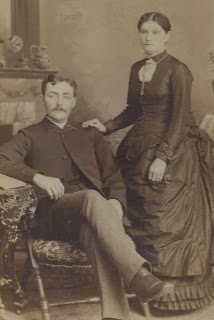
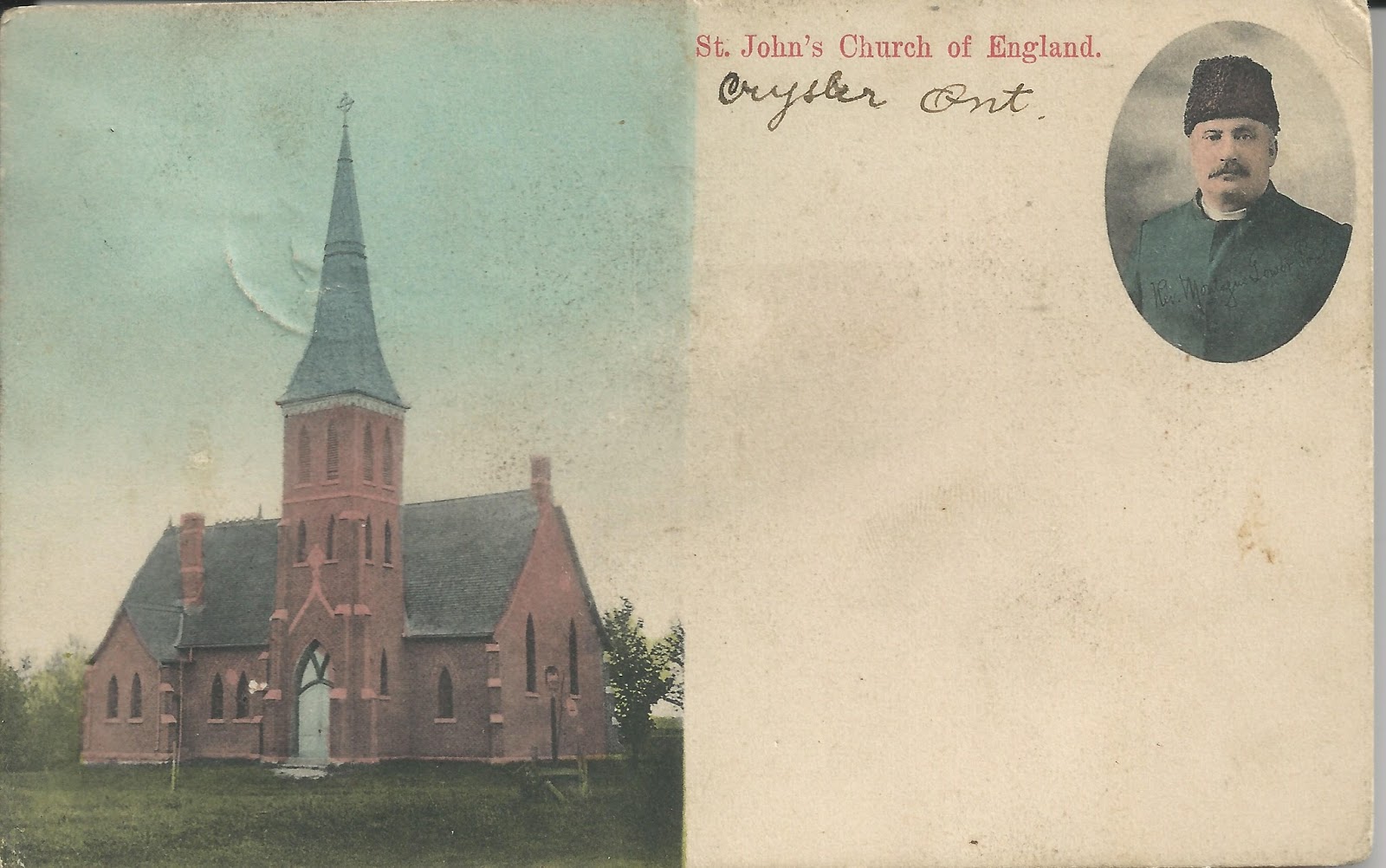
Stuart Carruthers was born on October 11, 1870, in Finch, Ontario.  His father Andrew William Carruthers was 54 and his mother the former Jean Steven was 37. He was 6th born in a family of eight which included my great grandmother Margaret.  Stuart can be found on the 1871, 1881 and 1891 census of Canada living with his family in the Winchester sub-district of Dundas County. His first name was written “Stewart” on some of them as it is in some of the later documents as well.   He married Jane Smirl who had been born in nearby Hallville in 1872 on December 20, 1893, in Russell, Ontario.  The unidentified picture below was among my Grandma’s and I think it looks like some of the Carruthers.  The style of clothes and the type of picture would be about right for 1893 but if anyone can confirm or deny my guess, please do!  My Grandpa Frank Kinnaird lived with Stuart and Jane after the death of his mother in 1894 so it would make sense that he had a picture of them.  The 1901 Canadian Census shows Stuart, Jane, 3 sons, 7 year old Frank Kinnaird and  John O’Neil living at Concession 11 Lot 23 Cannamore, Ontario.  Google maps names a Carruthers Road which intersects with a Stevens Road near this place today!  Five years later J.J. O’Neil would be married to Stuart’s sister Christina and they would be living in Manitoba with Frank, starting a new life on the prairies!

Stuart and Jane had a family of five, four boys and a girl, all of whom married and lived their lives in the same general area of  Ontario:
Orrin Victor ( 1895-1950) married Beulah Jessie Ford
Keith (1897-1964) married Amy Marcellus Loughridge
William John (1899-1978) married Mary Oliphant
Carl Maxwell (1901-1973) married Laina Amelia Lahte
Sybil Maude (1904-1991) – married James Hugh Watson
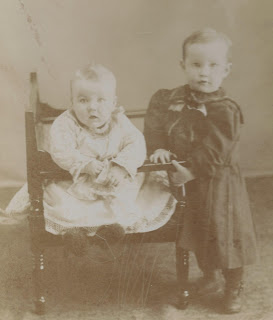
                               Orrin Victor Carruthers and William Francis Kinnaird 1896
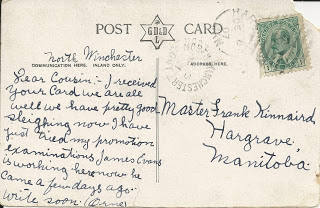
North Winchester
(Postmarked December 1907)

Dear Cousin,

I received your card and we are all well we have pretty good sleighing now I have just tried my promotion examinations.  James Evans is working here now.  He came a few days ago.
Write soon.
Orne

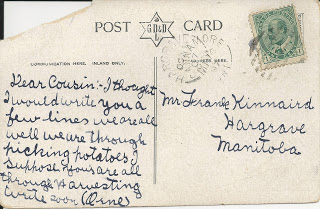
(Postmarked October 1907)
Dear Cousin,
I thought I would write you a few lines we are all well we are through picking potatoes I suppose you’s are all through harvesting.
 Write soon.
Orne
Orrin married Beulah Jessie Ford in 1919 and they had 5 children.  Sadly two boys died in WWII
Keith Carruthers and Amy Marcellus Loughridge married in 1918
The other Carruthers brothers sent postcard as well.
 North Winchester December 7, 1908
Dear Cousin,
I am going to write you a few lines letting you know I think you are forgetting the boy down here called Keith Carruthers and I want you to hurry up and write.
From your remaining friend,
K.C.(Keith Carruthers)

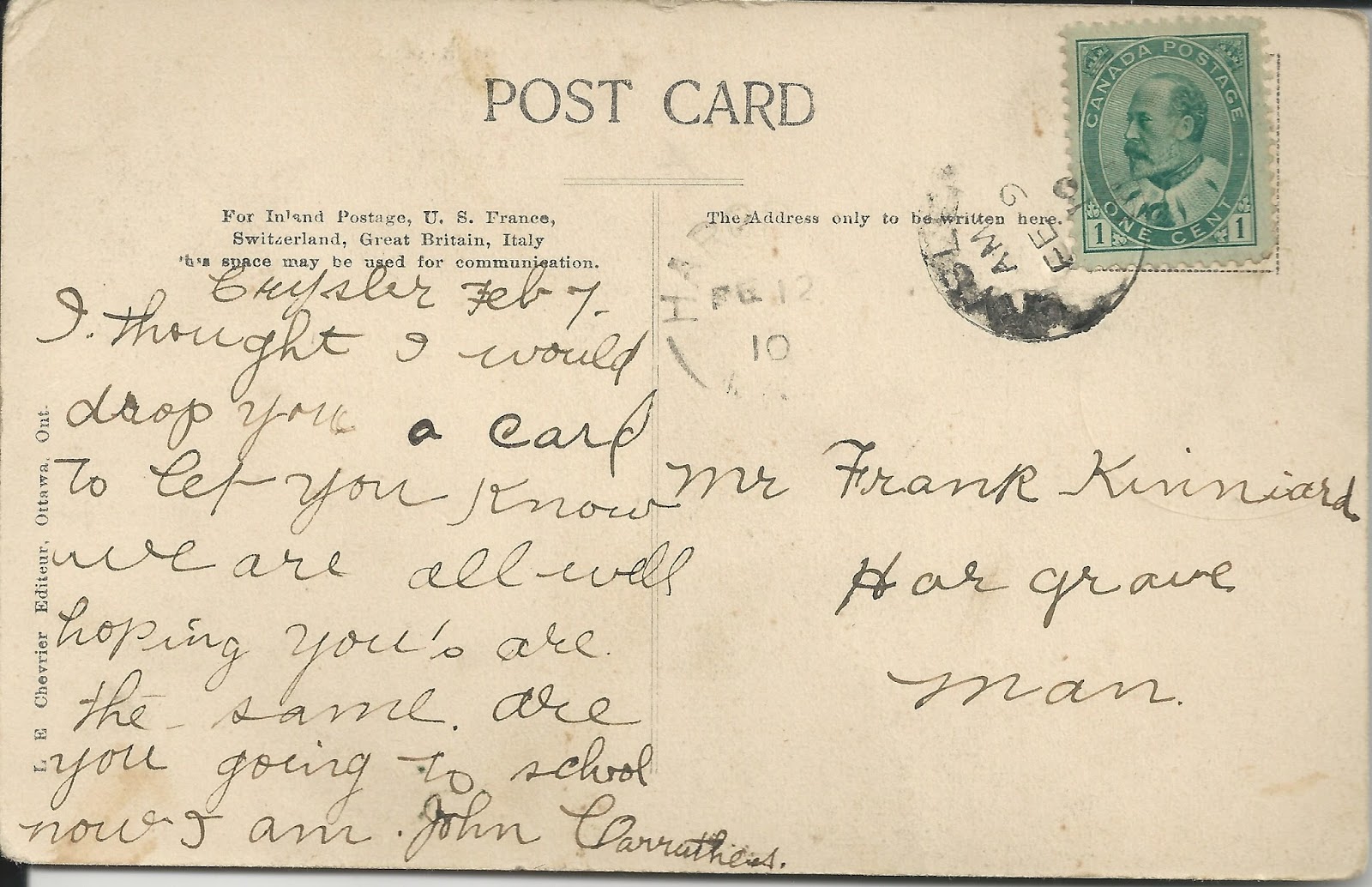
Crysler, Feb. 7 (postmarked 1910)

I thought I would drop you a card to let you know we are all well. Hoping you’s are the same. Are you going to school now? I am.
John Carruthers
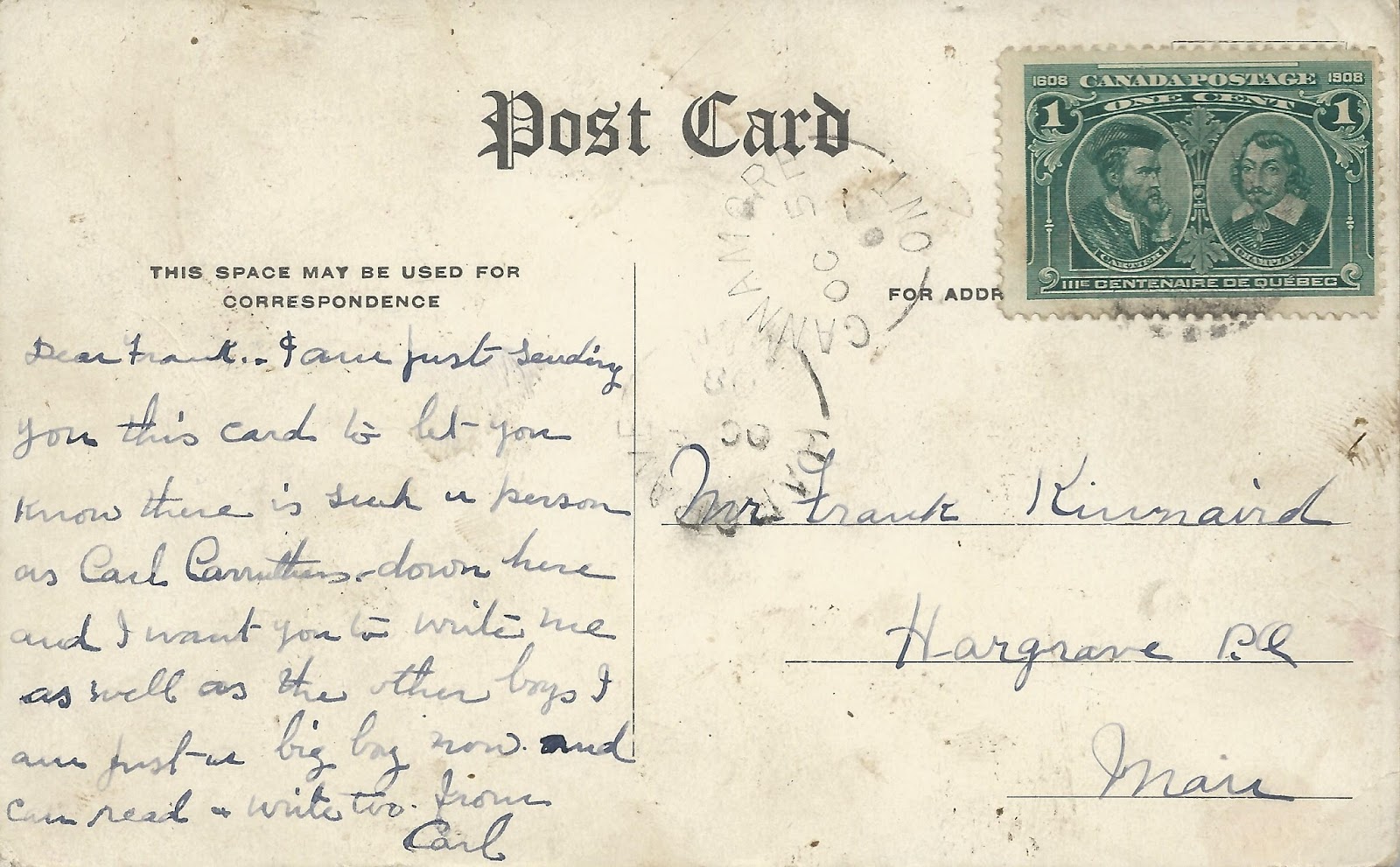
Postmark – Cannamore, Ont October 5, 1906

Dear Frank

 I am just sending you this card to let you know there is such a person as Carl Carruthers down here and I want you to write me as well as the other boys. I am (?) big boy now and can read and write too.
from Carl
Stuart Carruthers died young on January 12, 1917, in Morewood, Ontario, at the age of 46.  Tragically, his wife Jane died a short 11 months later on November 3, 1917 at the age of 45.  They are buried in Morewood Presbyterian Cemetery with his parents and sister Margaret.

Winnipeg’s connection to the Spirit of ’76

Written by: Danielle Da Silva
Community journalist — The Sou’wester

It’s an iconic American image of patriotism and victory and has been reproduced in ways too many to count.

Archibald Willard’s painting Spirit of ’76 is celebrated by our neighbors to the south but it also has a close connection to Winnipeg.

Gail Carruthers, 97, stands next to a print of the iconic American image the Spirt of '76. Carruthers is directly related to the fife player seen on the right, Hugh Mosher. Carruthers is Mosher's great-grand daughter.  (DANIELLE DA SILVA/CANSTAR/SOUWESTER)
DANIELLE DA SILVA – SOU’WESTER

Gail Carruthers, 97, stands next to a print of the iconic American image the Spirt of ’76. Carruthers is directly related to the fife player seen on the right, Hugh Mosher. Carruthers is Mosher’s great-grand daughter. (DANIELLE DA SILVA/CANSTAR/SOUWESTER)

Gail Carruthers, 97, is the great-granddaughter of the fifer on the far right of the painting: Hugh Mosher. According to Carruthers, whose family originally came from Perry, Ohio, and later Brighton, Ohio, the painting is a great likeness to her great-granddad.

“He was a farmer with a big family but he played the fife and he was in the war and he looked the right part to be in the picture, that’s what we were told.”

“He wasn’t a well-known man or anything,” Carruthers explained, surrounded by photos in her Fort Rouge period home. “He was a farmer with a big family but he played the fife and he was in the war and he looked the right part to be in the picture, that’s what we were told.”

Archibald Willard was close friends with Hugh Mosher. The two both served in the Civil War and at the conflict’s close returned to Wellington, Ohio. It was during this period, around 1876, that Willard was inspired to sketch a scene from a commemorative parade titled Yankee Doodle, which closely resembled the current Spirit of ’76. That sketch was the starting point for over a dozen variations on the painting.

“There are at least 14 versions that Willard himself did,” said history curator Emily Lang of the Ohio History Connection.

“He’s a really interesting figure especially in Ohio art. Basically his whole career, with the exception of a short stint in Chicago and his service in the Civil War, was spent in Ohio.”

While the painting at the time of its creation was considered crude by some, over the years it has become a true icon of American culture.

“It’s probably one of the most important pieces of the late 19th century,” Lang said. “Really, the reason why it is so famous is because it has been reproduced in so many different ways.”

The Spirit of ‘76 depicts three musicians marching across a battlefield after victory. On the right, playing the fife, is Hugh Mosher.
SUPPLIED PHOTO

The Spirit of ‘76 depicts three musicians marching across a battlefield after victory. On the right, playing the fife, is Hugh Mosher.

The Spirit of ’76 has appeared in popular culture in many forms: on shopping bags, on the cover of Disney Magazine, on fabric, and as part of sales promotions, to name a few.

The print that hangs in Carruthers’s home was actually part of a mail-in promotion sponsored by Carnation Evaporated Milk. It was the 1970s, Carruthers recalled, and if you sent in a wrapper from the can of milk with 50 cents to the company, they would send you a print of one of four famous paintings.

“I sent it in to Chicago and I said I hoped I could get this because the fifer was my great-grandfather,” Carruthers recalled. “All my relatives who had sent one of these had theirs sent folded. Mine came rolled up, with no creases.”

Carruthers had the print framed and gave it to her mother as a gift. The print has remained with Carruthers since.

Despite the recognition the painting has in America, Carruthers says she doesn’t know much about her great-grandfather and her family rarely spoke about him.

Gail Carruthers's family used to hold regular family reunions. Pictured in the large group photo are primarily descendants of Hugh Mosher. In the bottom left is Carruthers's mother and aunts. (DANIELLE DA SILVA/CANSTAR/SOUWESTER)
DANIELLE DA SILVA – SOU’WESTER

Gail Carruthers’s family used to hold regular family reunions. Pictured in the large group photo are primarily descendants of Hugh Mosher. In the bottom left is Carruthers’s mother and aunts. (DANIELLE DA SILVA/CANSTAR/SOUWESTER)

“Someone said that Hugh, my great-grandfather, visited Washington once and was recognized by people, so they’d speak to him, they recognized him from the painting. I never heard anything else about him, really,” she said.

At 97, Carruthers is preparing to move from her home and has gathered the artifacts she has connected to Mosher including notes, photos, and furniture. Some of the items will be donated to museums in Brighton, Ohio where Mosher is buried and other items have been passed onto her nephew to keep the history in the family.

Carruthers says that while having a relative depicted in American iconography isn’t of much importance to her, her family history through the ages is.

“I am proud to be a Canadian but I am also proud of my American heritage,” Carruthers said. “I am ninth from the Hugh Mosher that came to the United States in 1632. So yes I am proud of them, so I like to see that picture.”


New Jersey Colony

Farming in the Middle Colonies


The New Jersey Colony
The New Jersey Colony was one of the original 13 colonies located on the Atlantic coast of North America. The original 13 colonies were divided into three geographic areas consisting of the New England, Middle and Southern colonies.

The New Jersey Colony was classified as one of the Middle Colonies. The Province of New Jersey was an English colony in North America that existed from 1664 until 1776, when it joined the other 12 of the 13 colonies in rebellion against Great Britain and became the U.S. state of New Jersey.


Map of 13 Colonies Chart

Around 1524, Giovanni de Verrazano became the first European to explore New Jersey. He sailed along the coast and anchored off Sandy Hook. The colonial history of New Jersey started after Henry Hudson sailed through Newark Bay in 1609. Although Hudson was British, he worked for the Netherlands, so he claimed the land for the Dutch. It was called New Netherlands.

Small trading colonies sprang up where the present towns of Hoboken and Jersey City are located. The Dutch, Swedes, and Finns were the first European settlers in New Jersey. Bergen, founded in 1660, was New Jersey’s first permanent European settlement.

In 1664 the Dutch lost New Netherlands when the British took control of the land and added it to their colonies. They divided the land in half and gave control to two proprietors: Sir George Carteret (who was in charge of the east side) and Lord John Berkeley (who was in charge of the west side). The land was officially named New Jersey after the Isle of Jersey in the English Channel. Carteret had been governor of the Isle of Jersey.

Berkeley and Carteret sold the land at low prices and allowed the settlers to have political and religious freedom. As a result, New Jersey was more ethnically diverse than many other colonies. Primarily a rural society, the colony grew to have about 100,000 people.

Eventually, governing power was transferred back to England. For many years, New Jersey shared a royal governor with New York. The governorship was finally split in 1738 when New Jersey got its own governor, Lewis Morris.

Map Of Camden, New Jersey, & Environs

John Cabot was the first European explorer to come into contact with the New Jersey shore. Henry Hudson also explored this area as he searched for the northwest passage. The area that would later be New Jersey was part of New Netherland. The Dutch West India Company gave Michael Pauw a patroon-ship in New Jersey. He called his land Pavonia. In 1640, a Swedish community was created in present-day New Jersey on the Delaware River. However, it is not until 1660 that the first permanent European settlement of Bergen was created.

In 1664, James, the Duke of York, received control of New Netherland. He sent a small English force to blockade the harbor at New Amsterdam. Peter Stuyvesant surrendered to the English without a fight. King Charles II had granted the lands between the Connecticut and Delaware Rivers to the Duke. He then granted land to two of his friends, Lord Berkeley and Sir George Carteret, that would become New Jersey. The name of the colony comes from the Isle of Jersey, Carteret’s birthplace. The two advertised and promised settlers many benefits for colonizing including representative government and freedom of religion. The colony quickly grew.

Richard Nicolls was made the governor of the area. He granted 400,000 acres to a group of Baptists, Quakers, and Puritans. These resulted in the creation of many towns including Elizabethtown and Piscataway. The Duke’s Laws were issued that allowed for religious tolerance for all Protestants. In addition, a general assembly was created.

Sale of West Jersey to the Quakers

In 1674, Lord Berkeley sold his proprietorship to some Quakers. Carteret agrees to divide the territory so that those who bought Berkeley’s proprietorship were given West Jersey while his heirs were given East Jersey. In West Jersey, a significant development was when the Quakers made it so that almost all adult males were able to vote.

In 1682, East Jersey was purchased by William Penn and a group of his associates and added with Delaware for administrative purposes. This meant that most of the land between the Maryland and New York colonies were administered by Quakers.

In 1702, East and West Jersey which were joined by the crown into one colony with an elected assembly.

New Jersey During the American Revolution 

A number of major battles occurred within the New Jersey territory during the American Revolution. These battles included the Battle of Princeton, the Battle of Trenton, and the Battle of Monmouth.

Significant Events

  • New Jersey is divided into East and West Jersey in 1674. It is reunited in 1702 when it becomes a royal colony
  • New Jersey was the third state to ratify the Constitution
  • New Jersey was the first to ratify the Bill of Rights

The Clydesdale Champion of Carp: Stan Carruthers

Clydesdale horse, Stan Carruthers, Gordon Carruthers Sr, Clydesdales, Eastern Regional Clydesdale Association, Clydesdale breeding program

Born in 1940, Stan Carruthers of Carp, Ontario, was predestined to work with Clydesdales.

“My grandfather was a stallioneer in Carp, and he used to have Percherons,” explains Stan. “In 1922, he sold his Percheron and bought a Clydesdale stallion. That’s how the love affair began.”

As a young man, while Stan would put together the occasional draft team to show and sell with his father, he wasn’t able to work with horses full-time.

Clydesdale horse, Stan Carruthers, Gordon Carruthers Sr, Clydesdales, Eastern Regional Clydesdale Association, Clydesdale breeding program

Stan’s love of horses came from his father, Gordon Carruthers Sr. Photo courtesy of Stan Carruthers

“For the first five or six years, all we ever thought of was war,” says Stan. “School was secondary to me for a long time. They weren’t teaching me what I wanted to learn. The horse industry was all I’d ever lived or dreamed, but there was no teacher for that other than my dad.”

In 1959, after a stint in the dairy industry, Stan began the transition to horses as his primary business. He purchased a pair of Standardbred siblings, Minor Joe and Minor Helen, who would become champions in the show ring as well as on the racetrack.

“There were all kinds of Standardbreds in the Carp area at one time; it was a big industry on a local level,” commented Stan. “Minor Joe was tough and intelligent, and he would go as far and as fast as he had to go to win.”

It wasn’t until the 1970s that Stan would make the switch to breed and show Clydesdale’s exclusively.

“The draft industry was kind of punky in the 1950-60s, but everything flew after 1972,” says Stan. “A friend of mine, Cyril Greene, wanted to get into the Clydesdale business. So, he bought a bunch of horses and asked me if I’d drive them for him. I said yes, but I have to take my dad wherever I’ll go.”

Clydesdale horse, Stan Carruthers, Gordon Carruthers Sr, Clydesdales, Eastern Regional Clydesdale Association, Clydesdale breeding program

Stan started in the horse business with a pair of champion Standardbred siblings, Minor Joe (pictured) and Minor Helen, before making the move to Clydesdales. Photo courtesy of Stan Carruthers

In addition to his driving, Stan was actively involved in the Carp community and sat on the board of the Carp Fair.

“I went on the fair board in the centennial year, 1967, and it was quite big at the time,” says Stan. “All the draft breeds showed together – Percheron, Clydesdale and Belgian – and there was favouritism from the judges. We had enough entries – 12 or 15 hitches in the ring with more guys getting in all the time – that I organized the Eastern Regional Clydesdale Association. Ontario had a club, but they were too far away and there are a lot of breeders in Western Quebec. So, I organized in ‘75, had the first Clydesdale show in ‘76, and in ‘77 I split the Percherons and Belgians into their own organizations.”

Shortly after founding the Eastern Regional Clydesdale Association, Stan decided to breed his own line of Clydesdales. The search for a good foundation mare led him to Truro, Nova Scotia over Christmas break of 1980, where he purchased eight mares and a yearling stallion. One of the mares, Elmview’s Pioneer Betsy (Betsy), would become the matriarch of a long line of Clydesdale champions. Her second foal, Lady Di, became somewhat of a local celebrity in Carp, with 31 championships to her name and several local commercial appearances.

“She was a natural,” says Stan of Lady Di. “When she was in the show ring, the judge couldn’t take his eyes off her.”

Clydesdale horse, Stan Carruthers, Gordon Carruthers Sr, Clydesdales, Eastern Regional Clydesdale Association, Clydesdale breeding program

In 1975, Stan founded the Eastern Regional Clydesdale Association. He is pictured driving with his son, Gordon Carruthers (right). Photo courtesy of Gordon Carruthers

Inspired by the success of the Carp Fair and with a robust herd of award-winning horses to call his own, Stan turned his eyes to a bigger prize: The World Clydesdale Horse Show and Trade.

“Around 1992, the Americans were trying to have a World Show but couldn’t get enough investors,” explains Stan. “It didn’t look like this show was going to happen, so I asked the Americans if they would come to Canada if I could do a world show. They said yes, so I left immediately before they could give it a second thought.”

For seven years, Stan campaigned across Canada and the globe to put together a world-class event. He attracted support from politicians and investors with a business plan that estimated a $35,000 contribution to the Ottawa economy. To attract exhibitors and attendees, Stan set up booths at local fairs, and traveled to Scotland and England to advertise at Highland Shows.

When the show finally arrived on August 25-29, 1999, the fruits of Stan’s labour were evident. With almost 400 horses in attendance at the Carp fairgrounds – including six from the `Clydesdale’s birthplace, Scotland – The 1999 World Clydesdale Horse Show and Trade was, at the time, the largest Clydesdale show and competition in the world.

Thousands of attendees paid the $10 entrance fee to the event. In addition to standard line and hitch classes, as well as an international auction, the eclectic event program included Clydesdale barrel racing, a medieval jousting simulation, and a craft marketplace.

Clydesdale horse, Stan Carruthers, Gordon Carruthers Sr, Clydesdales, Eastern Regional Clydesdale Association, Clydesdale breeding program

tan’s love of Clydesdale competition took him across North America and inspired his travels to the birthplace of the breed in Scotland and England. Photo: Lynn Cassels-Caldwell

“The memories of that were unbelievable,” says Stan of the show. “It was hot – I’ve never seen that many dirty feet and saddles in all my life! But people came, and they’d sit there from 10 in the morning until six at night. I couldn’t believe it.”

Stan sold all six of his hitch horses at the show’s auction, including Lady Di’s most prolific offspring: Carp Valley Harold (Harold), owned by Owl Creek Clydesdales. Harold would go on to win a record number of awards, including seven national champion cart horse titles at the National Clydesdale Show in Milwaukee, Wisconsin. In 2007 alone, he captured three titles at the Royal Horse Show in Toronto, Ontario, and won both Best Clydesdale Gelding and the Men’s Cart Class at the World Clydesdale Show in Madison, Wisconsin. Harold’s long list of accolades earned the distinction of being one of the top three Clydesdales show geldings of all time.

“He was wild,” Stan says fondly of Harold. “If you hooked him up, you took a deep seat and hung on!”

World-class Clydesdales have continued to emerge out of the Betsy line, including five-time North American Champion, Carp Valley Adrien, owned by John Newell of Richmond, Ontario.

Clydesdale horse, Stan Carruthers, Gordon Carruthers Sr, Clydesdales, Eastern Regional Clydesdale Association, Clydesdale breeding program

Hank is the newest addition to the Carruthers’ current herd, and another foal is on the way. Photo: © EC/Caroline Soble

The current Carruthers Farm herd includes four Clydesdales, with a foal on the way. The numbers are a far cry from the herds of 25 or more that Stan used to maintain, as Carruthers Farm has adapted to meet the fluctuating demands of the draft business.

While the draft industry may be changing, Stan, now 78, has remained a constant force for its advancement in Canada and the local Carp area. He maintains his position as president of the Eastern Regional Clydesdale Association, and still attends as many local horse shows as possible.

“There is no display of horsepower in any of the World Show breeds like the Carp Fair ring,” comments Stan with pride. “It’s the best ring in the world.”

Clydesdale horse, Stan Carruthers, Gordon Carruthers Sr, Clydesdales, Eastern Regional Clydesdale Association, Clydesdale breeding program

Stan (right) has handed Carruthers Farm and its Clydesdale breeding program to the next generations: son, Gordon (left) and grandson, Blake (middle). Photo courtesy of Stan Carruthers

The day-to-day running of Carruthers Farm and its breeding program has been handed down to the next generation. Stan’s son, Gordon, continues to show homebred Clydesdales, descended from Betsy, across North America alongside his wife, Val, and their son, Blake.

“I wanted Blake to be a rider, but no…” jokes Val. “Blake will go to the Royal and World Show with his dad and he just lives for it, and talks about it for a month steady afterward. He absolutely loves it.”

It’s evident that Clydesdales run strong throughout the Carruthers family, but there’s no denying that Stan reigns as the breed’s most fervent champion. As Gordon puts it simply: “There is no one that loves Clydesdale horses more.”

This article was originally published in the Summer 2018 issue of Canadian Horse Journal.

Main article photo: Stan Carruthers, 78 is a lifelong champion of the Clydesdale breed, and brings the illustrious history of Clydesdales in Eastern Ontario to life through his photos and stories. Photo: © EC/Jessie Christie

Clan Carruthers: The Battle of Arkinholm (Langholm)

The Battle of Erkinholme was fought on the 1st of May, 1455.

Red Douglas. Black Douglas

(Supporters of James II) (Rebel forces)

George Douglas Archibald Douglas,

4th Earl of Angus Earl of Moray

Hugh Douglas

Laird of Johnston. Earl of Ormonde

John Douglas

Lord of Balvenie

The Battle of Erkinholme is more commonly referred to as the Battle of Arkinholm, albeit it’s known by some as the Battle of Langholm, primarily because it was fought where the town of Langholm now stands.

More accurately, the battle was fought on the outskirts of present day Langholm, opposite the lower return of a distinctive Z-shaped bend in the river Esk, which flows through the town, at least according to The Royal Commission on the Ancient and Historical Monuments and Constructions of Scotland.

The battle is noteworthy for having pitched two sides of the Douglas family at each other’s throats, but then again, that sort of thing wasn’t so unusual in mediaeval Scotland or elsewhere, for that matter. Even within our own family of a Carruthers fights between our own houses of Holmains and Dormont come to mind.

Although a small action, involving only a few hundred troops, it was the decisive battle in civil war between the king and the Black Douglases, the most powerful aristocratic family in the country. As the king’s supporters won it was a significant step in the struggle to establish a relatively strong centralised monarchy in Scotland during the late Middle Ages.

The two sides of Douglas were known as the ‘red’ and the ‘black’. The Chiefly line as they say, of the Douglases was the ‘black’ line, represented by the Earls of Douglas, whereas the ‘red’ line was represented by the Earls of Angus.

Both branches were descended through bastardy, with the Earl of Douglas descending from Archibald ‘the Grim’, an illegitimate son of Sir James Douglas, and the Earl of Angus stemming from an illegitimate child of William, the 1st Earl of Douglas. That made the main protagonists in the conflict at Erkinholme third cousins so, despite the name, the family ties weren’t that close.

There is some uncertainty about the leadership of the royal army. By some accounts it was led by George Douglas, 4th Earl of Angus, head of the Red Douglas family, a senior aristocrat, and third cousin to the Earl of Douglas.However other accounts describe it as a force of local Border families, Johnstones, Carruthers, Maxwell’s and Scotts, who had previously been dominated by the Black Douglases but now rebelled against them.

They were reputedly led by the Laird John Johnstone of Johnstone in Annandale, who succeeded his father 1455. The Carruthers Chief at the time would have been

The ensuing Battle of Arkinholm, involved only a few hundred troops on either side, but it was a definitive defeat for the Black Douglas brothers. Archibald Douglas, the Earl of Moray, was killed in the battle and his head was presented to the King. Hugh Douglas, the Earl of Ormonde, was captured and executed shortly afterwards, but John Douglas, Lord of Balvenie, escaped to England, there to join the 9th Earl.

After the battle the Douglas, Earl of Angus (Red Douglas) was awarded the Douglas Lordship of the Black Douglas, along with the original possessions of his ancestors in Douglasdale.

Thomas Carruthers, the 2nd son of John Carruthers the 3rd Laird of Holmains, received a charter for the lands of Corry on 23 July 1484, for his services at the Battle of Arkinholm. The lands of Corry were forfeited from George Corry for implication of him in the Albany-Douglas invasion

Clan Status: Last Chief. Died

Douglas Armigerous Archibald Douglas, 1st Duke. 1761

Johnston Official. Lord Patrick Hope-Johnstone

Scott. Official Richard Scott, Duke of Baccleuch

Maxwell. Armigerous William Maxwell of Carruchan 1863

Carruthers Armigerous John Carruthers of Holmains. 1807


Clan Carruthers: Scottish Clans & Families, what are they?

October 2, 2018Clan Carruthers

iu-4

Courtesy of Mercury News

There seems to be a great deal of confusion by some with regards, amongst other things, what a Scottish Clan or family is, what it isn’t and who can use the collective term.

The first thing that needs to be said, which seems to be very obvious to most is it’s Scottish, and therefore totally intertwined with Scotland, it’s culture, it’s traditions, laws and history.

To call a group a ‘Scottish’ clan or family without those links seems strange and surely defeats both the purpose and rational for using that particular adjective to describe a clan or family. Therefore if it doesn’t, it simply isn’t.

An excellent piece written by the Council of Scottish Clans and Associations(COSCA) in the USA, says it all.

cropped-gc-badge-artwork-chosen-logo-10-1.jpg

Carruthers

SCOTTISH CLANS

While the rich and romantic history of the Scottish clan system is rare, perhaps unique, among the nations of the world, not every surname with a Scottish heritage is associated with a Scottish clan.

Indeed, it has been estimated that fewer than 30% of all Scottish surnames carry a history of clan association.

True Scottish clans and traditional clan lands are found in all parts of Scotland including the Highlands and Islands, Lowlands and Scottish Borders.* But not all Scottish family names are associated with a recognized clan.

(Carruthers of course being an very ancient family from the West March of the Scottish borders, was recognised as a clan by the 1587 Act of Unruly Clans, by James VI and the Scottish Parliament.ed.)

THE CLAN SYSTEM

The clan system in Scotland is closely bound up with Scottish heraldry and much is determined by the Lord Lyon of Scotland, the nation’s chief heraldic officer.

The Standing Council of Scottish Chiefs acknowledges about 140 clans that have chiefs recognized by the Lord Lyon of Scotland.

Recognition by the Lord Lyon of a chief confers noble status on the clan or family which gives it a legally recognized status and a corporate identity. A family or name group that has no recognized chief has no official position under the law of Scotland.

Many of the cases that have come before the Lyon Court in the last 50 years have related to determination of the chiefships of clans. Presently, several Scottish clan organizations are pursuing identification and recognition of a chief by the Lord Lyon.

(A clan with no Chief is classed as Armigerous as us the case of Carruthers, which is why the Clan Carruthers Society International are working so hard to have a Chief recognised by the Lyon Court, headed by the Lord Lyon, in EdinburghWe are one of those several clans following due process. ed.)

SCOTTISH DISTRICT FAMILIES

If your surname isn’t historically associated with a recognized Scottish clan do not despair.

It is estimated that at least 5,000 of all Scottish surnames are actually district family names and not part of a clan. Often district families were not closely involved in the violent and tumultuous lifestyle of many clans. As the result, members of district families were often better educated, had a higher standard of living and an overall better quality of life by some standards. They carried on Scotland’s commerce and agriculture, contributed to the arts and sciences, and were responsible for many inventions and discoveries that have influenced modern society.

Without question, district families of Scotland played a key role in the growth and development of the nation and its achievements.

More than fifty (50) recognized districts exist in Scotland, each with its own distinctive tartan. If your surname is associated with a family from a particular Scottish district you may proudly display your district’s tartan.

The Scottish District Families Association was formed in 1997 for the purpose of providing an organization for persons whose name or ancestry links them to a Scottish district rather than a clan.

Members of the SDFA receive quarterly newsletters containing news about members, Scots in America, profiles of various districts, and games/festival dates. Members also receive a pin (two pins for a family membership) with the SDFA emblem – a map of Scotland displaying Scotland’s ancient name of “Caledonia”.

SCOTTISH ARMIGEROUS FAMILIES

The Scottish system of heraldry reaches back to the Middle Ages but it is alive and flourishing today. Scotland’s heraldic tradition and laws influence many aspects of the Scottish clan system, including as mentioned above, helping to determine which ‘clans’ have chiefs and who those individuals are and will be.

The expert organization in the field of Scottish heraldry and armigerous families is The Society of Scottish Armigers (SSA), based in the United States. Visit the SSA online and learn more about this fun and fascinating aspect of Scottish clan and family history, law and tradition.

(Inside Scotland, it remains the Court of the Lord Lyon, external to that it is the Heraldry Society of Scotland. ed.)

As the SSA reminds us, ‘outside the jurisdiction of the Lord Lyon, it is in the worst possible taste to pretend that someone else’s Scottish arms are you own, although many people do not realize that this is the case.’

Chiefly Arms of Clan CarruthersAncient and"Honourable' Carruthers Clan Int (LLC) Badge

(The Arms, the main part of which is the shield, but includes a mantle, helm, torse and crest, with the motto above (Scottish Style), are owned by an individual not a family. As stated in the piece by COSCA, misuse is offensive at best. A typical abuse is seen above. The Arms to the left are the Carruthers Arms we all know, which belong to a Carruthers chief once confirmed by the Lord Lyon. To the right is a badge made up of the misuse of the Carruthers arms, the supporter (dragon) mantle, helmet, and scroll for the motto (English style) of the Arms of the City of London, and the supporter (Unicorn) from the Arms of the British Monarchy. ed. )

As you can see, a very succinct, descriptive and informative piece by the Council of Scottish Clans and Associations on what a Scottish clan or family structure is, who can use it, who can call themselves what and where that recognition comes from.

Clan Carruthers Society International has been working over the last 10 years to achieve our goal of having a Chief confirmed by the Lord Lyon leading to the Carruthers clan being considered official through that process. We hope you support us in our endeavours as the official society of Clan Carruthers

Promptus et Fidelis

*www.ClansandCastles.com

Share this:

Clan Carruthers: Scottish Clans & Families, what are they?


October 2, 2018Clan Carruthers


B9320513749Z.1_20160119172449_000_GGPD6Q1F9.1-0

Courtesy of Mercury News

There seems to be a great deal of confusion by some with regards, amongst other things, what a Scottish Clan or family is, what it isn’t and who can use the collective term.

The first thing that needs to be said, which seems to be very obvious to most is it’s Scottish, and therefore totally intertwined with Scotland, it’s culture, it’s traditions, laws and history.

To call a group a ‘Scottish’ clan or family without those links seems strange and surely defeats both the purpose and rationale for using that particular adjective to describe a clan or family. Therefore if it doesn’t, it simply isn’t.

An excellent piece written by the Council of Scottish Clans and Associations(COSCA) in the USA, says it all.


SCOTTISH CLANS          

cropped-gc-badge-artwork-chosen-logo-10-1.jpg

While the rich and romantic history of the Scottish clan system is rare, perhaps unique, among the nations of the world, not every surname with a Scottish heritage is associated with a Scottish clan.

Indeed, it has been estimated that fewer than 30% of all Scottish surnames carry a history of clan association.

True Scottish clans and traditional clan lands are found in all parts of Scotland including the Highlands and Islands, Lowlands and Scottish Borders.* But not all Scottish family names are associated with a recognized clan.

(Carruthers of course being an very ancient family from the West March of the Scottish borders, was recognised as a clan by the 1587 Act of Unruly Clans, by James VI and the Scottish Parliament.ed.)

THE CLAN SYSTEM

The clan system in Scotland is closely bound up with Scottish heraldry and much is determined by the Lord Lyon of Scotland, the nation’s chief heraldic officer.

The Standing Council of Scottish Chiefs acknowledges about 140 clans that have chiefs recognized by the Lord Lyon of Scotland.

Recognition by the Lord Lyon of a chief confers noble status on the clan or family which gives it a legally recognized status and a corporate identity. A family or name group that has no recognized chief has no official position under the law of Scotland.

Many of the cases that have come before the Lyon Court in the last 50 years have related to determination of the chiefships of clans. Presently, several Scottish clan organizations are pursuing identification and recognition of a chief by the Lord Lyon.

(A clan with no Chief is classed as Armigerous as us the case of Carruthers, which is why the Clan Carruthers Society International are working so hard to have a Chief recognised by the Lyon Court, headed by the Lord Lyon, in EdinburghWe are one of those several clans following due process. ed.)

SCOTTISH DISTRICT FAMILIES

If your surname isn’t historically associated with a recognized Scottish clan do not despair.

It is estimated that at least 5,000 of all Scottish surnames are actually district family names and not part of a clan. Often district families were not closely involved in the violent and tumultuous lifestyle of many clans. As the result, members of district families were often better educated, had a higher standard of living and an overall better quality of life by some standards. They carried on Scotland’s commerce and agriculture, contributed to the arts and sciences, and were responsible for many inventions and discoveries that have influenced modern society.

Without question, district families of Scotland played a key role in the growth and development of the nation and its achievements.

More than fifty (50) recognized districts exist in Scotland, each with its own distinctive tartan. If your surname is associated with a family from a particular Scottish district you may proudly display your district’s tartan.

The Scottish District Families Association was formed in 1997 for the purpose of providing an organization for persons whose name or ancestry links them to a Scottish district rather than a clan.

Members of the SDFA receive quarterly newsletters containing news about members, Scots in America, profiles of various districts, and games/festival dates. Members also receive a pin (two pins for a family membership) with the SDFA emblem – a map of Scotland displaying Scotland’s ancient name of “Caledonia”.

SCOTTISH ARMIGEROUS FAMILIES

The Scottish system of heraldry reaches back to the Middle Ages but it is alive and flourishing today. Scotland’s heraldic tradition and laws influence many aspects of the Scottish clan system, including as mentioned above, helping to determine which ‘clans’ have chiefs and who those individuals are and will be.

The expert organization in the field of Scottish heraldry and armigerous families is The Society of Scottish Armigers (SSA), based in the United States. Visit the SSA online and learn more about this fun and fascinating aspect of Scottish clan and family history, law and tradition.

(Inside Scotland, it remains the Court of the Lord Lyon, external to that it is the Heraldry Society of Scotland. ed.)

As the SSA reminds us, ‘outside the jurisdiction of the Lord Lyon, it is in the worst possible taste to pretend that someone else’s Scottish arms are you own, although many people do not realize that this is the case.’


Chiefly Arms of Clan CarruthersAncient and"Honourable' Carruthers Clan Int (LLC) Badge

(The Arms, the main part of which is the shield, but includes a mantle, helm, torse and crest, with the motto above (Scottish Style), are owned by an individual not a family. As stated in the piece by COSCA, misuse is offensive at best. A typical abuse is seen above. The Arms to the left are the Carruthers Arms we all know, which belong to a Carruthers chief once confirmed by the Lord Lyon. To the right is a badge made up of the misuse of the Carruthers arms, the supporter (dragon) mantle, helmet, and scroll for the motto (English style) of the Arms of the City of London, and the supporter (Unicorn) from the Arms of the British Monarchy. ed. )

As you can see, a very succinct, descriptive and informative piece by the Council of Scottish Clans and Associations on what a Scottish clan or family structure is, who can use it, who can call themselves what and where that recognition comes from.

Clan Carruthers Society International has been working over the last 10 years to achieve our goal of having a Chief confirmed by the Lord Lyon leading to the Carruthers clan being considered official through that process. We hope you support us in our endeavours as the official society of Clan Carruthers

Promptus et Fidelis

*www.ClansandCastles.com

Share this:


The Lion and the Clans

The earliest recorded use of the Lion rampant as a royal emblem in Scotland was by Alexander II in 1222 with the additional embellishment of a double border set with lilies occurring during the reign of Alexander III (1249–1286). This emblem occupied the shield of the royal coat of arms of the ancient Kingdom of Scotland which, together with a royal banner displaying the same, was used by the King of Scots until the Union of the Crowns in 1603, when James VI acceded to the thrones of the Kingdom of England and Kingdom of Ireland. Since 1603, the Lion rampant of Scotland has been incorporated into both the royal arms and royal banners of successive Scottish then British monarchs in order to symbolize Scotland; as can be seen today in the Royal Standard of the United Kingdom. Although now officially restricted to use by representatives of the Sovereign and at royal residences, the Royal Banner continues to be one of Scotland’s most recognizable symbols.

Image result for 'Lion Rampant

The ‘Lion Rampant’ Flag

This is NOT a national flag and its use by citizens and corporate bodies is entirely wrong.

Gold, with a red rampant lion and royal tressure, it is the Scottish Royal banner, and its correct use is restricted to only a few Great Officers who officially represent The Sovereign, including;

  • the First Minister as Keeper of the Great Seal of Scotland,
  • Lord Lieutenants in their Lieutenancies,
  • the Lord High Commissioner to the General Assembly of the Church of Scotland,
  • the Lord Lyon King of Arms,
  • and other lieutenants specially appointed.

Its use by other, non-authorized persons is an offence under the Act of Parliament 1672 cap. 47 and 30 & 31 Vict. cap. 17.

Why is the image of a lion so prevalent in Scottish Clan heraldry?

Why would a beast that was never native to Scotland feature so heavily?

The image of the lion in art and culture dates back to pre history and cave paintings. Our ancient ancestors who’s story began in Africa would have admired these powerful beasts and they would become symbols of noble savagery. As society advanced the symbolism became stronger; In ancient Egypt the lioness was merged with the human to create the sphinx.

In almost every other culture the lion was also present. Hittites, Assyrians, Babylonians, Persian and many early islamic cultures. Its not hard to understand, after all the lioness is a dedicated mother and ruthless hunter, the male lion a majestic animal that defends his pride with fury. a good role model for early civilisations.

The lion probably entered early Christian culture via a manuscript called the ‘Physiologus’. This document probably dates back to around the 2nd century AD and consists of a number of descriptions of animals and birds as characters in a series of moral tales. In the opening story a lioness gives birth to stillborn cubs but the lioness brings them to life by breathing upon them, this and other similar stories are a direct reference to the idea of Christ’s resurrection and the redemption of man. The Physiologicus also gives us the story of the Pelican wounding herself to feed her young, an image that can be seen on the Stewartcrest.

lion1

In the middle ages the manuscript was translated into latin and spread through central Europe and was adapted into several ‘Bestiaries’ With such strong links to these moral tales such animals would naturally form the cornerstone of heraldic symbolism where they would become like ‘moral flash cards’.

Such tales established the idea of the lion as the ‘king of the beasts’ and so its understandable that heraldic art would take on this concept of using the lion as a symbol of the ruling elite. This symbol entered Scottish heraldry with King William I. Known as William the Lion this tag did not come from his appearance of character but simply from his adoption of the lion as part of his own standard. His successor Alexander II took the same red lion rampant on a yellow ground and made this the royal symbol that would become the well known Royal Standard of Scotland.

I have used the phrase ‘rampant’ above. this refers to the attitude that the animal adopts, in this case raised up on hind legs and paws raised to strike (the lion can stand on either one or two legs depending on tradition although in British heraldry it tends to be one with the other also poised to strike). There are many other attitudes that animals such as lions, wildcats etc can assume; ‘Passant’ is walking with one fore paw raised, ‘Statant’ is standing with all paws on the ground, ‘Salient’ is leaping, ‘Sejant’ means in a sitting position and so on. Other phrases you may hear are ‘Guardant’ or ‘Affrontee’, where the animal faces the viewer and ‘Regardant’ where the animal looks to its rear.

With such strong links to Scottish royalty its no surprise that the Scots nobility would incorporate the lion into their own arms, some such as MacGregor make no secret of this with a lions head and the motto which translates as ‘Regal is my Race’. Here are the clans  and Scottish armigerous families we know of that use the lion symbol in their crests.

Baxter (A Lion Passant) Broun (Rampant) Bruce (Statant) Chalmers (Head and Neck)

Cumming (Rampant) Dundas (Head, Guardant) Fairlie (Head Couped)

Farquharson (Rampant) Heron (Demi Lion Rampant) Home / Hume (Head)

Inglis (Demi Lion Rampant) Little (Demi Lion Rampant) Lundin (Demi Lion Rampant)

MacDowall (Lion’s Paw) MacDuff (Rampant) MacGregor (Head) MacLaren (Head)

MacPhee (Demi Lion Rampant) Maitland (Sejant, Affrontee) Middleton (Demi Lion Rampant)

Moncrieffe (Demi Lion Rampant) Moubray (Demi Lion Rampant) Newton (Demi Lion Rampant)

Nicolson (Demi Lion Rampant) Pentland (Head) Primrose (Demi Lion Rampant)

Stuart of Bute (Demi Lion Rampant) Vans (Rampant) Young (Demi Lion Rampant)

Its easy to be confused about how an animal native to Africa could have such a profound symbolic influence in Europe, we should also remember that lions though not native or wild would have been brought over with invading Romans who would have kept the creatures for games or even as status symbols. Personally though I prefer to believe that it was not these poor caged beasts that influence the heralds of early medieval Europe but the lion tales of old that were seen as symbols of the ancient code of chivalry.

Source:

Rodger Moffet….Director of ScotClans. Expert in all things clan and tartan.

http://www.lyon-court.com/lordlyon/237.html

http://www.lyon-court.com/lordlyon/375.html


MOUSWALD: ANCESTRAL HOME OF CLAN CARRUTHERS.

clan carruthers1

Brought to you by your Clan Society;
Clan Carruthers Society-International

•INTRODUCTION

Although Carruthers lands extended far beyond Mouswald, it was the home of our chiefs for many years. This description, in part from the 1800’s paints a picture that would reflect what it was like in ancient times.

•CURRENT DESCRIPTION

The ancient parish of Mouswald in Nithsdale, situated 2km northwest of Carrutherstown and 10 km southeast of Dumfries in south-west Scotland lying on the B724 south of the A75. It is The site views southward over the Solway Firth. The parish itself has various spellings in the literature: Mouswald, Mousewald, Mosswald or Muswald.

•INFORMATION DESCRIBING THE PARISH FROM RECORDS OF THE EARLY 1800’s.

No automatic alt text available.

•LOCATION

It is situated on the south western extremity of Dumfriesshire lying midway between Rivers Nith and Annan.

No automatic alt text available.

The name of this parish signifies the ‘Wood’ near the Moss, the latter syllable being derived from the Saxon wealt or walda, a woody district.

No automatic alt text available.

It was formerly written Muswald & Mosswald It is now frequently written Mouswald, which seems incorrect as the elision of U is certainly more in unison with the derivation and mode adopted in precedents.

The Parish of Mouswald lies midway between the Rivers Nith and Annan and is bounded on the west by Torthorwald Parish. On the north it is bounded by that of Lochmaben, on the east by Dalton and on the south by Ruthwell. It has no detached portion within the boundaries of another parish nor within its limits a detached part of any other parish.

The Western Boundary is defined by Wath Burn a small Stream which empties itself into Lochar Water, at which point of junction the latter stream traces the south-western boundary for about ¼ mile the south, east and northern boundaries are not of any strongly-defined natural kind being walls palings runners and roads.

•LANDSCAPE

The appearance of the parish is plain and level with some rising grounds which have however like most other hills in Lower Nithsdale a gentle acclivity. Its length is from 4 to 5 miles its breadth from 2 to 3 miles or per statistics, its Area is 8¼ Miles or 4725 Scotch Acres which is equal to 5953¼ Impl. (Imperial).

The soil on the west side is of a light sandy nature and contiguous to Lochar Moss at the south west, it therefore consists for the most part of a wet and marshy pasture. However, towards the east where the ground rises the Soil is very productive.

Related image

Lochar Moss forms the South western district from which the people procure abundance of fuel. The classification of land may be 4,278. cultivated, 1260 bad pasture and Moss, 256 improvable with advantage and 189 wood.

No minerals abound and there is no manufacture carried on. The highest hill is 700 feet above sea level but is cultivated to its summit. Several rills take their source in the upper grounds, the largest of which is Mouswald Burn which creeps sluggishly over a distance of 3 miles to Wath Burn. Numerous fine springs also contribute to water this parish, several of which having dedicatory names might imply their repute during Popish times.

Lochar Water as previously noticed touching the parish at the south western extremity of the parish, is the only considerable stream.

•SERVICES AND POPULATION

Two turnpike roads from Dumfries to Annan and Carlisle run through the Parish from north west to south east and Glasgow and south-western Railway presents a similar direction towards Gretna. The turnpike and parish toads are all in excellent repair.

There are three villages or hamlets: Mouswald which has a population of 160, Woodside and Cleughbrae which have a joint population of 150.

The parish church a handsome modern structure in a central and convenient situation and placed as it is upon an elevation is a prominent object it is visible from almost every point of the parish. It has accommodation for 386 sitters. The patron is the Marquis of Queensberry carrying a stipend and glebe of £240.15.0. annually.

There is only one parish school which has but limited accommodation and is in indifferent repair. Salary attached to it was £25.13.4 with £9.10.0 fees.

There is also a Free Church and school on Mount Kedar which from their situation at southern parish boundary also accommodate the adjoining Parish of Ruthwell. There is also on the Summit of this hill a handsome monument to the memory of the late Dr. Duncan the first Minister of the Free Church, a man esteemed alike for his great learning, his beneficent public acts and charitable purposes.

However little is known of the early ecclesiastical state of this Parish. A church dedicated to St Peter existed in close proximity to the well called St. Peter’s well, the waters of which no doubt furnished an excellent supply during Popish times, as the spring has never been known to freeze even during the hardest frosts nor does Wath Burn into which it flows ever freeze for a considerable distance after their junction.

•ANTIQUITIES

Several antiquities exist in this parish, respecting which little authentic information can be procured, as the surmises of locals being little in conformity with history and seemingly at variance with the early character of this district.

The remains of two camps are yet visible one at Burronhill near the centre of the Parish and another about ¾ mile north east east thereof.

The former is allowed to be British (Anciebt Briton); from the little remains yet existing, it seems to have had a double fosse and to have been of a circular formation.

The second approaches to that of a square, is of such dimensions only to be occupied as an Outpost – called Castra Aestiva or Summer encampment, and is pronounced by people of locality to be Roman.

Such a supposition seems inconsistent with facts as no Roman remains have ever been found in this locality and no Roman road has ever been traced in the district. The nearest Station or Roman Camp was on Wardlaw Carlaverock about 7 miles distant, with a dense forest and marsh intervening.

If Roman is its Construction it could only be attributed to the period of Agricola’s fourth campaign or his subjugation of the Selgovae, but Tacitus remarks that at that period Agricola was impeded in his march to the east of Lochar Water (the intervening space between Wardlaw and this camp ) by a dense forest and extensive morass. There is argument that it might have been constructed during the undertaking of the Roman Road in the adjoining Parish of Lochmaben. That seems also improbable as the entire district South was long previously conquered. These camps from the above facts therefore may more consistently be ascribed to a much later period.

Another camp is reputed to have existed on Pantath Hill the traces of which cannot now be discerned but a cairn called Stryal or Tryal Cairn although now scarcely discoverable as a distinct feature from the surrounding ground, is pointed out. Tradition affirms its having been the place where malefactors (criminals) heard their sentence pronounced. This cairn was originally 288 feet in circumference.

Another cairn is spoken of called Deadmangill which has now entirely disappeared, the name however is still applied to the glen wherein it was situated. This cairn is traditionally reported to have marked the spot where delinquents were executed.

A tumulus (ancient burial ground/barrow) now called Elf Knowe, where human bones have been found, is reported to have existed near Bucklerhole, at the North western extremity of the oparish.

•MOUSWALD TOWER

Image may contain: house, sky, tree and outdoor

Five Border Towers are said to have existed in this oarish, but examiners have only been able to discover the vestiges of three respectively at Bucklerhole, Mouswald Mains and Raffles. However, they have all been strong square buildings and extend nearly parallel.

The centre one originally belonged to Sir Simon Carruthers and from vestiges still existing and its name “Mouswald Place” was the strongest and most important in the district.

The present proprietor has versus juro antiquairia dubbed his house as The Place of [the] Parish, thus depreciating in importance the once proud and stubborn stronghold. Mouswald Place is a 16th century stone tower house, founded by the Carruthers family and is found within the Mouswald Caravan Park.

The largest and the only remaining border tower of the five in the Mouswald parish, the sites of four others have been lost. Sadly only the eastern half of this tower, with its plain walls and unvaulted basement, stands to any height.
It measured 23 ft. 11 in. by 17ft. 9 in. and the walls were 6 ft. thick. They stood up to 30 ft. high in 1912.

The east wall and the returns at the NE and SE angles, standing to a height of c.10.0m, are all that remain of this tower. The walls are 2.0m thick, except at the NE return where the north wall, battered to a height of c4.0m, is 3.0m thick at ground level.

•HISTORICAL CONCEPT

This land and the land around it belonged to the Clan Carruthers, Mouswald itself up to the 16th century. This is therefore Carruthers country at its heart and is in its entirety as well as some hills, old forest and marshland is also a green and pleasant land with rolling hills, open meadows, streams and rivers nearby. Our heritage is steeped in these lands as Carruthers were lording it here from the thirteenth century, with a reputation for cross-border raiding. Sadly this predisposition finally brought the Mouswald branch of the family to an end when Simon Carruthers was killed in action in 1548. Our clan was then led by the Holmains line, now recognised as the chiefly line, with living descendants to this day.

Being so close to our roots of both the parish of Carruthers and the picturesque Carrutherstown itself, it is obvious that in those days the fruit didn’t fall far from the tree. Since then Carruthers have flown to all corners of the world, from all nationalities and from all walks of life.

A BASE NEAR MOUSWALD- Carrutherstown

This is a great place to base oneself as a visiting Carruthers surrounded by our history and artifacts, with Comlongon Castle and it’s Green Lady (see other post on the ghost of Marion Carruthers) being close by. The Carrutherstown Millennium monument, supported by many Carruthers in local populations, is found outside the Village Hall facing away from the elements.