ARCHAEOLOGISTS have found the remains of the Borders kirk where Wallace was recognised after victory over the English at the Battle of Stirling Bridge in 1297.
Selkirk’s Auld Kirk where the remains of a church linked to William Wallace have been discovered
The historic event occurred after he defeated English forces at the Battle of Stirling Bridge in 1297.
A ceremony took place in front of gathered nobles and clergy in the Kirk o’ the Forest in Selkirk.
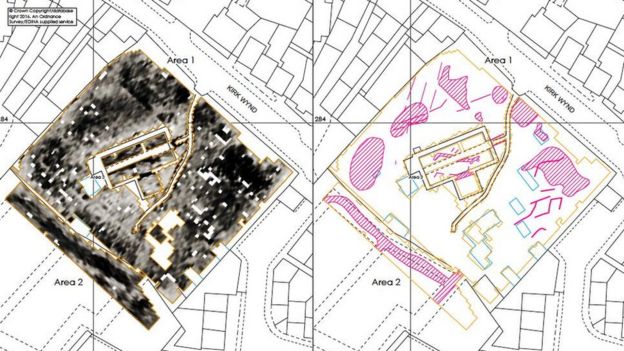
A geophysics survey in the ruins of the town’s 18th Century Auld Kirk has revealed remains of a medieval chapel.
The investigation was expected to find traces of its 16th Century predecessor but instead it showed remains which could pinpoint the spot where Wallace was honoured.
It is a scene which was depicted in Mel Gibson’s Braveheart.
The church itself was demolished and later churches built on the site.
Dr Bowles said: “Ruins of the Auld Kirk date from the 18th century, but we knew this had replaced earlier churches on site from the 12th and 16th centuries.
“It has been widely acknowledged that this was the site of the Kirk of the Forest where Wallace was made Guardian of Scotland following his and Andrew Moray’s defeat of the English army at the Battle of Stirling Bridge in 1297.
“We had been expecting the geophysics survey to uncover a 16th century church that we know to have existed and which was a replacement to the medieval church, but the only evidence in the survey is in relation to the medieval church.
“The association between Wallace and the local area is quite well documented, with Wallace using guerilla tactics to fight the English from the Ettrick Forest, and the Scottish nobles made Wallace Guardian of Scotland in recognition of his military successes.
“Wallace went on to become the legendary figure he remains today.”
We hope to work with the community to make the most of this fascinating discovery and the tourism potential it has. Colin Gilmour, Selkirk CARS project manager
Dr Chris Bowles, Scottish Borders Council’s archaeologist, said: “The association between William Wallace and this area is quite well documented, with Wallace using guerrilla tactics to fight the English from the Ettrick Forest.
“We knew vaguely that this site was associated with Wallace, and that the Scottish nobles made him Guardian of Scotland at the Kirk o’ the Forest in recognition of his military successes.
“We had been expecting the geophysics survey to uncover a 16th Century church that we know to have existed and which was a replacement to the medieval church, but the only evidence in the survey is in relation to the medieval church.”
He said they found the “foundation footprint of a medieval chapel” within the footprint of the 18th Century church.
“There are certainly wall lines forming an east-west aligned rectangle,” he said.
“The measurements are similar to St Margaret’s Chapel in Edinburgh Castle and point to it possibly being a Romanesque chapel.
“If it is the Kirk o’ the Forest, it is where Wallace was honoured. He went on to become the legendary figure he remains today.”
‘Limited investigations’
Dr Bowles, who commissioned the survey by the University of Durham in conjunction with the Selkirk Conservation Area Regeneration Scheme (Cars), said the site could now become a visitor attraction.
“While these geophysics results suggest a medieval chapel beneath the later church, we are very restricted by the burials in the area to allow any excavation,” he said.
“But in the future it may be possible to conduct limited investigations in areas where there is no evidence of burial.”
Gary Stewart, convenor of the Society of William Wallace, hailed the discovery as “a rare physical link to the hero”.
It is hoped the site could become a visitor attraction
He added: “This is a fantastic discovery, and another piece in the jigsaw of Wallace’s life.
“It lets us know the exact place where Wallace was appointed as Guardian.”
Colin Gilmour, Selkirk Cars project manager, said the discovery could draw tourism to the town.
He said: “There is nothing currently signposting people to the Auld Kirk site, but with this latest discovery it could become a major attraction and assist with the regeneration of the town centre.
“We hope to work with the community to make the most of this fascinating discovery and the tourism potential it has.”
Scottish Borders councillor Ron Smith said the discovery strengthened the links between William Wallace and Selkirk.
A re-enactment of Wallace’s appointment to guardianship could be held at the site later this year.
This is Carruthers country.
They were lording it here from the fourteenth century, with a reputation for cross-border raiding, a predisposition that finally brought the Mouswald branch of the family to an end when Simon Carruthers was killed in action in 1548.
There are fragments of the Curruthers’ fifteenth-century castle within the grounds of the house known as Mouswald Place.
An earlier occupation of the area, in the ninth century or thereabouts, was Scandinavian. We know that from the origin of the name in Danish mosi vollr, ‘mossy field’. The modern pronunciation foxes the stranger: it is ‘mowzle’.
The present kirk was built in 1816 but radically altered in 1929. But there had been worship on this spot from the thirteenth century.
Rev John Gillespie was the kirk’s outstanding minister (hence the Gillespie Memorial Hall). His service to the parish was long, from 1865 until 1912. In 1903 he was elected Moderator of the General Assembly (two other pupils from his boyhood school at Newton Wamphray also became Moderator). Gillespie’s great interest was in farming, about which he was so knowledgeable that he was dubbed Scotland’s ‘Minister of Agriculture’. The cup awarded at the Royal Highland Show for Galloway cattle is a Gillespie endowment.
At Mount Kedar, to the south-east, there is a monument commemorating Rev Henry Duncan of Ruthwell, the savings bank pioneer. When Duncan opted for the secessionist Free Kirk in the 1840s, it was in the neighbouring Mouswald parish that he set up his new kirk and Mount Kedar was the manse.
Mouswald Grange, to the north-west, has a striking tower that was once part of a windmill, built in the late eighteenth century. It processed oatmeal.
It must have been fun to live here at one time, if a local rhyme is to be believed:
Rivel [Ruthwell] bucks and Dawton [Dalton] belles,
They’re a’ sic senseless asses, o!
But there’s nane sae free when at a spree
As the Mouswald lads and lasses, o!
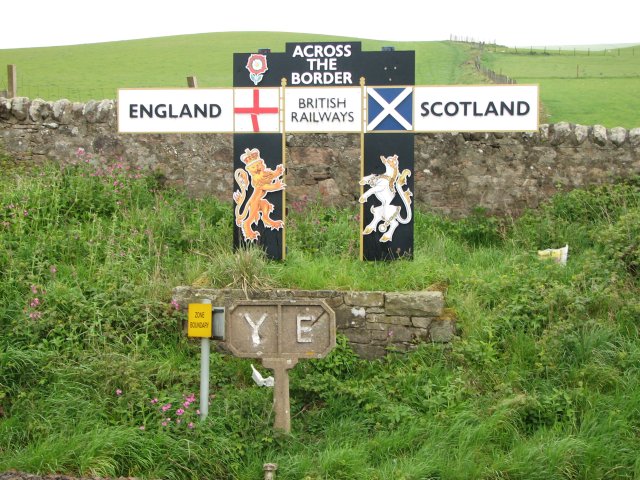
Originally, the area known as Strathclyde covered both sides of what is now the Scotland and England border. Inhabitants of both sides of the border spoke the same language and families settled on what became later, both sides of the border. When Strathclyde became part of Scotland, the Scottish border lay considerably South of its present position. It was not until the reign of William II of England (1087-1100) that Carlisle was established as an English town.
Debatable Lands
For several centuries, there lay between the kingdoms of England and Scotland a stretch of ground known as the Debatable Lands. These lands came to be occupied by what were known as “broken men”. These men were originally of good family, but owing to various circumstances, had become little beyond common thieves.
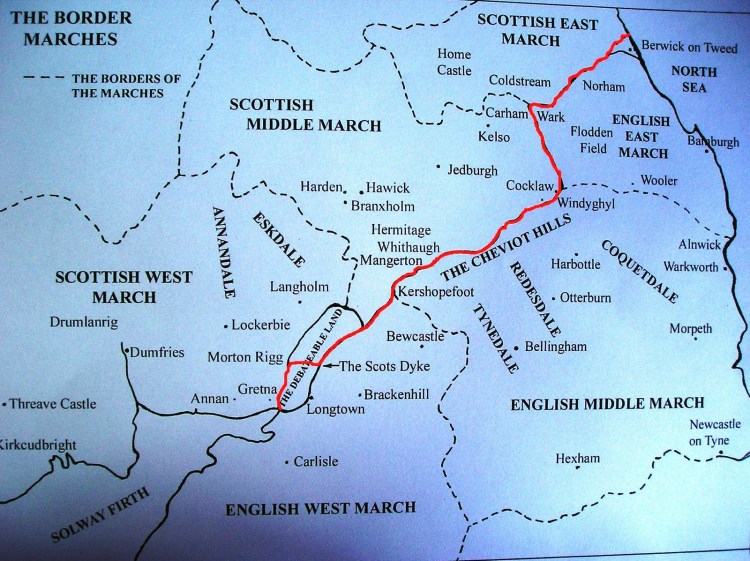
The border area had been divided, on both sides, into three marches, with a subset for that area on the southwest side called the “Debatable Lands”, because both England and Scotland claimed it. In 1552, the decision was mutually made to put up an earthen barrier, the so-called “Scots Dike”, to split it. The northern part, Canonbie, was added to Scotland and the southern part, Kirkandrews, became a part of England.
The border area had been divided, on both sides, into three marches, with a subset for that area on the southwest side called the “Debatable Lands”, because both England and Scotland claimed it. In 1552, the decision was mutually made to put up an earthen barrier, the so-called “Scots Dike”, to split it.
Unlike Hadrian’s Wall, farther to the south, with its system of walls and towers and gates and little forts and big army camps, this was never an elaborate military structure, or even like Offa’s Dike between England and Wales, but simply a boundary marker in low-lying land (and only 3.5 miles long– 5.6km).
In this wild world, there are no long walls, of stone, wood, or earth to protect anyone, but castles, towers, and fortified farmhouses called bastles (possibly from the same root as “Bastille”?). Here we see Hermitage Castle, Smailholm Tower, and Black Middens Bastle.
Although we see these now as gaunt ruins, we should always imagine them—as in this reconstruction of Smailholm—as living spaces, as well as refuges in an often lawless land.
One has only to see the thick walls of a bastle and, originally, no door at ground level (stairs appear to be a later convenience for a more peaceable time), to imagine the danger from reivers, raiders from either side of the Anglo-Scots border and sometimes, as there was a certain amount of intermarriage, from both.
As can be seen in this reconstruction, these walls might be all that would stand between the inhabitants and destitution or even death, should the reivers come raiding.
There was also the possibility of buying them off, by paying them blackmail, a word whose origin is contested, but whose purpose is clear: protection money. If you paid them, in coin or cattle, you were safe—at least until the price went up.
Curbing such behavior was the job of the Border Wardens, there being six, one for each March on each side of the border. Theirs was a difficult job: too much territory, too few men, and too few resources to back them up. Wonderfully, one of these Wardens, Robert Carey, has left us a memoir, which is available on-line: memoirsrobertca00orregoog.
If you were attacked and you survived, you might send word to the Warden or one of his officers, who could organize a posse to pursue the raiders. By law, all able-bodied locals were supposed to turn out to help when the organizer—Warden or officer—rode by with trumpeter and a rider who carried a flaming bit of peat on his “staff” (local word for “lance”).
This was called the “hot trod” and, under its conditions, the pursuers were allowed to cross the border. Such occasions could be very dangerous, however, as those raiders would be chased back across their own territory, giving them the chance to delay or destroy those in pursuit in an ambush on familiar ground.
Much of the blame for over 300 years of Border raiding goes to King Edward I of England (reigning 1272-1307). Edward decided to interfere in Scottish affairs when Alexander III of Scotland died and Margaret, the Maid of Norway, became the heir to the Scottish throne. Edward chose of acquire Scotland by peaceful means by marrying his young son Prince Edward to the Maid. After Margaret died on the way to Scotland, the throne was left open to 13 competitors and Edward I resorted to less peaceful means. The result was the War of Scottish Independence, ending with King Robert the Bruce sitting on the newly independent Scottish throne.
People living on the Border were the victims of these circumstances. The passing back and forth of armies, both English and Scottish, made tilling the ground and agricultural pursuits useless. There was no point in sowing crops that would be burnt down or trampled before the harvest. Therefore, cattle became their principal property, but it was always liable to be stolen. If their cattle were stolen, the people had to survive somehow, so they stole cattle back. Robbing thus appeared to be fair reprisal. However, under Border Laws, the pursuing of raiders into their own country was appropriate and often led to skirmishes and bloodshed. What we now look at as common thieving, became the normal mode of subsistence, considered honorable and lawful. This continued on both sides, even after there was peace between the two countries.
Establishments of Wardens;
In order to better “police” the Border, and to ensure grievances were settled, both sides of the Border were divided into territories known as the Marches. On each side of the the Border there was established a West March, an East March and the Middle March.
It was the Scottish West March that involved the Carruthers family.
This West March was comprised of Nithsdale, Annandale, Eskdale, Ewesdale, and Wauchopedale (which was the Stewartry of Annandale and the Sheriffdom of Dumfries). Caerlaverock, Lochmaben, Annan, and Threave were the most important strongholds, with Lochmaben being identified as a “Royal Castle”. The Warden, the Deputy, and the Sheriff were stationed at Dumfries. The Deputy was charged with the defense of Scotland from England. A Captain, who was known as the Keeper of Annandale, was stationed at Langholm. The rest of the wardenry was defended by the various families who lived in the Border area.
The Warden had great powers and appointed deputies, clerks, sergeants and dempster’s. The castles of Lochmaben, Langholm, Annan, and Threave were in his charge and he could call out the full armed force of the wardenry for the invasion of England. He had power to make truces with the English Warden and, in peacetime, one of his chief duties was to meet on certain days for the settling of disputes and granting compensation for crimes committed. He could hold Justice Courts for the trial of Scottish subjects under his jurisdiction and could compel the attendance of nobles, barons, and landed gentry who were bound to present before him their tenants and servants when their names came before the court. Unruly Borderers could face action from the Warden’s Lieutenant, who could use sword and fire to demolish their houses and castles.
The penalty for wounding a person of the opposite realm was estimated by a jury, consisting of 6 Englishmen and 6 Scotsmen, named by their respective Wardens – and was then doubled. If the person committed the crime of “burning or spoyling of goods”, they had to pay back the value of the goods, plus twice the value as penalty. Convicted murderers, were executed by the opposite Warden and his property sold to pay to the heir of the deceased. In 1563, it was agreed that an offender proved guilty on three occasions of stealing, should be executed.
Deadly feuds were occasionally stopped by the Warden arresting the persons at the feud and delivering them to the opposite warden. This worked for smaller families, but not for the feuds involving the larger clans such as the Scotts, Elliotts, Maxwells, Armstrongs or Johnstones.
To understand and appreciate our ability to have a definitive tartan of our own we must first understand its use by families in the borders of Scotland. The history of the use of a clan tartan by Graynes (Reiver families) is definitely not strong. The evidence suggests that if plaid was worn, it was most certainly of a regional pattern rather than specific to a particular family. It is also fair to suggest that kilts would not have been worn, but rather trews (trousers) would have been the order of the day for the reasons alluded to before and of course, because they were widely available as the mode of dress on the borders at the time.
Kilts as we know, were worn in Scotland but were evolved as a highland concept, being taken from the earlier ‘brat’ or woollen cloak (also known as a plaid), which was worn over a tunic. This earlier cloak or brat may have been plain in colour or in various check or tartan designs, depending on the wealth of the wearer; the earlier fashion of clothing had not changed significantly from that in the highlands since Roman times. This lead to the Breacan an Fhéilidh (belted plaid) or Feileadh Mòr (great plaid) as normally depicted in ancient highland dress. From around the 17th or early 18th century the fèileadh beag (the small kilt), or filibeg, or philabeg, using a single width of cloth worn hanging down below the belt came into use. It become popular throughout the Highlands and northern Lowlands by around mid 1700’s, although the great kilt or belted plaid continued to be worn by the highland clans. In a modern world most Scottish clans/families enjoy wearing the kilt, irrelevant of their region of birth and there is no reason why they shouldn’t. It gives a feeling of national pride and anchorage in the customs and traditions of all things Scottish, where the heritage of our homeland remains important us all, wherever they hail. Clan Carruthers should be of no exception.
Saying all this, here are two pieces from the (STA) Scottish Tartan Authority’s website for your deliberation:
It has to be remembered that, in the present context, tartan is Highland and that the Lowlands did not adopt it in the ‘family’ sense, to any large extent, until the mid-eighteenth century, when the Lowland tartan industry had begun to grow up as a result of the 1747 Act which sought to abolish tartan altogether. My recent research into military tartans suggests strongly that the blue, black and green tartans owe their existence to military fashion or even War Department ruling: this is not to say that all such tartans are military ones but that the army started the idea. The other class of dark tartans, those known as ‘hunting’, almost certainly derive jointly from a rather obscure statement by George Buchanan (see the right hand column) and the strident colours of the early synthetic dyes. A third class, many-hued, comprises the Sobieski confections, which are either inventions or minor modifications of established tartans of their time. http://www.tartansauthority.com/tartan/the-growth-of-tartan/the-origin-of-clan-tartans/
Therefore with the resurgence in all things Scottish and Scottish families redefining and registering themselves as Clans and with their Chiefs being accepted onto the Standing Council of Chiefs, a tartan of our own seemed the next logical and identifiable step along the road to an international Carruthers Clan Society, which was set up in 2017. It is fair to say, that any clan is defined, in the eyes of the public by the three ; they are its distinct tartan, its clan arms and badge and its history. As a family entity we now have all three from which to progress to clan status if we so chose.
Although we would still retain the right to wear Bruce, in 2017, Dr George Carruthers, a Fifer by birth registered a Carruthers tartan, designed by Brian Wilton, with the Scottish Tartan Register. The tartan followed the Bruce sett (pattern) and thread count with variations in the thread colours and subtle changes in the sett itself in order to differentiate it and allow the design to be accepted as unique to the ancients, honourable and distinct Clan Carruthers, wherever they may hail.
Carruthers Dress
SRT No. 11700. Designer: Wilton, Brian Tartan date: 01/12/2016 Registration date: 25 January 2017 Category: Name Restrictions: Registration notes: A dress version of the George Carruthers (Personal) tartan (STR ref. 11699). This tartan can be used by others bearing the Carruthers surname.
Another Carruthers Tartan was registered at the same time, but is for private use by the family of Dr G. Carruthers.
Carruthers Private
SRT No. 11699. Designer: Wilton, Brian Tartan date: 01/12/2016 Registration date: 25 January 2017 Category: Name Restrictions: Yes. For the sole use of the copyright holder and those authorised by him. This tartan cannot be offered for sale or woven without the express permission of the copyright holder. Registration notes: A personal and private tartan for Dr George Carruthers and his family based on the Bruce clan tartan.








 CLAN CARRUTHERS SOCIETY (USA)