BORDER REIVERS-BUCCLEUCH’S RAID ON CARLISLE CASTLE

Walter Scott was born in 1565. His ancestral home was Branxholme in Teviotdale. Today one of the four original towers of Branxholme still stands, the Nesby tower, about five miles south of Hawick in the Scottish Border country.


History of Branxholme – Branxholme Castle Holiday Cottage ...


The-Nesby-Tower-home-of-Sir-Walter-Scott-of-Buccleuch
The-Nesby-Tower-Branxholme-Scottish-Borders

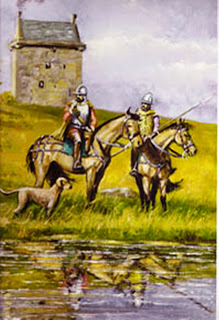
In 1590 he was knighted by James V1, king of Scotland, and appointed Keeper of Liddesdale. Sixteenth century Liddesdale, part of the Scottish Middle March, was the most dangerous place to live in the whole of Britain yet Scott accepted the role with self-assurance and alacrity. He knew he had the iron will, the power and the personality to subdue the unruly Border Reiver clans of Liddesdale-the Armstrongs, the Elliots, Crosers and Nixons.

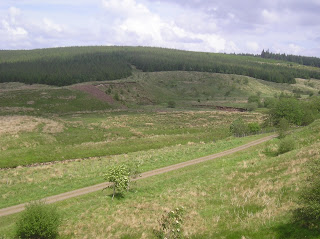
In 1596 a Day of Truce was held between the Scots and English at the Dayholm of Kershope on the Border Line between England and Scotland.

A-Day-of-Truce-was-held-at-the-Dayholme-of-Kershope
The-Dayholme-of-Kershope

Outwardly this Truce Day was but a minor affair as the trials to be heard were those of  petty felons. As such deputy March Wardens were appointed to oversee and control the business of the day. Robert Scott of Haining presided for the Scots, Thomas Salkeld for the English.

The Day of Truce was always attended by both Scots and English to witness that each of the trials was conducted with both fairness and justice. Since 1583 the numbers had been limited to one hundred from each of the countries as previously the numbers were so large that the whole affair became uncontrollable. The trouble always centred on the fact that it was inevitable that among those asked to attend, mainly from the Border Reiving fraternity, there would be those who were at odds, often violent odds, with each other. English and Scots eyed each other with deep suspicion and hatred- the animosity a product of past raids and savage encounter. In an attempt to control those who attended it was written into Border Law that each man must swear that he would not offend ‘by word, deed or countenance’.

Conversely as many present would be wanted by the law and the law in the shape of the March Wardens their land-sergeants and bailliffs presided,  a further enactment of Border Law was the ‘Assurance of the Truce’. Thus from sunrise of the Day of Truce until sunrise of the following day all men were considered beyond reproach, inviolate and untouchable unless they broke their own vow.

Sir Walter Scott had asked William Armstrong of Kinmont, the most notorious of the Scottish Border Reivers of the late sixteenth century, to attend. Kinmont was much prized by the English; his raids from Scotland into English Tynedale, Northumberland, often at the head of huge numbers from the Scottish Border valleys were particularly violent and vicious and resulted in death and maiming to those who endeavoured to contest the theft of vast numbers of cattle and sheep which were driven slowly back to the Scottish homelands.

At the Day of Truce at the Dayholme of Kershope many an eye filled with hatred viewed Kinmont with frustration that became a fixation. Present within yards was enemy number one of the English, yet he was untouchable under Border Law.

When the Truce had finished, before sunset, Kinmont set off for home with others going in the same direction: down the Kershope burn to its confluence with the river Liddel then onwards to Morton Rigg Tower.

The-little-Kershope-Burn-is-the-Border-Line-between-England-and-Scotland
The-Kershope-Burn-Joins-the-River-Liddel

Thomas Salkeld, English Deputy West March Warden and his retinue from Carlisle moved in the same direction but on the English bank of the river Liddel.

The temptation to capture Kinmont was too strong; he was the nearest he had been to the English for many a year. In unison both of thought and action, the English party turned their horses into the river, reached the Scottish bank and pursued Kinmont at pace. Near the confluence of the rivers Liddel and Esk Kinmont was taken, bound to his horse and, surrounded by Englishmen, moved stealthily onward to Carlisle and the dungeons of its castle.

Kinmont had been illegally taken  by the English. They had violated the Border Law. The sun had not yet set. It was still hours to the rising of the sun on the day following the Day of Truce.

When news of the capture reached Sir Walter Scott he was incandescent with rage and immediately wrote to Thomas Salkeld demanding Kinmont’s release. The arguments that the capture provoked soon reached the ears of the monarchs of Scotland and England, James V1 and Elizabeth 1. The diplomatic wrangling that ensued produced no answers to issue; the English believed the capture was legal for a number of reasons including that Kinmont had violated the Truce whilst the Scots were adamant that it was definitely illegal.

After a month in which the diplomatic approach seemed only to achieve rancour, claim and counter claim, Sir Walter Scott decided that a more pro-active approach was called for.

In this he was greatly assisted by the English family of Grahams who had their own reasons for supporting Scott including the demise of the English West March Warden , Thomas Lord Scrope. The Grahams were truly “English at their will, Scottish at their leisure”. They were, without doubt, the most powerful of the English Border families. Not many men contested their stranglehold over the protection rackets and blackmail that were endemic in the Border lands.

After meetings at both a race meeting in Langholm in the Scottish Borders and dinner within Langholm castle, Scott and the Grahams decided that they would take the bull by the horns and endeavour to rescue Kinmont from Carlisle castle, the second strongest in the whole of the Border lands.

A veritable army would never succeed in reaching the castle unnoticed, not with the river Eden to cross, its main ford being the Eden bridges which was manned by professional soldiers twenty-four hours a day.

No, the plan demanded small numbers and stealth and there was twelve miles of English ground to encounter before Carlisle was to be reached. Small numbers could be at the mercy of any of the English Border Reiver families out on a raid in the area. However the Grahams let it be known that there would be no-one out on the prowl on the night chosen to head for Carlisle. They would see to that!

On the night of April 13th 1596 about eighty of the Scottish Border Reivers left Morton Rigg Tower and headed for Carlisle. Armstrongs, Irvines and Johnstons and Kinmont’s sons were among those who rode south. The weather was perfect for the campaign. The rain poured for the whole of the night ride southwards into England. There would be few folk abroad on such a night.

The-Route-Sir-Walter-Scott-followed-to-Carlisle-to-rescue-Kinmont-Willie-Armstrong
Buccleuch’s-Raid-on-Carlisle

Having reached the Scots Dyke (still the Border line between England and Scotland) the party of about twenty Johnsons reined their horses right and positioned themselves in the trees of the Debateable Lands. Their role was to be one of waiting for the return of the raiding party after the attempt to rescue Kinmont; shepherd them home to the lands of Ewesdale or ambush any English pursuers.

From the Scots Dyke the remainder of Scott’s raiders passed the towers of Westlevington, Houghton, Tarraby until they reached the tower of Stanwick on the Staneshaw Bank. As each was passed a light appeared in each signifying that the Grahams were on watch, ready to intervene should there be anyone to contest the party’s southern journey.

The Irvines, one formidably fierce Scottish Border clan of Reivers, now peeled away and concealed themselves in the wooded area of the Staneshaw, their role the same as the Johnsons.
Now there were just twenty or so left for the assault on the formidable pile of Carlisle castle, mainly Armstrongs and Kinmont’s sons. Scott urged his men forward, encouraged by the perverse weather as it continued to rain in mind-blowing sheets.

Carlisle-Castle-where-Kinmont-Willie-Armstrong-was-Imprisoned
Carlisle-Castle-Cumbria-England

Cold and drenched the raiders reached the Eden bridges but knowing any attempt to assault and subdue its garrison would be futile, they moved to the west, reached the river Eden, dismounted and, without any ceremony, swam the raging river.
bridges-guard-bridge-view-two-fife-74773704
It is said that after approaching the castle with ladders to scale the walls, they found that they were too short and that the alternative of undermining a postern door in the western wall of the castle was undertaken.

( It is my belief that this was not the case. Earlier that year Thomas Lord Scrope had dismissed the captain of the castle, one Thomas Musgrave, a man in league with the Grahams. He still had men of his ilk working within the walls of the castle. I believe that one of his cronies watching out for the raiding party, opened the postern gate for the raiders).

Five of the raiding party entered the castle whilst the remainder, some twenty strong, stood outside the wall and created a carcophony of strident noise with drums and trumpets. It was to good effect. The garrison of the castle, hidden under tarpaulins to protect themselves from the foul weather, thought that a sizeable army was investing the castle and panicked.

The five raiders, with opposition from just two of the inmates of the castle who proved to be ineffective, were led to the room where Kinmont was warded and soon released him.

Soon the raiders with Kinmont in tow had re-crossed the river Eden, mounted their horses, and rode hard for the Border. Thomas Lord Scrope, West March Warden and his deputy, Thomas Salkeld endeavoured to gather some opposition to the audacious assault of the Scottish raiders but it was too late. They were away and joined by the Irvines at the Staneshaw Bank and the the Johnsons at the Scots Dyke.

Kinmont went into hiding until the heat had died down. It would not be for long.
NGS68272
Sir Walter Scott was, without doubt, the outstanding character to walk and ride the Border lands of the sixteenth century. In his younger days he had proved himself to be a formidable Border Reiver but as the century moved on and he got older and wiser, he had the intelligence to see that the days of the Reiver were numbered.

In 1606 he was made the first Lord Buccleuch. He died in 1611 and was buried in St. Mary’s church in Hawick.


Border-Reivers-Invade-English-Tynedale

Image may contain: 1 person

In October 1593 the Border Reiver clans of the Scottish Border valleys answered the call to arms. They were intent on teaching the English a lesson in ‘might is right’. Such a large-scale raid had never been planned before. For once the Scottish clans put their differences behind them, the relentless feud and blood-feud, and acted in concert for this great foray south of the Border Line. It involved a thousand men from the valleys of the Ewes, Esk, Liddel and Annan. Men with names that had, for generations, struck fear into the hearts of any who dared to contest their lawless ways. Armstrongs of Mangerton and Morton and Elliots of Dinlabyre and Larriston joined forces with many others who smarted for a final reckoning with the clans of Tynedale, the Hunters and Milburns in particular.

Scottish Border Reivers Attack Tynedale

No photo description available.

A thousand strong, with pennants flying from their saddles, a gesture that generally signified war and not normally used by the Reivers in their nightly predatory wanderings, the Scottish Border Reivers descended on Tynedale, Northumberland, the English county that abuts the east of the English Scottish Border. It was a day-time foray, unusual and meant to be noticed, overt and signalling that they wished to be seen and recognised. Their goal was the valley of the Tarset, part of Tynedale, and the lands of Simonburn, now a lovely picturesque village; well-known today through the Northumberland stories of Katherine Cookson. Simonburn is used as a backdrop in televised versions of some of her stories.

N7889
Enter a Ruins of Simonburn Castle, Simonburn. Photo by Peter Ryder.caption

Simonburn Castle Tower House (Simonburn)

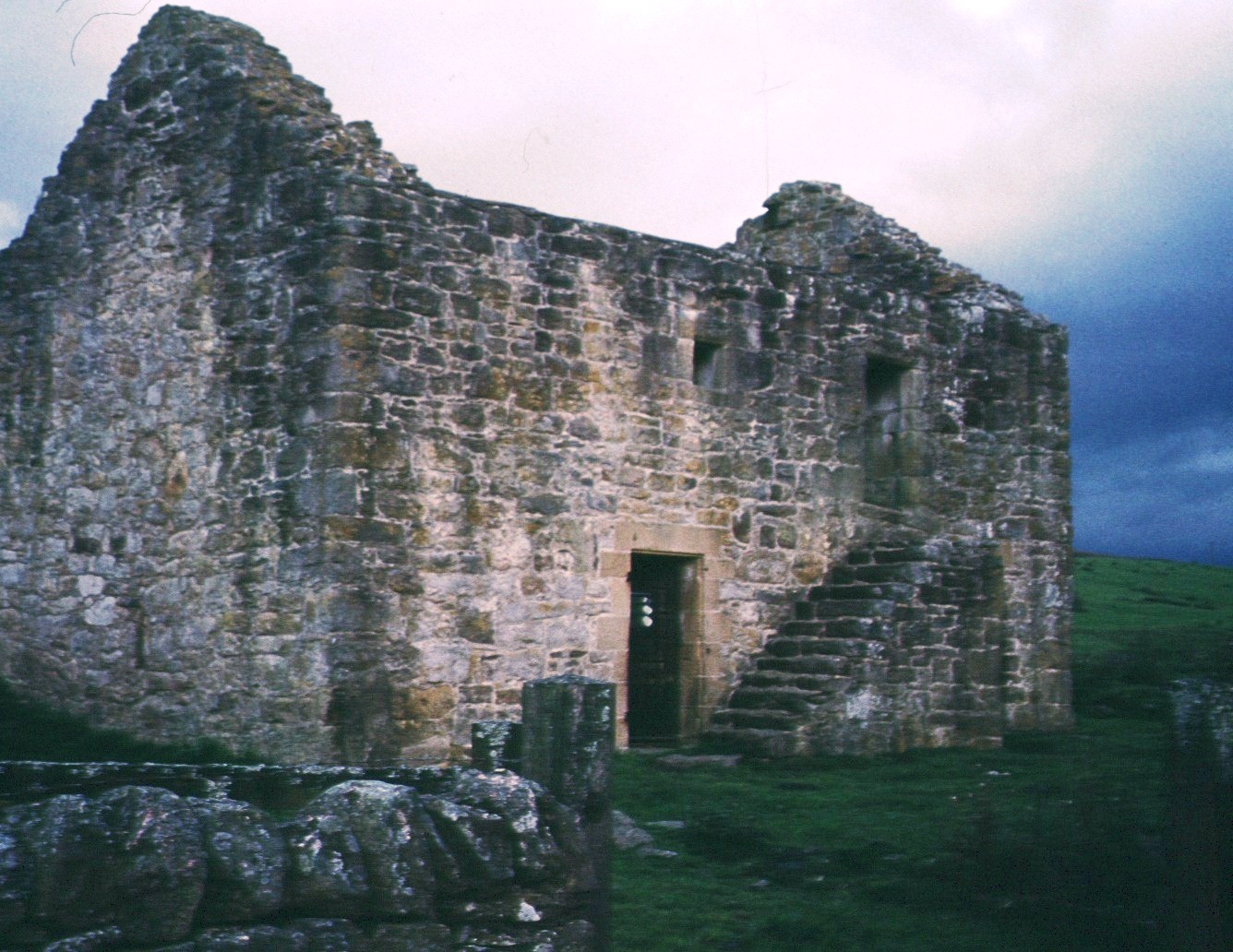
Simonburn Castle stands on a steep hill formed by the junction of two steams. The remains of a 13th century tower house lie at its core. Although it was repaired in the 18th century, and used for a time as an eyecatcher for Nunwick Park, the upper storeys have now collapsed. The tower was built of small stone blocks. Only the ground floor basement of the tower stands today, which has become filled in with rubble. It is a Grade II Listed Building protected by law and a Scheduled Monument protected by law.

Reference number: N7889
Historical period: Post Medieval (1540 to 1901)
Medieval (1066 to 1540)
Legal status: Listed Building
Scheduled Ancient Monument
Event(s): FIELD OBSERVATION, Ordnance Survey Archaeology Division Field Investigation 1965; J R Foster
FIELD SURVEY, Towers and Bastles in Northumberland 1995; P RYDER
PHOTOGRAPHIC SURVEY, Towers and Bastles in Northumberland 1995; P RYDER
FIELD OBSERVATION, Towers and Bastles in Northumberland 1995; P RYDER

Simonburn in the 16th century was a fortified place, its massive pele tower housing a garrison of fifty well-armed soldiers always at call to repel any invader into the holme-lands of the river Tyne, especially the raiders from the Scottish Marches. Alas today it is an overgrown ruin of ever dwindling proportions. It is said that gold was buried within its massive walls and successive generations, especially in the 18th century, have abused both its presence and history in futile attempts to lay the rumour to rest. A sad sight indeed today!

On the occasion of the Great Raid the garrison of the Pele Tower were unaware of the massive Scottish Border Reiver horde who stole into the area from Stonehaugh and moved on to Tarset.

The Raid on Tarsetdale

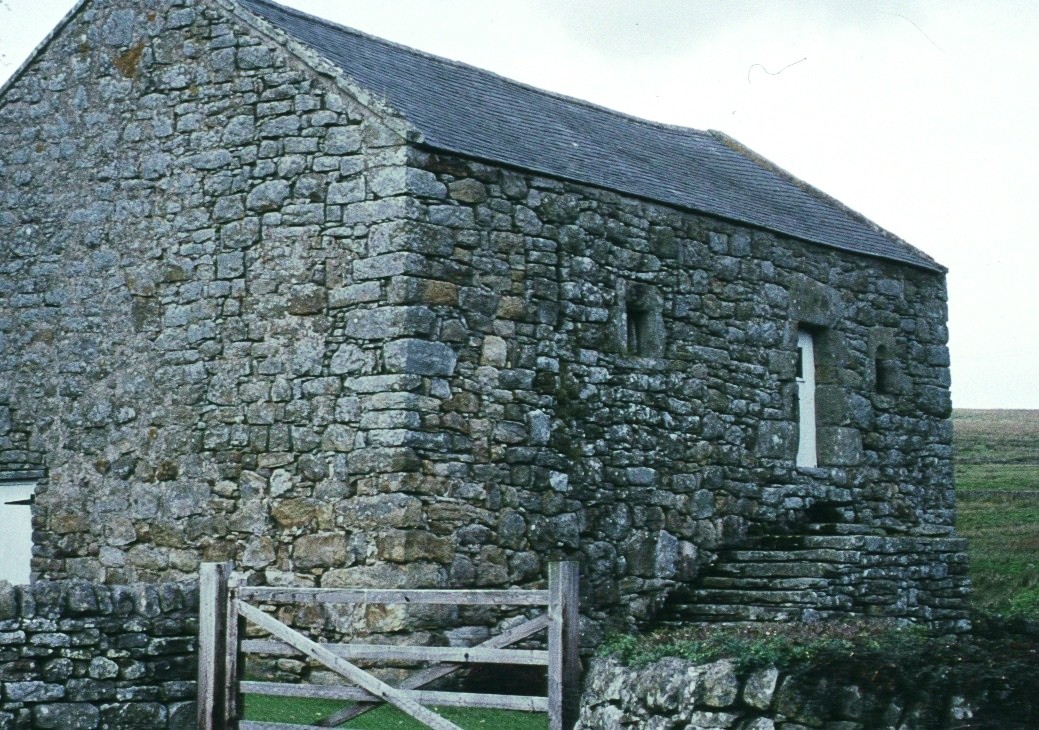
The Scottish Reivers soon overcame any opposition from the inhabitants of the Gatehouses, fortified bastle houses which stood sentinel to the entrance to the valley of the Tarset. Within a very short time they were engaged with a particularly vicious crew who inhabited the fortified houses of the Redheughe, the Bog Head, the Starr Head, the Water Head, the High Field, the Black Middens and the Kyme. These were the Hunters and Milburns, men renowned for the fighting prowess, their aggression and zealous guardianship of their homelands.

Black-Middens-Bastle-House-was-Raided-by-the-Scottish-Border-Reivers
Black-Middens-Bastle.

Against the massive numbers from the Scottish valleys they were put to flight but not before they had contested every inch of ground. Both the Hunters and Milburns would recover from the loss of their livelihood and the ruin of their homes. They lived to exact retribution in the Scottish Border valleys. Time brought these English Border Reivers some satisfaction.

Gatehouse-Bastle-House-is-at-the-Head-of-Tarsetdale-Northumberland-England
Gatehouse-Bastle

The Outcome of the Scottish Reive

The Scottish Reivers, led by William Ellot (Elliot) of Dinlabyre, together with the Laird of Mangerton, (leader of clan Armstrong) and William Armstrong called Kinmott (Kinmont) drove off ‘nine hundred five score and five (1005) head of nolte (cows), 1000 sheep and goats, twenty-four horses and mares, burned an onset and mill and carried away £300 of insight gear (household goods and farming implements).
The rape of Tynedale, including Tarset was complete.
The Scottish Border Reivers, though harassed on their way back to the Scottish valleys, repelled every attack and brought the proceeds of the reive safely home. To safeguard the illegal gains, the product of the reive would be put in the hands of several ‘recettors’, or receivers until the heat of the raid had died down. Often these men, engaged in a lucrative trade but which required nerve and a frame of mind that could hold its own counsel, lived miles from the lairs of the thieves, Indeed it was not unusual for some of these men to be English.

Aftermath

Even though the principals of the Great Raid on Tynedale were taken before the King of Scotland, James V1, and were admonished for their massed attack on the English at a time when he desired to promote a harmonious relationship with his English counterpart, Elizabeth 1, no action was taken against them.
English authority was incensed at the response of the Scottish king. The Forsters, Middle March Wardens for England, were to have a personal interview with the King. He promised much but took no action. James V1 of Scotland, though he often abhorred the unruliness of his southern clans, knew they had a place in the society that prevailed in Scotland. The Reivers were the best light cavalrymen in Europe. They had always been a barrier to English expansion.
The Aim of the Reivers
It seemed as if the Scottish Border Reivers, unusually massive in their numbers, invited reprisal for their raid on Tynedale and desired a large scale confrontation. There is a hint within their action that they knew their ‘day’ was coming to an end. It was no secret that Elizabeth 1 of England, heirless and known as the Virgin queen, had indicated that James V1 of Scotland would succeed her on the English throne and thus unite the two countries. What price a Border in turmoil then? The Border would be a thing of the past in a new United Kingdom.
Were the Reivers of the Scottish valleys, in their Great Raid on Tynedale, endeavouring to promote friction between Elizabeth and James? As they moved south on that fateful day in October 1593, with pennants flying as in time of war, did their raid have a deeper significance than the stealing of beasts and the ruin of the men of Tynedale?

Union Despised by Scottish Border Reivers

Should the plans of the two monarchs come to pass then the Border between the two countries would have no future meaning. Both countries would be ruled by one King. As early as 1593, ten years before James’ accession to the English throne, the Scottish Reivers began to contest the issue of Union. Should James not show control of his unruly Borderers then there was a chance that Elizabeth would think twice about his ability to follow her on the throne of England. His failure might just prolong the lives and times of the Border Reivers.

Simonburn-Village-often-Raided-by-the-Scottish-Border-Reivers
Simonburn-Village-Today.
Posted 5th August 2011 by 

Border-Reivers-the-Fray-of-Haltwhistle-and-the-Raid-of-Robert-Carey

‘The first thing they did was the taking of Hartwessel, and carrying away prisoners and all their goods. I sent to seek justice for so great a wrong. The opposite officer sent me word it was not in his power, for that they were all fugitives, and not answerable to king’s laws. I acquainted the King of Scots with his answer. He signified to me that it was true and that if I could take my own revenge without hurting his honest subjects, he would be glad of it’.
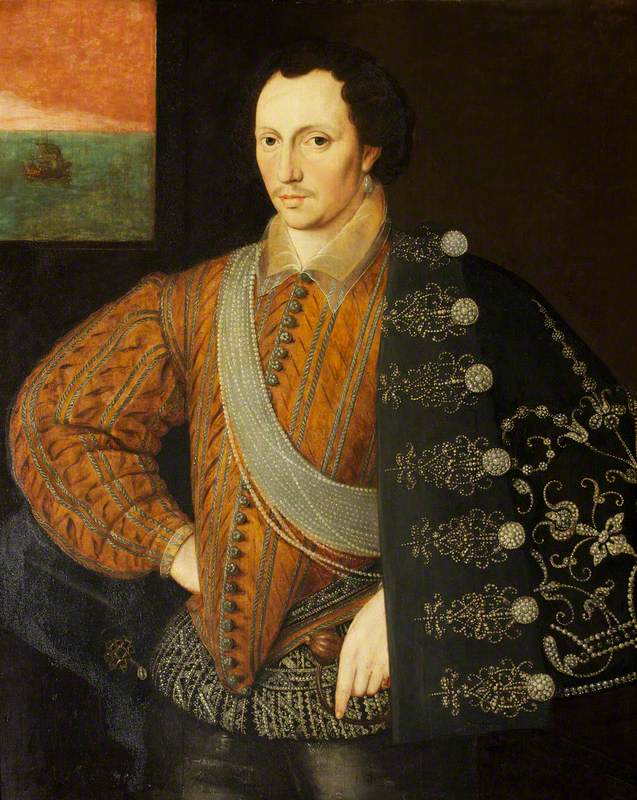
NT; (c) Montacute House; Supplied by The Public Catalogue Foundation

These are the words of Sir Robert Carey taken from his Memoirs in which he relates the main events of his life between 1577 and 1625; He was the brother of Philadelphia Carey, the wife of Thomas, Lord Scrope, Warden of the English West March from 1593 to 1603. It was Carey who rode for Edinburgh on the death of Elizabeth 1 to inform James V1 that he was now king of both England and Scotland. He was now James VI and 1.

The Memoirs include a description when Carey, as English Middle March Warden, had to deal with the Scottish Armstrongs following a raid on Haltwhistle (Hartwessel).

(I have found various dates for this affair, the year 1601 being mentioned more than once. As Carey was English Middle March Warden until 1603 then this date is probable).

Following the initial raid on Haltwhistle Carey invaded Liddesdale with two hundred horse and reclaimed the goods stolen which were divided and given back to the people they had been stolen from. As the English left Liddesdale with goods (probably cattle, sheep and ‘insight’, the word used for household goods), one of the leaders of the raid, Sim Armstrong of the Calfhill, braver and much rasher than the rest of the raiders who had been hiding within their strongholds at Carey’s coming, chased back but in his rage he was run through with a spear wielded by one of the Ridleys of Haltwhistle. He died from the wound.

The Liddesdale clans then vowed revenge, stating that they would devastate Haltwhistle and the surrounding area. They returned to Haltwhistle to carry through their murderous intentions  and set many houses on fire  and again took away all the goods of the people. As they were running up and down the streets determined to fire the whole town, yet another Ridley, holed up in one of the bastle houses, let loose an arrow on them and killed another Armstrong, one of the sons of Sim of Whitram.

A-Fortified-House-in-Haltwhistle-Tynedale-Northumberland
Bastle-House-Haltwhistle

The whole of the population of the English Middle March now lived in fear of further reprisals from the Armstrongs and the other clans of Liddesdale. They were even contemplating leaving their houses and ekeing out a precarious living in the hills before the next winter, the time when reiving, feud and revenge would reach its yearly heights.

Carey deliberated on what to do next and called the gentleman of the country to his presence to seek their advice on what should be done to counteract the very real threat that there would be more raids on the Middle March, and not just Haltwhistle.

To a man they advised Carey that he should petition a further hundred horse from Elizabeth1 and the English Privy Council. These could be added to the forty already in his pay and serve as a military deterrent to the Liddesdale clans during the following autumn and winter. Only then would the poor folk of Haltwhistle and its environs find the courage to remain put and carry on with their normal lives.

Robert Carey had other ideas.He did not relish asking for more horse as this would be a further expense on the country.

Another-Fortified-Farmhouse-in-Haltwhistle
Another-Bastle-House-in-Haltwhistle

He decided that he, with his two deputies and forty horse, would lie in the waste lands as close as possible to the outlaws. He asked for further volunteers but many of the gentry declined saying that he could only live by such means until the autumn. He would then have to return to a normal life. It wa in the autumn and winter months that the thieves did most of their mischief thus a wasted effort to try and catch them off their guard during the summer months when they would lie low, be well guarded and yet better informed of Carey’s movements. They would simply bide their time until Carey had to return to his  other duties and respond to raid and reive by other miscreants from the Scottish West and Middle Marches.

However some of the younger men relished the thought of such an adventure, a great and welcome change from the normality of their everyday lives.

The-Massive-Stone-of-a-Bastle-House-Wall-in-Haltwhistle-Northumberland
Bastle-House-Wall-Haltwhistle

Very soon Carey had near two hundred horse to join him in his purpose.

They met in the waste and built a fort and, within its confines, log cabins to lie in. They stayed from mid June until the end of August.

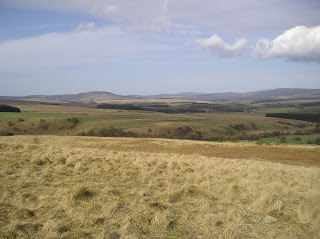
Once the outlaws were aware of Carey’s intentions they fled their houses hellbent for Tarras Moss, a wild and dangerous land in the sixteenth century, a sanctuary and haven which only those familiar with its stinking bottomless bogs dare enter. Many a man inocent of the dangers of its ground had lost his life, engulfed by the sucking quagmire. I have walked much of this ground, and even today when much of it has been drained, there are still places that cause the walker to hesitate and circumnavigate what appears to be a heaving mess of liquid mud.

Tarras-Moss-a-Refuge-for-the-Border-Reivers
Part-of-Tarras-Moss-Today

The outlaws were confident that Carey and his followers would not attempt to enter the Moss and goaded him with taunts that they would keep him awake the following winter. Carey sent a hundred and fifty men led by a ‘muffled’ man not known by any of the company thirty miles into Scotland. This move was carried out with such stealth and subtefuge  that none of the Scots were aware that it had happened. They were then brought to the north side of Tarras Moss where they split into three divisions, each with the responsibility of watching one of the passages which were the escape routes for the outlaws should the English attack from the south.

The Liddesdale Armstrongs had scouts on the tops of the hills on the English side of the Moss and when, one morning, they saw three hundred horse and a thousand foot of the English approaching, they raised the alarm. The English broke as fast as they could into the Moss causing the outlaws to flee to what they had always perceived as the safe passages into Scotland. There they were ambushed by the three English divisions who were lying in wait.

Most of the outlaws panicked, about turned and fled deeper into the recesses of the Moss where the English dared not follow for fear of getting lost or losing their lives.

However, five of the outlaws were captured, notably two of the sons of Sim of Whitram. They were taken back to Carey at the fort and immediately used as the bargaining power to free all English prisoners from the Scottish Border Reivers of the Middle March. Carey also demanded other terms and conditions before he would release his Scottish prisoners. Under bond the Armstrongs were made to warn Carey of any impending raids from other clans in their Border valleys.

Eventually the prisoners were released.

Carey was a wise and just March Warden. On capturing the five outlaws he could justifiably have hanged them but he had an eye for the future and his ongoing relationships with the Armstrongs of Liddesdale and thus the safety of his own people. The Armstrongs might have been outraged by the killing of Sim of Calfhill and one of the sons of Sim of Whitram but, nevertheless, they recognised that Carey had shown restraint in his dealings with them. For a while then they demonstrated some respect for him and not a little fear.

In Carey’s own words ‘God had put an end to this troublesome business’.

Robert Carey’s Memoirs were originally published in 1759 and again in 1808 and 1905. They are a stirring first hand account of not only life on the Borders in the reiving times but also of his exciting involvement in the Spanish Armada and his relationship with the English Queen, Elizabeth 1.

One of the Border Ballads relates the story of the ‘Fraie of Hautwessel’.

A few years ago I bought a copy of Carey’s Memoirs under the title of ‘The Stirring World of Robert Carey’ which, I think, contains the same text as the 1905 edition of the Memoirs. The spelling is modern English, the language consistent with an educated man of the sixteenth century. For a short perusal of what it is like to read and also the Border Ballad see this website:
http://www.dickinsons-of-whitfield.org
For the book see:
Ripping Yarns.com

Border-Reivers-Langholm-Castle

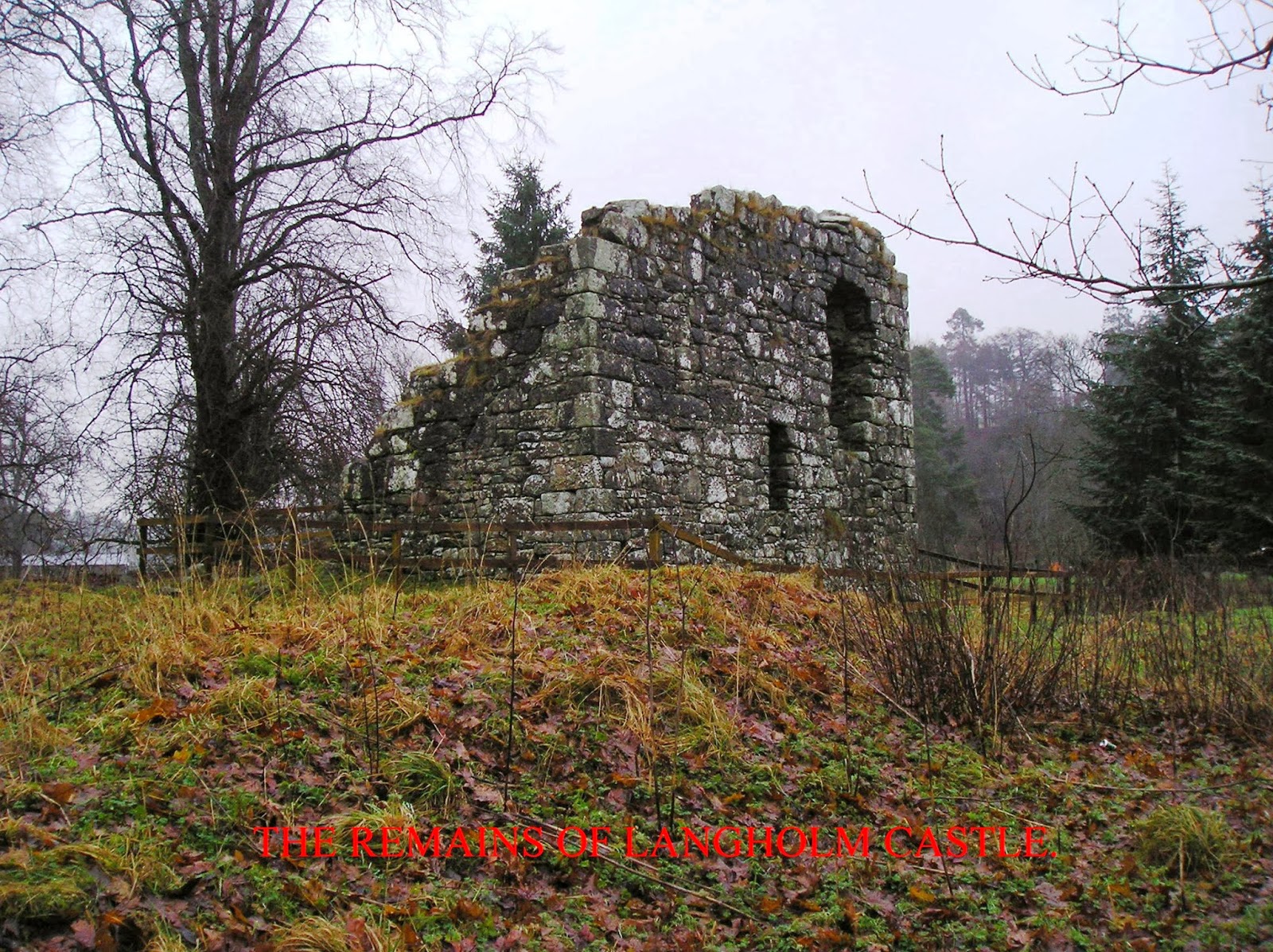
Near the confluence of the rivers of Ewes and Esk stand the forlorn remains of Langholm Castle.

Langholm-Castle-stands-on-theBanks-of-the-River-Ewes
Confluence-of-the-Rivers-of-Ewes-and-Esk-at-Langholm

Today there is little to be seen. The south wall of a tower still stands to six metres high and smaller remains of the east and west walls. But walk the ground and its obvious that the castle once covered a much larger area. Though many of the turf-covered outlines are hard to interpret, were they wall or buildings, it is still clear to my eyes that Langholm Castle covered a vast area?

Purportedly build by Christopher Armstrong of Barngleish about 1526 as an Armstrong stronghold, my mind is disturbed by thinking that this was just another pele tower built by the clan that held sway in the district. The outworks which now lie covered are too long and wide even when considering that the tower would be surrounded by a barmkin wall. This Chrisopher Armstrong was born about 1505 and was brother to Johnnie of Gilnockie. He would be the right age to build a tower in 1526 but the holm of Langholm is not a very defensive place for such a small building as a pele even given that the rivers Esk and Ewes protected it on two sides.

Another Christopher, son of John and Elizabeth was born in 1523 and died in 1606. He had a son, also called Christopher, who was born in 1562. Thus we can say with some certainty that the Christopher, born in 1523 was the same person who was granted the castle of Langholm in 1562 by Lord Maxwell- he was appointed keeper ‘of the hous and place of Langholm’ by John, Lord Maxwell.

So are the years 1526 and 1562 being mixed up here? I can’t say for certain that that is the case. There are many documents, primary sources of the period, to which I have no access. I welcome comments from anyone who can confirm or refute my thoughts. Should this occur, then I will gladly write a follow up to this post.

Just another thought! the John Armstrong who was Christie’s father was ‘Johnnie of Gilnockie‘- the man, who with his followers, was hanged without trial in 1530 by the seventeen year old king of Scotland, James V. Johhnie’s father was Alexander, 6th Laird of Mangerton.

I feel that this was a stronger place in the two hundred and fifty years that Scotland fought for its independence. During those years of sporadic war and truce, of violence and atrocity, the castle stood as a barrier to English inroads to the west and Annandale, and to the north, to the Scottish heartlands.

Langholm-Castle-Stands-near-the-River-Ewes
Border-Reivers-Leaving-Hollows-Tower

(Courtesy of Bill Ewart of Langholm)

It is interesting to note that Langholm castle, in a Commission of the Wardenship of the Scottish West March, was noted as being as important as the castles of Annan, Lochmaben, and Thrieve. They were classed as his His Majesty’s ‘oun houses’ Surely it was thus more important than the other pele towers that stood at the time? Even Hollows Tower, built about 1526 ( why does this date crop up again), was not perceived as so important? Hollows stands in entirety to this day following renovation.

Perhaps the tower of Langholm, the remains of which still stand, was the central tower of a much more complex range of buildings. Again my interpretation and again I welcome comments.

Langholm Castle-Barred-the-Way-North-and-West-to-English-Armies
The-Forlorn-Remains-of-Langholm-Castle

These are my own thoughts. I am not convinced that Christie of Barnglies’ built a tower here at such a late date as 1526.

The castle was raised when James the V1 of Scotland became James 1 of England in 1603. True James dropped a lot of the Armstrong strongholds on his way south to the English throne, but I think he ruined something special when he ordered his forces to invest the castle of Langholm.

The-Raid-Begins-at-Langholm-Castle
Reivers-Set-Out
(Courtesy of Bill Ewart of Langholm)

Border-Reivers-Sir-Richard-Lowther

Sir Richard Lowther | England, scotland, John middleton, Castle

Richard Lowther was born about 1530. His date of birth is often given as 1529,1530 or 1532.
He died in 1607 and is interred in the Lowther Church Mausoleum in what is now Lowther Park near Penrith, Cumbria, England.
The-tomb-of-Sir-Richard-Lowther-in-the-Lowther-Mausoleum
                              The-Tomb-of-Sir-Richard-Lowther
(In the Lowther Mausoleum, Lowther near Penrith England)
The-Inscription-on-Lowther's-Tomb-in-the-Lowther-Mausoleum
                                          The-Inscription-on-Lowther’s-Tomb
The Lowther family of Westmoreland (Cumberland and Westmoreland,together, are now known as Cumbria) have been part of the fabric of Cumbrian society for centuries to the present day. Richard succeeded to the Lowther estates on the death of his grandfather in 1552.
marches_map_original
Richard Lowther was Sheriff of Cumberland on two occasions in the reign of Elizabeth 1 of England; firstly in 1566 when he was knighted and again in 1588. He was also a Commissioner between England and Scotland and briefly Warden of the English West Marches against Scotland between the death of Henry Lord Scrope in 1592 and the appointment in that role of Henry Scrope’s son, Thomas Lord Scrope in 1593. Lowther’s temporary appointment as March Warden, he was the first commoner to hold the post since 1327, after many years as deputy to Henry Lord Scrope would have an acrimonious effect on the relationship between him and his successor, Thomas Lord Scrope. Scrope had already been made Captain of Carlisle castle and thus commanded two salaries whilst March Warden. Much to Lowther’s wrath Scrope chose his brother-in-law, Sir Robert Carey as his Deputy Warden, The move left Lowther without a meaningful role in Border society nor a salary. He had often complained to Lord Burghley , first minister under Elizabeth, that whilst March Warden, and not as was normal, Captain of Carlisle castle, he could not maintain a paid military force. He felt that he had been unjustly and unfairly treated, that the Wardenship was his by right of long and distinguished service.
Carlisle-Castle-where-Kinmont-Willie-was-held
                                                                         CARLISLE CASTLE
Without doubt it was. Lowther was well respected by his counterparts, the Wardens of the Scottish West March for fairness and justice. However, he was to commit the cardinal sin of offending the monarch, Elizabeth 1. When in 1568 Mary, Queen of Scots fled Scotland after the stalemate that was the Battle of Langside deciding to throw herself on the mercy of the English queen, she landed in Workington on the west coast of Cumberland and was escorted to Carlisle castle by Lowther. After arguing with the Earl of Northumberland, Sir Thomas Percy, about which of the two should have custody of the Scottish queen, Lowther, backed by the garrison of the castle, held on to the illustrious fugitive from the Scottish nation.
Thomas Percy thought that as Mary had moved from Workington to the Liberty of Cockermouth, part of his estates, that he should be responsible for her custody.
An Eternal Lineage | Living Royalty
Lowther was to say following his success in holding on to control of the Queen of Scots that the violent confrontation with Thomas Percy was uncalled for. He was to report that:
“My Lord (Percy) growing into some heat and angre gave me great threatenings with many evill wordes and a like language, calling me a ‘varlett’ and suche others I neither desserved never looked for at any man’s for the servyce of the prynce (the Queen)”.
Injudiciously, however, he allowed Mary to speak with the Duke of Norfolk a few days later and, as a result, was heavily fined in the Star Chamber.
From that date, 1568 until 1592, Lowther remained deputy March Warden but was always, thereafter, considered as a man who could not be completely trusted by Elizabeth 1 and the Privy Council of England.
In 1593 when the twenty-five year old Thomas Lord Scrope arrived in Carlisle to succeed him as English West March Warden against Scotland, Lowther became completely disillusioned with his place in the Border hierarchy. He did, however, knuckle down to his responsibilities even though he harboured a great resentment that Scrope held a post for which he was not qualified as he had little knowledge of the intrigues that governed Border society.
Bolton-Castle-the-Ancestral-home-of-the-Scropes
                           Bolton-Castle-Wensleydale-Yorkshire-England
(The ancestral home of the Scropes of Bolton)
His dissatisfaction would truly manifest itself in the rescue of the great Scottish Border Reiver, William Armstrong of Kinmont. His true relationship with his immediate superior, Thomas Lord Scrope, would reach new depths- a chance on Lowther’s part to sully Scrope’s reputation.
Kinmont Willie was illegally captured by the English following a ‘Day of Truce’ held at the ‘Dayholme of Kershope’ in March 1596. Following the failure of diplomatic overtures by the Scots in a bid to have Kinmont released from house arrest in Carlisle castle, Sir Walter Scott of Buccleuch and a small party of Scottish Border Reivers, mainly Armstrongs, took the law into their own hands and successfully rescued the formidable Kinmont Willie with surprising ease from the fortress that was Carlisle castle.
The-Dayholme-of-Kershope-where-the-Day-of-Truce-was-held
                                     The-Dayholme-of-Kershope
(Where the Day of Truce took place)
A romantic portrait of the rescue tells of scaling ladders that were too short to breach the walls of the castle and the undermining of the western port of the castle to effect entry. However the reality was different.
There was much inside help from inmates of the castle in which the English Grahams figured prominently.The western port was opened from the inside and five only of the eighty strong raiding party entered and were confronted by only two of the garrison. The remainder, whilst ostensibly on watch, were hiding and sleeping under coverlets from the horrendous rain of that night in April 1596.
Thomas Lord Scrope, completely humiliated that the defence of the second strongest fortress on the English Scottish Borders had been so easily overcome even implicated Sir Richard Lowther, among others including the Grahams, as one who had known that the Scottish Border Reivers would attempt a rescue on the night in question.
Scrope was to state:‘The Lowthers are my great adversaries’.

‘And regarding the myndes of the Lowthers to do villeny to me, havinge beene assured by some of their owne, that they woulde do what they coulde to disquiet my government, I am induced vehementlye to suspect that their heades have bin in the devise of this attempte’…(the rescue of Kinmont Willie).

In his own quiet way Lowther did all he could to undermine the effectiveness of Scrope’s wardenry and to sully his reputation as leader of the English West March. It is very probable that he knew of the intended raid on the castle yet took great satisfaction in not warning his superior, Thomas Lord Scrope.

Yet in the final analysis Sir Richard Lowther would slowly fade from mind, Scrope would join that exclusive club known as Knights of the Garter.

The capture and rescue of Kinmont Willie Armstrong was the last great event in the times of the Border Reivers before the Union of the crowns of England and Scotland in 1603 would effectively see to their demise. The history of it is replete with suspense and more pertinently, treachery and vengeance.

The-Tomb-of-Thomas-Lord-Scrope-in-Langar-Nottinghamshire
                                   The-Tomb-of-Thomas-Lord-Scrope
(In the village of Langar Nottinghamshire England)
Calendar of Border Papers.
All photos are my own.
My wanderings over Border Reiver country.

Border-Reivers-The-Scottish-Border-Clans-Bond-against-Liddesdale

Liddesdale-the-most-Dangerous-Place-to-live-in-Europe-in-the-16th-century
Liddesdale

In 1569 the clans of Berwick, Roxburgh, Selkirk and Peebles pledged themselves to repel and disown the clans of Liddesdale. The regent of Scotland, Moray, suggested that they should unite their efforts to subdue the inhabitants of the valley of Liddesdale, especially the Armstrong’s and Elliot’s thereof.

Liddesdale, often referred to as the ‘Cockpit of the Borders’, was known as one of the most dangerous places to live in Europe. Anyone who entered its confines without prior knowledge of the nefarious inhabitants, did so at their peril.
Whilst all the Border clans and surnames, be they Scottish or English,defied both law and authority and swore allegiance only to their own folk, the Liddesdale Border Reivers, the Armstrong’s and Elliot’s in particular, took lawlessness and depredation to its ultimate level.They raided with complete impunity.
In the sixteenth century they raided England, specifically the inhabitants of Tynedale and Redesdale, with regular monotony and, moreover,with total disregard for the high level of law enforcement which surrounded them.
Not content with leaving many an English family without the means of survival in a harsh landscape, virtually destitute unless they dared to return the ‘favour’ and raided back,very often not a wise option, the Armstrong;s and Elliot;s even attacked the people of their own country,stealing cattle, sheep and ‘insight’ (household goods).
On the Scottish side of the Border the Armstrong’s were often at feud, the deadly canker that permeated the Border lands, with the Turnbulls, the Kerr’s,the Johnston’s and the Irvine’s.

River-Liddel-at-its-junction-with-the-Kershope-Burn
River-Liddel-where-it-is-joined-by-the-Kershope-Burn

In 1561 fifty-three of the Liddesdale Reivers endeavoured to plunder Hawick fair but were caught and thirty-three were condemned and either hanged or drowned. If such an action was an attempt to subdue their reiving practices, then it failed dismally. It was business as usual for Border Reivers of Liddesdale.

Regent Moray (James Stuart. earl of Moray and Mar, half-brother of Mary, Queen of Scots) suggested the alliance of the neighboring counties in 1569 to counteract Liddesdale’s power and it was readily acceptable. Exhausted by the relentless infighting with their own countrymen, the inhabitants of Berwick, Roxburgh, Selkirk and Peebles welcomed the action.

They agreed ‘never to intercommune with any of the said thieves, their wives, bairns, or servants, or give them meat, drink, house or harbour,
nor were they to be allowed to resort to markets or trysts, nor permitted to remain or pasture their flocks on any lands outwith Liddesdale, except such as within eight days of the date of bond found responsible sureties, that they would reform.enormities committed by them in time by-past, and keep good rule in time coming.”

All others, not finding such security, were to be pursued to the death with fire and sword, and all kind of hostility, as open and known enemies to God, the King, and the common good. This bond was very numerously signed.

Nothing changed. The Liddesdale clans, as was their wont, ignored what they considered were the empty words of the less powerful  

The Liddesdale Border Reivers carried on in own inimitable way, robbing and reiving on both sides of the Scottish English Border,

It was only with Union of the Crowns when both counties were united under one monarch, James VI and 1 that dire action was taken against the Border clans and surnames of both countries.

Border-reivers-at-Hollows-Tower
Border-Reivers-at-Hollows-Tower 

The leaders of such families as the Grahams of England and the Armstrong’s of Scotland were summarily executed whenever they were apprehended. Others shipped to Ireland where they lived a life of penury for years in the bogs of Roscommon. Some were sent to the Low countries to garrison the towns of Flushing, Brille and Ramekins in the Dutch war with Spain.

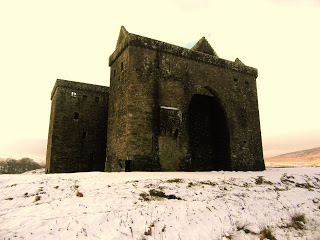
Hermitage-Castle-Guardian-of-Liddesdale
Hermitage-Castle

In 1530 it was a boast of Liddesdale that they could put 3000 light cavalry into action whenever they were required to defend their territory. Today Liddesdale is a quiet valley, sparsely populated.

blog at end

BORDER REIVERS PACIFICATION

In 1603, James V1 of Scotland became king of England when Elizabeth1 of England died without issue. He was the son of Mary, Queen of Scots who was the grand-daughter of James 1V of Scotland and his wife Margaret Tudor, sister of Henry V111, king of England. The blood of the English Tudors then ran through James’ veins; thus he always had the major claim on the English throne.

From early in his reign as king of both realms James decreed that the Border Marches, the lands of England and Scotland which lay on both sides of the Border Line and the haunt of the notorious Border Reivers, would exist no longer, they were to be ‘vanishe and delete’. They were to be known as the Middle Shires of a new United Kingdom. The Border Reivers, both English and Scottish, used and abused by the monarchs of both nations for centuries, were now an embarrassment to a king who sought to stamp his rule over both kingdoms.

Ill or Busy Week

The Border Reivers had lived a life of theft, murder, extortion and blackmail for generations, from the time of the Scottish Wars of Independence, beginning about the dawn of the 14th century. They knew that now a monarch ruled over both nations their days were numbered. They had many scores still to settle as James Stuart made his royal progress to London, the crown of England and untold wealth. Feud and blood-feud were the ‘canker’ of the Border folk. The Reivers would take one last swipe at enemies both in their own country and across the Border in the other.

The Border Marches showing the Border Line between England and Scotland

The Border Reivers believed that the rule of law was held in abeyance between the death of a monarch and installation of a successor. It was the perfect opportunity to bring to a head the differences that might, in some cases, have existed for generations. And all achieved without any comeback.

The time between Elizabeth’s death and James’ investiture in the crown of England was known, in the rich and sarcastic parlance of the Reivers, as Ill Week or Busy Week. The Border, from the Solway in the west to the North Sea in the east was awash with crime, theft and murder as the clans and families made one last attempt to get the better of sworn enemies.

The River Sark where it enters the Solway Firth

On his accession James had said that the crimes committed in  Busy or Ill Week should be disregarded but now, in a move which was typical of the man, he demanded that those who were caught up in the endless raids at that time, were guilty of ‘foul and insolent outrages… in the Borders’ and should submit to his mercy.

James V1 of Scotland and 1 of England would use the crime of Ill Week to his advantage within a short time of ascending the throne of England. The Scottish and English Lords who fawned at his knee would become benefactors of his largesse when he decreed that the lands of the Border Reivers should be confiscated as a result of the turmoil and violence which had followed the days immediately following the death of Elizabeth.

The Graham family of the lands of the river Esk were particularly signalled out for callous retribution.

The River Esk into the Solway Firth
(The Lake District Mountains to the South)

A Border Commission

By 1605 James had set up a Commission on the Borders ostensibly to punish the Border people for their centuries of waywardness. It was made up of five Englishmen and five Scots under the direction of Sir Wilfred Lawson. Their brief was to rid the Border country of the malefactors, the Border Reivers, whose families had created havoc in the area for years. The Commission was granted authority to scour the whole of the Border country, both English and Scottish, for the leading members of the clans and surnames (families) and to deal with them as they saw fit. Northumberland, Cumberland and Westmorland, the palatinate of Durham on the south and Berwick, Roxburgh, Selkirk, Peebles, Dumfries and Kirkcudbright and Annandale on the north of the Border, were to be the areas to be relentlessly targeted.

Under the auspices of the Duke of Cumberland, a man with an insatiable desire for land and its revenue, the focus of the Commission would take a different turn. Though the latter had the responsibility of clearing the whole Border of its miscreant tribes, an undue emphasis was placed on clearing the lands of the river Esk in the west, a rich and fertile land yielding abundant crops and succulent pasture and the haunt of the family of the English Grahams. It had been for centuries. The avarice of Cumberland would direct the Commission to his own desires and ends.

The Commission set to with a vengeance to punish the Grahams.

What’s in a Reiving Name?

Not everyone with a name identified with the calling was a Border Reiver. Many families with reiving names did their utmost to follow decent lives despite the constant war of attrition that surrounded them. To the men of the Commission and the veritable armies that followed them an Armstrong, an Elliot, a Graham and a Milburn, to name but few, were Border Reivers and dealt with accordingly, irrespective of their backgrounds. The Grahams, many peaceful and law-abiding, were very harshly dealt with. Their history shows that they were the major force on the English Scottish Border, had often provided the men of arms who created a buffer state against the Scots. And all at the invitation of successive English monarchs who wished to hold their northern neighbours in check. Yet following the Union of the Crowns they were hounded from their lands, summarily executed, or transported.

The Reiving Clans are Persecuted

Many of the men of the reiving Clans were rounded up and hanged. Mass hangings became a familiar sight in the Borderlands in the first decade of the 17th century. Most often the punishment was inflicted without trial. Whilst there were many who deserved their fate, others suffered just for their name.

Avaricious eyes, purportedly on the side of law and order, saw the potential of ridding the land of its former tenants, the Border Reivers, and acquiring riches beyond their dreams. Thus began an era of ethnic cleansing. The lands of the river Esk were of particular interest to the Duke of Cumberland and he ensured that the Commission directed their efforts to clearing the Grahams from the area. Their chief of men were hanged or drowned, their homes and crops burned, their dependants, wives and children, left destitute in the wake of unconditional greed ostensibly carried out in the name of the law.

The Reivers and Holland

One of the options to remove the Reivers from the Borders was to send them to the Cautionary Towns of Holland where English garrisons existed at Flushing, Brill, Ramekins and Walcherin. These places were held by the English as insurance against a huge loan made by Elizabeth 1 to aid the Dutch in their war against Catholic Spain.

The Grahams of Netherby and Mote were singled out for this dubious distinction. Taken from imprisonment, many of them in Carlisle, (almost thirty had escaped on the hearing of their fate), they were shipped to Holland never to see wives or children again.

Reivers Transported

Within a few short years of James coming to the throne of England yet another enterprise to rid the Middle Shires of the reiving clans was pronounced.

It was decided to transport the clans and families to Ireland, to the bogs of Roscommon. They were rounded up and taken to the west Cumberland ports and shipped to a life of subsistence and penury. This was a particularly harrowing time in the history of the Armstrongs, the Grahams and others. Yet they were hard, obdurate people and many survived. Within a few generations their descendants had emigrated to all corners of the world.

The Highland Clearances, so well documented and lamented over, were not the first in Scottish history.

A hundred and fifty years before the clansmen of the Highlands were flushed from the homes they had inhabited for centuries and a way of life that had little changed in a millennium, a similar action was taking place in the Borders. And for the same underlying reason: avarice. To clear the lands of the Border tribes especially the valleys and holmes of lower Eskdale, home of the Grahams, provided wealth and eminence for the Lords who would ignore rationality and common-sense justice, eschew any sympathy in the quest of self-aggrandisement.

It was a harrowing time for the Grahams of Esk, signalled out by a Scottish king who had previously been often thwarted by their presence and power, a monarch who harboured an irrational hatred of all of the name.

True to the resilience of the Border Reiver, the Grahams would re-appear in their native lands again. Indeed they are still there today.

Testimony surely to a people who were hard to subdue.

Posted 3rd January 2013 by https://wwwborderreiverstories-neblessclem.blogspot.com/

Location: Penrith, Cumbria, UK

Labels: border reivers busy week 1603 clan graham elizabeth 1 of england ill week 1603 james V1 of scotland reivers

http://www.reivershistory.co.uk/

blog at end

‘LYNE KIRK’…. NOT LYNE KIRKLAND

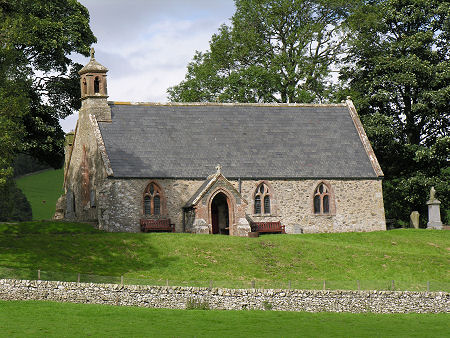
Lyne Church Seen from the A72

Lyne Church occupies the brow of a small, pronounced ridge a hundred yards north of the A72 at a point a little under five miles west of Peebles. Access is along an extremely minor road that leaves the A72 a little to the west of the church and encounters a locked gate where it begins to curve round to approach the church. It is possible to park here in a way that will not cause an obstruction.

Records suggest that there has been a church here since the 1100s, at which time it was a “dependency” or subsidiary of Stobo Church. It became a parish church in its own right in the early 1300s.

Nothing now remains of this earlier church and it is tempting to speculate that the earlier church was totally demolished before the church you see today was built on the same site.

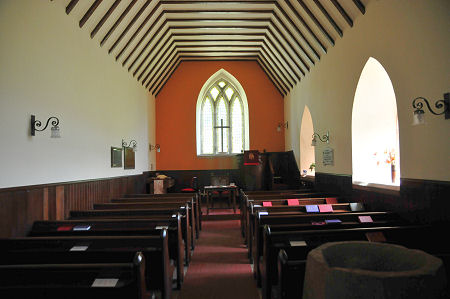
The Interior, Looking East

The building of the current church took place between 1640 and 1645 and was paid for by John Hay of Yester, later to become the 1st Earl of Tweeddale. The church that emerged in 1645 would have looked very much like the one you see today, though it is likely the exterior was originally covered in harling or render.

The only significant external change was the addition of an entrance porch in the 1800s. The church underwent a major restoration in 1888. Another, exactly a century later, saw the removal of the roof back to the main beams alongside work on many other aspects of the church. The result was that when the first post-restoration service was held on 5 November 1989 it was in a church that in many ways was in a better condition than it had been when first built.

Lyne Church is not a large building externally, and with walls over a metre thick, what you find inside is a remarkably intimate space. And a remarkably original one. You’d expect a restoration in the late 1980s to respect the character of the church: it comes as a relief to discover that the 1888 restoration was also done sensitively. As a result it is still possible to enjoy the unusual canopied pews at the rear of the church, and the original wooden pulpit, all dated 1644. Near the door is a massive stone font which seems to have been the only feature to survive from the original medieval church.

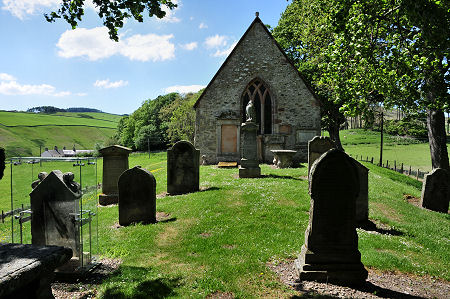
The Church from the East, with the Adam and Eve Stone on the Left
The Church from the East,
with the Adam and Eve Stone on the Left

The church stands in a small churchyard, with most of the graves to the east or west of the church itself. The earliest dated stone is from 1707 and there is also an “Adam and Eve” stone depicting the ill-fated couple which dates back to 1712. It is wonderful to see that this has been restored and protected by a perspex case: all too often magnificent post-Reformation gravestones have been left to fend for themselves elsewhere in Scotland.

Two hundred yards to the north east of the church is Abbey Knowe, the site of a Northumbrian cist cemetery from the 600s-700s. Its existence suggests that there may actually have been a church in the immediate vicinity 500 years before the establishment of Lyne Church itself in the 1100s.

The Adam and Eve Stone.

The kirkyard contains many fine gravestones including the beautiful “Adam and Eve” gravestone, from 1712, depicting the temptation, by Lucifer, to eat the fruit of the tree of knowledge.

The old gravestone with the beautiful Adam and Eve carving was cleaned and treated against moss and lichen and put under perspex for protection. Paradise protected but lost.

Perspex and treatment help preserving the stone but the measure taken have also taken the graves beauty and integrity.

Sources:

https://www.undiscoveredscotland.co.uk/peebles/lynechurch/index.html

https://en.wikipedia.org/wiki/Lyne_Kirk

blog at end

Kerr, Washington Caruthers

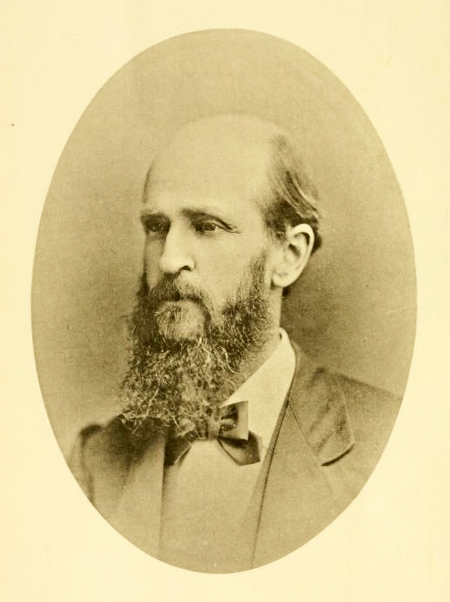
Photographic portrait of Washington Caruthers Kerr, from the <i>Journal of the Elisha Mitchell Scientific Society</i>, Vol. IV, July-December 1887.  Presented on Archive.org.


Washington Caruthers Kerr, geologist, was born in eastern Guilford County in the Alamance Creek–Alamance Church region. His Scotch-Irish parents were William M. Kerr, a small farmer, and Euphence B. Doak, who reportedly possessed unusual mechanical talent. When “W. C.” was a small child, the family moved to the Haw River area in western Orange County, which in 1849 became the eastern section of the new county of Alamance. His father died about 1835 and his mother in 1840, leaving four sons and two daughters. W. C., quick and bright, was the namesake of the family’s pastor, the Reverend Eli Washington Caruthers. Indeed, Caruthers was then the state’s outstanding Presbyterian as well as principal of a good preparatory school in Guilford County. Cared for and guided by his mentor, young Kerr entered the sophomore class at The University of North Carolina and was graduated in 1850 with highest honors. He taught for one year at Williamston in Martin County, and for another year at Marshall University in northeastern Texas.

In 1852 Kerr was appointed as a computer in the office of the Nautical Almanac at Cambridge, Mass., and held the post for almost five years. He also studied at the Lawrence Scientific School and came in contact at Harvard University with such luminaries as Louis Agassiz, naturalist, and Asa Gray, botanist. Between 1857 and 1862 he served as professor of chemistry, mineralogy, and geology at Davidson College, teaching upper-level courses. One of his students recalled in later years: “We used to call him ‘Steam Engine,’ instead of Kerr, such was his promptness to time and rapid motion.” Another remembered: “He was a man of small physical stature,—with massive forehead whose amplitude was increased by baldness and his way of wearing his hair. His face was thin and intellectual—his eyes blue and piercing . . . his voice . . . clear and penetrating. He . . . could not brook shamming or laziness. His rebukes were often cutting—always deserved.” Kerr’s contribution to the Confederacy (1862–64) was as chemist and superintendent of the Mecklenburg Salt Company at Mount Pleasant, S.C., near Charleston; he improved the manufacturing process and cut the cost of firewood by half.

Governor Zebulon B. Vance appointed Kerr state geologist in 1864, but conditions in North Carolina during the final year of the Civil War precluded either systematic work or a salary. In 1866 he was reappointed by Governor Jonathan Worth. Kerr evaluated in Raleigh the “geological reconnaissance” performed by Chapel Hill professors Denison Olmsted and Elisha Mitchell in the 1820s (the first state survey in the nation), and the more detailed survey of state geologist Ebenezer Emmons during the 1850s. Neither, however, covered adequately the western quarter of the state, where most of the mineral resources were located. With an eye on economic development, Kerr concluded that the region beyond the Catawba River merited particular attention, and that an accurate geographic and topographical map of North Carolina should be produced.

Although not a trained specialist, Kerr was a keen observer and hard worker. His first official report stated that he had traveled, “mainly in the saddle,” 1,700 miles in less than four months; his second, 4,000 miles in eleven months. The legislature appropriated only $5,000 annually for all geologic operations, which meant that Kerr could have no permanent assistants. Nevertheless, by 1870 his own statewide survey was ready for publication. The lawmakers, however, placed so low a priority on the work that it did not appear until 1875—a major frustration. Kerr’s 325-page Report of the Geological Survey of North Carolina concentrated on topography, climate, geology, soils, fertilizers, and ores. His large fold-out geologic map was tinted in five colors by Mrs. Cornelia Phillips Spencer of Chapel Hill. The base for this map was that of the federal Coast Survey. After fifteen years of intermittent labor, Kerr in 1882 had calculated his own base, thus providing by far the most accurate map of North Carolina up to that time.

As state geologist he touched every county and, when not in the saddle, employed buggy, spring wagon, boat, handcar, or train. Always he collected specimens for the state museum in Raleigh. His correspondence was voluminous, his conferences frequent, his popular talks and articles many. He was a leading member of the state Board of Agriculture, lectured regularly on geology and related sciences at The University of North Carolina, and prepared displays of the state’s resources for expositions both at home and abroad. A respectable number of his professional papers were read before, and published by, several scientific societies.

Kerr made two important theoretical contributions to geologic science. He was first in the United States to explain a phenomenon that many North Carolinians and South Carolinians had often noticed: along rivers flowing from west to east, their south banks presented bluffs and high ground, their north banks low plains and swamps. Citing Ferrel’s “law of motion” (1859), Kerr deduced that this condition resulted from the coordinate action of stream flow and rotation of the earth. He was also first to describe the alternate freezing and thawing that produced “deep movement and bedded arrangement of loose materials on slopes,” even very slight slopes—a “frost drift” analagous to “glacial drift.” But his belief that glaciation occurred as far south as North Carolina was not accepted.

The satisfactions of his work were countered by certain vexations. Chief among them was the periodic meeting of the legislature and the inevitable confrontation between the state geologist, who favored plans for long-range economic development, and legislators, who expected immediate results for funds appropriated. To Kerr it was “real torture.” Never robust, his health gradually deteriorated (from catarrah of the digestive organs) after age forty. Yet this period witnessed his greatest productivity. An associate declared that Kerr was “often impatient, often despondent” but “clung to his work, impelled and sustained by nervous energy alone.”

In August 1882 he resigned his position to join the U.S. Geological Survey; some of his duties were in Appalachia, some in Washington. While in Washington, he prepared a report on the cotton production and general agriculture of North Carolina and Virginia for the Tenth Census, and wrote the article “North Carolina” for the ninth edition (1884) of the Encyclopaedia Britannica. Finally his failing health persuaded him to give up regular work, resign from the Geological Survey, and spend summers in Asheville and winters in Tampa, Fla. The Elisha Mitchell Scientific Society at Chapel Hill elected him president in 1884, and the university honored him with the Ph.D. in 1879 and the LL.D. in 1885. During his lifetime Kerr was almost the only North Carolina-born scientist active in the state. His great service was to open the eyes of the people to their own natural resources, especially minerals. He died, of consumption, at Asheville and was buried in Oakwood Cemetery, Raleigh.

Kerr married Emma Hall of Iredell County in 1853. Their three children were William Hall, automatic-bagging inventor and manufacturer; Alice Spencer, a teacher who died of consumption at twenty-one; and Lizzie, who married Professor George F. Atkinson of Chapel Hill. In a letter to Lizzie from Burnsville dated 17 Nov. 1882, Professor Kerr, as most people called him, unconsciously left a portrait of himself: “I came in here Monday morning from Grandfather [Mountain], Tuesday went to Tom Wilsons, Wednesday to top of [Mount] Mitchell. Ground frozen hard & ice in path to top, & little lines of snow in the furrows of the rocks & whitening the top branches of the balsam trees. Day pleasant . . . I have taken board for party at Ray’s, 4 men & 4 horses.”

References:

At Home and Abroad (Charlotte), February 1883.

Davidson College Monthly, February 1891.

J. A. Holmes, Elisha Mitchell Scientific Society Journal (1887 [portrait]).

A. S. Kerr Papers (Southern Historical Collection, University of North Carolina Library, Chapel Hill).

South-Atlantic, August 1878.

C. P. Spencer Papers, Orange County Wills and Estates (North Carolina State Archives, Raleigh).

George Troxler, Journal of Presbyterian History, June 1967.

Additional Resources:

Kerr, Washington Caruthers; Cain, William; Guyot, A.; and Cumming, William Patterson. 1966. Map of North Carolina. Raleigh: State Dept. of Archives and History.

Cornelia Phillips Spencer Papers, 1833-1975 (bulk 1833-1942) (collection no. 00683). The Southern Historical Collection. Louis Round Wilson Special Collections Library. University of North Carolina at Chapel Hill. http://www2.lib.unc.edu/mss/inv/s/Spencer,Cornelia_Phillips.html (accessed January 17, 2014).

Image Credits:

Elisha Mitchell Scientific Society (Chapel Hill, N.C.); North Carolina Academy of Science; University of North Carolina at Chapel Hill. Journal of the Elisha Mitchell Scientific Society. Chapel Hill, N.C.: Elisha Mitchell Scientific Society. 1887. https://archive.org/details/journalofelisham04elis (accessed January 17, 2014).

Authors: