Name – originally there was a route through the hills to England, so Yetholm was the ‘place at the gate’, from the old Scots ‘yett’ meaning a gate, and ‘holm’ or ‘ham’ the Anglo-Saxon for a settlement.
Graveyard Record – Recorded by the Borders Family History Society in their ‘Roxburghshire Monumental Inscriptions III’. The 2nd Edition contains the extension graveyard as well as the original.
Places of Interest – Kirk Yetholm is at the north end of the Pennine Way, and for many years those who had travelled the whole route and who could produce a copy of Alfred Wainwright’s Guide could claim a free half pint.
St Cuthbert’s Way also passes through Yetholm, on its way from Melrose to Lindisfarne.
The War Memorial is situated at the roadside half way between the two villages.
The Wauchope Memorial is on Town Yetholm Green.
The Gypsy Memorial stands on Kirk Yetholm Green.
The Yetholm Gypsies have made the village famous throughout the world. The Faa and Blythe groupings were the dominant families in British Gypsy culture throughout the past three hundred years. Although gypsy blood still courses through many local veins, the discreet family links have died out as the members have intermarried with the locals. The Baillie, Tait, Douglas, Young, Gordon and Blyth families all have blood links with the gypsy families of the past.
The former ‘Gypsy Palace’ is just off Kirk Yetholm Green, on the road to Halterburn. Once the home of the King of the Gypsies, it is now a private house.
People Bearing the Name Yetham or Yethame
Adam of Yetham is a witness to charters in the reigns of William the Lion and Alexander II.
Reginald of Yetham appears about the same time.
William of Yetham lived in 1296, as he appears in the Ragman’s Rolls.
William of Yetham received a letter of safe passage to enter England from Edward II in 1320.
William of Yethame was archdeacon of Teviotdale between 1321 and 1326.
Famous People Associated
Major-General Andrew Wauchope of Niddrie
Rev John Baird – gypsophile and supporter of education for the travelling people
Dr Scott of Thirlestane – physician to King Charles II
Jean Gordon – the inspiration for Meg Merrilees in Walter Scott’s ‘Guy Mannering’- was born in Yetholm.
Jake Harvey – internationally acclaimed sculptor – born and brought up in Yetholm. Now lives and works in Maxton and Edinburgh
Rev Robert Story of Rosneath – father of Professor Herbert Story.
Andrew Thomson – famous in Australia, infamous in Yetholm!
Sir Henry Francis Oliver – Admiral of the Fleet.
Another question from one of our society members: Did Agnes Douglas, Countess of Argyll (1574 – 3 May 1607) marry John Carruthers 8th of Holmains, eg was she a Carruthers by marriage?
Sadly no.
This is totally incorrect historically. It is therefore important to check the facts. Not every person out there is a ‘Carruthers’ as much as we would wish them to be. Sadly, you simply cannot rewrite history.
AGNES DOUGLAS, Countess of Argyll
Agnes Douglas was definitely a Scottish noblewoman born in 1574 and it is recorded that she was the first wife of Archibald Campbell, 7th Earl of Argyll. She therefore did not marry a Carruthers, she died at the age of 33 just after the birth of her 3rd child.
This is taken directly from Clan Douglas Archives which is solidly backed up by other historical evidence and records.
‘On 24 July 1592, she married as his first wife, Archibald Campbell, 7th Earl of Argyll, the son of Colin Campbell, 6th Earl of Argyll and Agnes Keith.
Agnes, who was a Roman Catholic, was instrumental in her husband’s later decision to convert to the Catholic faith in 1618, eleven years after her death.
Despite Agnes’s religion, he commanded the royal troops which fought against the Catholic rebels led by George Gordon, 1st Marquess of Huntly in the Battle of Glenlivet on 3 October 1594. Argyll’s forces were defeated by the numerically smaller forces of Huntly.
AGNES’s MARRIAGE (the only one)
The marriage produced three children:
Lady Annabel Campbell (died 1652), married Robert Kerr, 2nd Earl of Lothian, by whom she had two daughters.
Lady Anne Campbell (died 14 June 1638), married George Gordon, 2nd Marquess of Huntly, by whom she had seven children.
Archibald Campbell, 1st Marquess of Argyll (April 1607- 27 May 1661), de facto head of government in Scotland during most of the conflict known as the Wars of the Three Kingdoms, and the most influential member of the Covenanter movement during the English Civil War. In 1626 married Lady Margaret Douglas (1610–1678), by whom he had four children, including his heir, Archibald Campbell, 9th Earl of Argyll. He was executed in 1661 by the orders of King Charles II of England on charges of High Treason. His head was exposed on top of the Tolbooth.
Agnes herself died on 3 May 1607, a month after the birth of her only son, Archibald.
Her husband married secondly on 30 November 1610, Anne Cornwallis, by whom he had three more children.
In 1599, when she was twenty-five years old, Agnes’s portrait was painted by Flemish artist Adrian Vanson. It is displayed in the National Gallery of Scotland. See below, the other pic is of her husband Archibald Campbell, 7th Earl of Argyll’.
As a clan, Carruthers really don’t need to make things up. We have a host of information in the pipeline ready for the green light. All again based on evidence and facts.
Once again, if evidence is presented I’m sure we, and Scottish historians world wide and more importantly clans Douglas and Campbell would be very interested to review it.
In 1286, King Alexander III of Scotland was on his way to his new young wife’s bed, during a storm, when he fell over a cliff. Whether his tumble was assisted or not isn’t recorded but his lust-driven freefall to oblivion was to have enormous consequences for the border between Scotland and England. From this point in time begins the story of the Border Reivers, also known as Riding Surnames and Steel Bonnets – family bands of hard riding, tough and resourceful men. They existed on plunder, cattle rustling, mayhem and sometimes murder, brought about by a border in a constant state of flux and turmoil.
They were to be a law unto themselves in the Marches either side of the border for over three centuries. Their time finally ran out when the crowns of Scotland and England were joined in 1603 under the Scots King, James VI/I. He broke the power of the Reivers by hanging many of them, dispossessing others and scattering those who resisted his will. It was the end of an enthralling chapter in the history of the Borders.
Below is an account of a 16th century raid on Willmoteswick fortified manor house, the home of the Ridley’s, by the warlike Armstrongs of Liddesdale. This manor guarded the ford at Haltwhistle and is relayed in the famous border ballad, ‘The Fray of Hautwessel’. The death of Wat Armstrong is a sobering reminder of the power of the English longbow.
‘John Ridley thrust his spear right through Sim o’ the Cathills wame (belly) … Then Alec Ridley let flee a clothyard shaft, it struck Wat Armstrong in the ee’, went through his steel cap, head an a’, it made him quickly fa’, he could na’ rise … The best at thief-craft or the ba’ (football), he ne’er again shall ride a raid’.
Band of Border Reivers
At this point in the narrative, it would be a good time to get one very important thing clear about the Border Reivers. They did not wear kilts or plaid, nor did they paint their faces with blue woad. This is a fantastical invention, a fabrication by the actor and director Mel Gibson, in his highly inaccurate film Braveheart. I feel sure there must be many people with no real knowledge of the true history of Scotland, who have watched that dreadful piece of old hokum and fallen for the ‘tartanfest’ it peddles, along with its distorted historical perspectives. His dressing of non-Highlanders in kilts was ridiculous, as ridiculous as dressing the Plains Indians in business suits and ray-bans, whilst they were fighting General Custer at the Battle of the Little Big Horn.
Edward and Wallace
The great families of the borders on both sides of it, were very closely connected and intermarriage was common if not the norm. In the late 16th century it was difficult to find one of the Scottish Armstrong clan for example, who wasn’t married to an Englishwoman. The governments of Scotland and England even passed laws to forbid cross-border marriages on pain of death. The independent borderers generally disregarded these laws and the governments were in no position to enforce them. The marriages continued unabated, as they still do to this day.
Anyway – back to 1286 and the airborne King Alexander III. After his date with destiny the kingdom passed to his infant grand-daughter, Margaret. King Edward I of England saw advantage in this and planned a marriage between the infant queen and his own son. Unfortunately Margaret died in 1290 and the Scottish succession was unclear. Edward I was invited to decide who should succeed to the Scottish throne and had his puppet Balliol installed as king. However, Balliol once installed began to have ideas of his own. He concluded an alliance with France and began to raid across the border into England. Edwards response was swift as he confiscated the property of all Scots in England. The Scots in turn massacred English sailors at Berwick. The Scots king then took the very unwise step of invading England where he met Edwards English army in battle.
It is interesting to note that as King Edward I waited at the border town of Wark with his army, he had with him some Scottish nobles. One of these nobles was a certain Robert the Bruce, later to become king of Scotland in his own right. In the west the Scots attempted to take Carlisle but the city held fast. In the east, Edward took Berwick and there was a great loss of life in that town. Edward and his army then entered Scotland and within five months he had brought the country to submission. The governor that Edward left in charge to control Scotland made a complete hash of the job and as a consequence of his misrule, the uprising of William Wallace happened.
Mighty Hermitage Castle – A Border Stronghold of Scotland
For years after the events described above, invasion followed counter invasion and the devastation all along the border went on for generations, it became a way of life. The area was never to be stable again whilst the two nations were dynastically separate. During this time a unique buffer region was being born, the lawless land of the Border Reivers.
The constant raids over the border made the growing of crops almost impossible and agriculture broke down. Crops were all too often burnt before they could be gathered and it made little sense to attempt to grow them. The people of the Borders mostly gave up on agriculture and lived by raiding, general skulduggery and blackmail, thus were born the fabled Border Reivers.
A common bond across the border
The word ‘blackmail’ entered the English language from the Border Reivers, along with the words ‘bereaved’ and ‘gang’. The people of the borders had taken a step backwards as far as the rule of law was concerned, everything fell away except the art of raiding and feuding. Powerful families evolved who raided across the border and often feuded with each other. There were also cross border alliances, marriages and even families such as the Grahams, who resided on both sides of the border. Even different branches of the same family feuded, the Kerr’s of Ferniehirst and Cessford were at each others throats for decades.
Another of the long lasting feuds was that between the Kerr’s and the Scott’s. Like Pirates and Smugglers, the Reivers have tended to be sanitised and romanticised over the past centuries and historical inaccuracies of the times have been stated as fact. Our friend Mel Gibson is a prime example of this with his fantastical version of the uprising of William Wallace, as mentioned earlier.
Such was the uniqueness of the people of the Borders, both Scots and English, that they had more in common with each other than those from outside the area, even those from their own country. They understood each other and lived by the same accepted rules. When Scotland and England were officially at war, the Borderers would be fighting on both sides. This was usually for the booty and plunder rather than from any sense of national allegiance. Their fights were never those of national sovereignty or for the rights of kings or the nobility.
The Border Reivers were Scottish when they will and English at their pleasure, or indeed the reverse. When they met on the field of battle as part of national armies, they invariably avoided each other and did each other little harm. Family was everything on the Borders and nationality was no more than a flag of convenience.
The Reivers were expert and skilful horsemen and rode hardy little horses called ‘Hobbys’. These horses were said to be capable of travelling up to 150 miles per day. It is little wonder that raids could happen so far from the border. Raids are documented as having taken place as far south as Yorkshire in England and within three miles of Edinburgh in Scotland. Sadly, these wonderful little horses no longer exist today. Probably the closest thing to them now is the Icelandic horse, which is another small and sturdy breed.
The Riders themselves wore a particular kind of clothing. They wore a steel helmet – hence their name of ‘steel bonnets’ – a shirt, over which could be worn a coat of mail but more usually was worn a ‘Jack’. A ‘Jack’ was a quilted coat of stout leather sewn with plates of metal or bone for added protection. It was an extremely good piece of protective clothing. They also wore breeches and high leather boots. They were considered to be some of the best light cavalry in the world during times of war.
No Robin Hoods
Over the centuries continual raiding laid waste to the Border Marches, so much so that at times the population in the areas found themselves in desperate circumstances. In the mid 1500’s the people of Dumfriesshire were close to starvation due to the depredations of the Reivers. The bands of Reivers were not solely English or Scottish, they could very easily consist of mixed bands and more often than not did. Family as ever on the border meant everything, nationality as we understand it today meant nothing.
The Reivers were no Robin Hoods, they were not robbing the rich to help the poor, they simply robbed to help themselves. They were not outlaws in the accepted modern sense either, as many of the nobles and ‘gentlemen’ were up to their necks in reiving. Often, March Wardens who were supposed to be keeping the actions of the Reivers in check were in fact Reivers themselves, or at least in league with them.
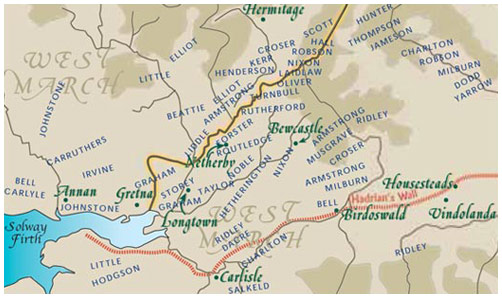
The March Lands of the Scottish Border Reivers
The demise of the Border Reivers
By the 16th century the unique conditions on the border had become an accepted way of life, people had never known anything else. The end came in 1603 with the joining of the crowns. No longer was there a border to be fought over, there was one crown and one country. King James set about breaking the power of the border families and he brutally harried and suppressed them. Whilst Scotland and England had been two separate countries, this pool of fine fighting men was a rich resource for both sides. When the crowns were united, in the eyes of the king they became nothing but brigands and scoundrels, and a menace to the stability of the realm.
Some of the great border families saw which way the wind was blowing and threw in their lot with the king, and prospered because of it. They eagerly rooted out other reiving families on behalf of the king, or even those of their own surname. Wanted men were hunted down and executed. They were now subject to ‘Jeddart Justice’, which was summary execution without trial. All Borderers were forbidden to carry weapons and they could only own horses of a value up to 50 shillings. Deprived of their basic reiving tools all unlawful activities eventually ceased. Many reiving families were also dispossessed of their lands by grasping heidsmen and nobles on the make.
Many were hung or transported to Ulster as part of the Protestant plantations that were to cause so much grief for Ireland over the coming centuries. For the first time in many long years, peace and stability returned to the Border region and it settled into a more civilised state of normality. Only a few powerful Reiver families remained in what was the old Marches with their land and positions intact. Many of the old Reivers who resisted change after 1603 moved to England, Ireland, America and Canada, where their descendents still reside to this day.
That has also been the story for the maternal side of our family, who having been uprooted from the Borders by dispossession migrated first to Cumberland in England, under threat from the noose of ‘Jeddart Justice’ and then a couple of generations later to Suffolk in East Anglia. From there they migrated to Canada, firstly to the province of Ontario and thence out to Saskatchewan and finally some of the family went on to the province of Alberta.
Our branch of this extended family, in the form of my grandfather, returned to the UK in the mid 20th century just before the onset of the Second World War. Others had returned prior to World War One. They served in the British forces rather than the Canadian during both world wars. Military service has tended to run in our family down the generations, myself included, probably a martial reminder in the bloodline of our old Reiving traditions.
We would recommend that anybody seeking to find out more about the Border Reivers and life on the Borders between 1286 and 1603, should read the excellent and highly readable book by George MacDonald Fraser called – ‘The Steel Bonnets,’ or that other excellent book about the Border Reivers called – ‘The Reivers’ by Alistair Moffat.
Another question from a very concerned member of ‘our’ society who read this on another page.
‘Is this true….
Hello, History is being re-written all the time due to all the new DNA findings, so this is confusing to keep up with it all. It always said that we were a sept of the Bruce Clan. To explain easily, that means a cousin, But we have found out that we were in Scotland long before Robert de Bruse senior or junior were around. In fact they both married Carruthers women. Our Carruthers Clan Society Int. LLC is official and at the Clan Gathering in 2918 we will have Chieftans that are being nominated now, and we will vote on a Chief.The Anciet Bruce Tartan was the Carruthers Tartan. Most Carruthers had left Scotland and it did not sell, when Braveheart came out, they renamed it the Ancient Bruce so they could sell it. Many of the tartan companies have gone back to naming it the Carruthers Tartan, now that there are a lot of Carruthers buying it again.’
HERE ARE THE FACTS, point by point, you simply cannot rewrite history :
First off Carruthers is a Scottish Clan, not Norse, English, Canadian, American nor any other nationality. It is and always will be Scottish by its roots, heritage and history.
Q: Are we cousins to Bruce.
A: No, there is no evidence to support this. A sept is a subdivision of a clan ‘with’ or ‘without’ family connection, however we are not as a family related to Bruce.
Q: Are Carruthers a sept of clan Bruce.
A: Septs came into being in those clans or families that didn’t have them, as a construct in the 1800’s. Carruthers were included as they were a) armigerous (without chief) and b) were known supporters of the family Bruce throughout history.
Once a Chief is legally recognised by the Lyon Court in Edinburgh, that will change and the clan will have official status in its own right with all that that entails. Happily this is all in hand.
Q: Did Carruthers exist before the Brus ( Bruce) family arrived in our shores.
A: Carruthers allegedly goes back way before the Normans arrived, to include de Brus, originating in the south western area of Scotland in the Briton kingdom of Strathclyde, now part of which is Dumfriesshire, our ancestral home.
Q: Were the wives of Robert the Bruce and his father Carruthers.
A: No: It is well recorded that King Robert the Bruce had two wives:
Elisabeth de Burgh 1302-1326
Isabella of Mar 1296
Neither of them were Carruthers.
A: Once again historical records show that Robert the Bruce senior married Marjorie, countess of Carrick in 1271. 1256-1292.
She was also not a Carruthers.
Q: Is Carruthers Clan Society Int. LLC the official representative of the Clan worldwide ?
A: Definitely not , it is a business run and registered in the US and there is no evidence to suggest they have any legal claims to be chief or chieftain nor to claiming the Bruce tartan. It is therefore not recognised by the Clan Carruthers Society, nor the clan in general for many reasons, to include those many false and potentially fraudulent claims.
Q: How is the clan Chief picked.
A: If there are no legitimate heirs to the chiefly arms ( eg title of chief), a gathering, supervised by the Lyon Court, may pick a commander for a period of 10 years. This is not the case with Carruthers who have descendants of the chiefly line.
A: Who officially recognises a Scottish Clan Chief
A: Only the Lord Lyon in Edinburgh may recognise with any legality a clan Chief and through them the Clan Carruthers becomes officially recognised. This is in hand. Any self appointed chiefs will not be recognised nor any chieftains the make, only a legally recognised Chief in Scottish law, may raise a clansman to chieftain status.
A: Is the Bruce tartan a Carruthers Tartan
A: As Borderers, and along with all the other Border clans, Carruthers never had a tartan as they wore leather trews not kilts and any plaid used was regional depending on the the weavers and not clan specific . Carruthers Red was designed and registered for the clan to use in 2017 because Bruce is Bruce.
Therefore ALL Bruce tartans are patented and registered to Bruce. This is based on the sett, colours and thread count which is the signature of any tartan. The Bruce tartan commonly used by Carruthers and many other ‘septs’ of that family is a Bruce tartan and not only is it rude and disrespectful to claim it as our own, it is fraud.
Q: Was the Ancient Bruce tartan actually a Carruthers tartan.
A: Simply no. See above, Irrelevant of the prefix: old, ancient, modern or what ever the clue is in the word Bruce and as can be seen above it has been registered to them since the 1800’s.
That same tartan has been freely available and used by Carruthers worldwide as a sept of Bruce and I this used of THEIR tartan.
To say that it never sold is simply inaccurate at best as it represented the Bruce family and was bought by them and their ‘septs’.
My understanding is also that once a Chief is in place and the Red Carruthers tartan officially recognised, and it will be, the major suppliers will start to change the tartan on their merchandise because the one they use is a recognised as a Bruce tartan.
SUMMARY
People have a choice, but before you make that choice please be aware of the facts.
Clan Carruthers Society-International has been tirelessly working for the benefit of the many not simply the few.
History and pedigree dictates we are entitled to it and we are loath to let others make claims on behalf of our family that simply embarrassing and continually shown to be untrue.
Please bear with us, we will have a legally recognised Chief of our Clan and through them Clan Carruthers will take their place as an official Scottish Clan along with the others.
In terms of physical size, Scottish Borders is the 6th largest of Scotland’s unitary council areas. It is only the 18th largest in terms of population, reflecting the largely rural nature of the area. For accommodation in the Scottish Borders.
The Scottish Borders extend from the North Sea coast north of Berwick-upon-Tweed in the east, to Annanhead Hill, only a mile and a half from the M74 motorway, in the west. Travelling south to north it extends from near Canonbie to the spine of the Pentland Hills and to the North Sea at Cockburnspath.
Historically, the phrase “Scottish Borders” was applied to the whole of the border between Scotland and England, and to the areas on both sides of it, though the alternative term “Scottish Marches” was often used. These were divided into an East March, a Middle March and a West March in Scotland, and a mirroring set of Marches in England. Between bouts of periodic open warfare that ravaged the area for over five centuries until the late 1600’s, the area was a happy hunting ground for cross-border feuds and banditry by border reivers. The East March in Scotland eventually became the traditional county of Berwickshire, and the Middle March became the traditional county of Roxburghshire.
Roxburghshire, also known as the County of Roxburgh, was one of the 34 traditional counties into which Scotland was divided for administrative purposes. It was the most south easterly of Scotland’s counties and provided a long stretch of the border with England. For much of its history this area was fought over, either by the armies of Scotland and England or during frequent periods of lawlessness, by border reivers.
The main settlements in Roxburghshire were Melrose,Kelso,Jedburgh and Hawick. The county town was Jedburgh. Roxburghshire was also home to the four great border abbeys, Melrose Abbey,Jedburgh Abbey,Kelso Abbey and Dryburgh Abbey. A notable absentee from the list of settlements in Roxburghshire is Roxburgh itself. Today, Roxburgh is a small village about three miles south west ofKelso. In 1400 Roxburgh was one of the most important royal burghs in Scotland, but the frequent conflict between England and Scotland weakened it, and the permanent capture of Berwick-upon-Tweed by the English in 1482 was the final nail in the coffin. Roxburgh was largely abandoned and today little remains beyond traces of the ramparts of its once magnificent castle.
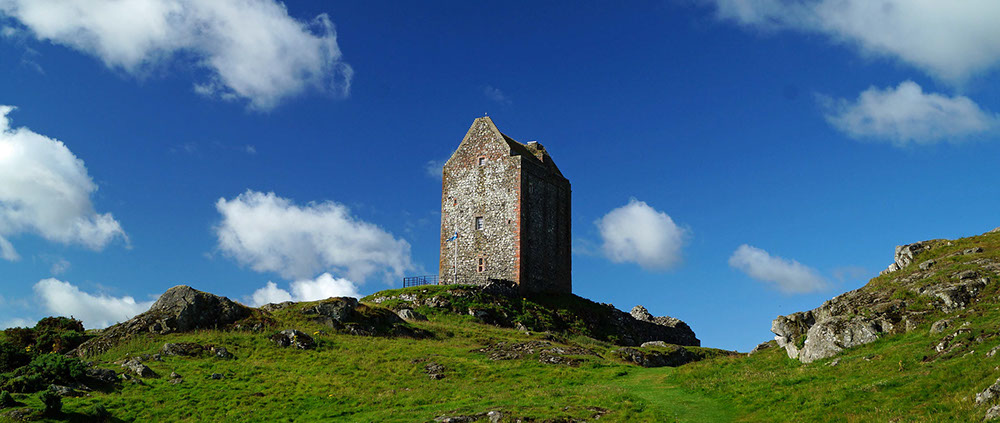
Smailholm Tower from the South
As the crow flies, Smailholm Tower lies almost exactly mid way between Melrose and Kelso. Access is either from the village of Smailholm, whose fine Norman church is worth a visit, or from the B6404, four miles north east of St Boswells. A minor road leads you through the farmstead of Sandyknowe and along a track past an old millpond to the parking area for the tower. From here you have a choice of steep or less steep grassy paths for the final hundred yards.
The landscape that immediately surrounds Smailholm Tower is remarkable. Though the tower lies less than two miles north of the River Tweed, the surrounding chaos of rocky outcrops would actually be quite at home at the opposite end of the country, in north west Sutherland.
It is very easy to see why this site suggested itself for the construction of a defensive tower house. For five hundred years, the border between England and Scotland was witness to repeated wars both large and small, and even in nominally peaceful times, cross border banditry was the norm rather than the exception.
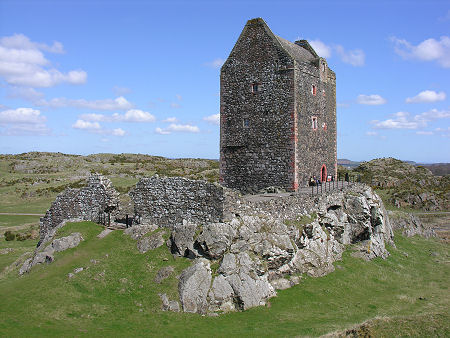
Smailholm Tower stands on a rocky crag that is just large enough to support the tower and the courtyards to its north east and south west. These were surrounded by a tall barmkin wall, now standing to anything like its original height only at the south west end. (Continues below image…)
The Tower from the South Before the Grass Roof was Installed
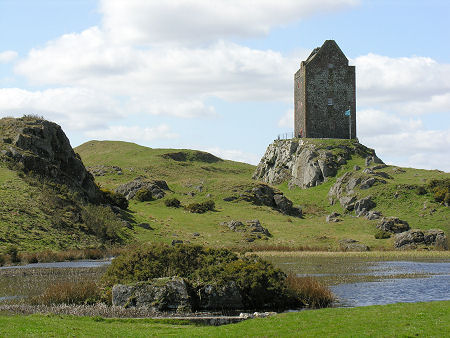
The tower was once the centre of a thriving settlement. The west courtyard was originally home to a hall and a kitchen, though in the 1650s the hall was replaced by a house. Outside the barmkin wall would have once stood cottages, stables and cattle enclosures, and traces of some of them can still be seen on the ground. There would also have been a mill, on the site now occupied by Sandyknowe Farm to the south east of the tower. The millpond still exists.
The only building now standing is the tower itself. This is a fairly typical tower house with five storeys, each of one major room, piled on top of one another. The building has stone vaulting between the second and third floors, and at roof level: indeed, today’s roof is in effect as a vaulted ceiling, which has been given an outer cladding of living grass.
The ground floor is now the Historic Environment Scotland reception and shop, while the mezzanine floor, originally used for storage, has a range of visitor displays and an excellent cut-away model of the tower. The upper three floors originally provided accommodation for the laird and his family.
The main focus of castle life would have been the hall on what is confusingly called the first floor. Above this would have been a main bedroom, with one or more further bedrooms in the top floor under the roof.
Doors from the upper floor give access to two wall-walks, one on the north west side of the tower, the other on the south east side. These would have formed an important part of the tower’s defences when under attack. The location gives staggering views from the wall-walks. Other signs that the tower was not just for show include a gun loop allowing the west courtyard and main gate to be covered, and another above the main door to the castle.
And Smailholm Tower certainly saw its share of action. It was built by the Pringle family in about 1450 and remained in their hands until 1645. During the 1540s Smailholm was attacked repeatedly by English raiders, the raids only ceasing when in 1548 the Laird, John Pringle, became what was called an assured Scot. In return for a promise not to raid England or to help efforts against English raiders in Scotland, his lands would be left alone.
Cross border conflict ought to have ceased with the Union of the Crowns in 1603, but in July 1640 a group of Covenanters successfully defended the tower against an attack from Royalists during the Civil War.
In 1645 the tower was sold to Sir William Scott. The Scotts built a new house in the West Courtyard. This remained in use until the early 1700s, when the family moved to a more comfortable and less exposed house they built a few hundred yards to the east at Sandyknowe.
The most famous member of the Scott family was Sir Walter Scott. As a child he spent time here with his grandparents recovering from polio, and it was at Sandyknowe and in the shadow of Smailholm Tower that Scott came to love the ballads of the Scottish Borders.
The upper three floors of Smailholm Tower are today used as a permanent exhibition of costumed figures and beautiful tapestries that recall Scott’scollections of ballards and the turbulent past of the area.
Smailholm Tower from the Millpond
A particular bone of contention between Scotland and England was Berwick-upon-Tweed. On the north bank of the River Tweed and the county town of the traditional Scottish county of Berwickshire,it was logically Scottish. But logic played little part in the politics of the day and in the two centuries up to 1482 the town changed hands no fewer than 14 times. Since then it has remained a part of England.
The first settlement on the coast north of the English border is Burnmouth, a village mostly hidden at the foot of the cliffs surrounding its harbour. A few miles north is Eyemouth, a busy and attractive fishing port and seaside resort whose fortunes and tragic misfortunes have been closely linked to the sea since the 1200s.
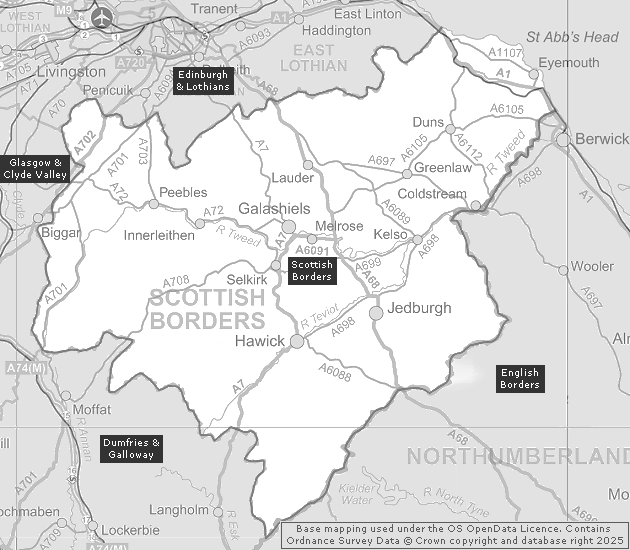
Scottish Borders, Showing Main Settlements & Connecting Areas
From Eyemouth the A1107 provides a quieter alternative to the A1 for those heading north, passing through Coldingham, complete with the church and other remains of Coldingham Priory. Just north of the fishing village of St Abbs, at St Abb’s Head, the coast turns to follow a generally westwards direction along the southern shore of the Firth of Forth. Three miles along the coast are the clifftop ruins of Fast Castle. West of St Abbs the A1 runs past Cockburnspath and close to the hidden gem of Cove
Inland from the North Sea Coast and the A1 lie the Lammermuir Hills, with the villages of Gifford to their north and Duns to their south. West of Berwick-upon-Tweed is Paxton House and the nearbyUnion Chain Bridge. while on the English side of the border is Norham Castle, where some key moments in Anglo-Scottish history were played out.
Following the main A68 road from Darlington to Edinburgh you cross the border at Carter Bar and descend towards Jedburgh, Smaller and more traditional in feel than Hawick,Jedburgh is overshadowed by the remarkably complete remains of Jedburgh Abbey, just to the south of the attractive centre of the town. Of the castle that once played such a central part in repeated Anglo-Scottish wars, nothing now remains, though the Victorians did build the Castle Jail on the site.
East from St Boswells the A699 takes you to Kelso, which also grew up around its abbey.Kelso Abbeywas once the most powerful and impressive of the four major border abbeys, but thanks to repeated invasions by Henry VIII during the “rough wooing” (see our Historical Timeline) it is the least well preserved of them today.
On the edge of the Cheviots south east of Kelso lie the twin villages of Town Yetholm and Kirk Yetholm, the latter being best known as being the start or finish of the Pennine Way. Also close to the border south of Yetholm is the hamlet of Hownam. North of Hownam is the more substantial village of Morebattle, while two miles to the latter’s west is the ruin of Cessford Castle.
Like Kelso,Coldstream lies on the River Tweed as it makes its way to the sea at Berwick. The town is best known for giving its name to a regiment of the British Army, the Coldstream Guards, formed in 1650. Coldstream lies just half the width of the River Tweed away from England and has had an eventful history as a result.
The main route through the western Scottish Borders is the A7, on which you find the important town of Hawick. In the remote upland countryside north west of Hawick are Ettrick and Ettrickbridge.
North of Hawick lies Selkirk, on a tributary of the Tweed, the Ettrick Water. This was the site of a royal castle from the 1100s but remained a small village until 1791 when it began a century of dramatic growth with the building of woollen mills along the river valley. The woollen industry which was once so important to the Scottish Borders has declined. But parts of the industry still thrive. Lochcarron of Scotland relocated to Selkirk from Galashiels in 2006, and Andrew Elliot Ltd’s Factory and Mill Shop is another excellent example of a working mill.
Further west is the A708. Attractions along this little used road include the James Hogg Monumentoverlooking St Mary’s Loch, and Tibbie Shiel’s Inn. Yarrow Kirk in the tiny settlement of Yarrow has a very unusual plan, while the nearby Yarrow Stone is a very early Christian memorial with a Latin inscription.
An alternative route through the area is provided by a minor road running close to the English borderalong Liddesdale to Newcastleton. This is an estate village built in 1793 for hand loom operators and the street pattern has changed little since. North from Newcastleton is the broodingly forbidding Hermitage Castle, in our view one of the two spookiest castles in Scotland (the other is rather more modern). Nearby is the Chapel of Hermitage.
The attractive town of Peebles lies on the north bank of the Tweed. Its broad High Street leads toPeebles Old Parish Church, built in 1887 and incorporating parts of an older church. The ruins of a still earlier church, Cross Kirk, can be found on the western side of the town, while St Andrews’ Tower, part of a parish church dating back to 1195, also still stands. Peebles is home to the excellentTontine Hotel, while nearby is the John Buchan Story.
West of Peebles, the River Tweed curves south above its confluence with the Lyne Water, passing Stobo Castle and Stobo Kirk on one side, and the Dawyck Botanic Garden on the other. The scattered settlement of Lyne, on the north side of the valley of the Lyne Water, is home to Lyne Church, and to the remains of a Roman fort and, at Abbey Knowe, a dark age Northumbrian cemetery.
To the south is Tweeddale and some of the most remote countryside anywhere in Scotland. In the tiny hamlet of Tweedsmuir near the A701 is the very attractive Tweedsmuir Kirk.
Ten miles north west of Peebles is the attractive village of West Linton with its unusually fine St Andrew’s Church. Heading back towards Peebles you find the village of Eddleston. This is home to the Horseshoe Inn. Between Eddleston and Peebles is the outstanding Cringletie House Hotel.Meanwhile, a minor road to the south west passes close by White Meldon, home to an important hillfort, and to the remains of the hut circles of the Green Knowe Settlement. After leaving Peeblesthe Tweed passes Innerleithen, which grew in the 1700s around its mills. A short distance south ofInnerleithen is Traquair House. This started life as the Palace of Traquair, a favourite retreat of Scottish Kings as far back as 1107.
Galashiels lies not on the River Tweed, but on the Gala Water. It grew as a mill town. Further up the Gala Water is the ancient village of Stow. If you travel east through Galashiels and past the confluence of the Gala Water with the Tweed you come to the very attractive town of Melrose: en route passing the home of Sir Walter Scott,Abbotsford.
Melrose is perhaps best known for being the home since 1883 of a rugby tournament, the Melrose Sevens, held in April each year. In the heart of the town lie the remains of Melrose Abbey, originally founded here by the Cistercians in the 1100s. Melrose was on the route of more than one marauding army from the south, and much of what remains dates back only to the 1400s. And quite a lot does remain, including a fair part of the Abbey Church, said to be the final resting place of Robert the Bruce’s heart. Forming part of the abbey is the excellent Commendator’s House Museum.Melrose is also home to two National Trust for Scotland gardens, Harmony Garden and Priorwood Garden, and to the Trimontium Museum, celebrating the town’s Roman heritage. On the flank of the Eildon Hills south east of Melrose is the Rhymer’s Stone.
North along the A68 from Melrose is Earlston, with, beyond it, Lauder. Lauder is a traditional market town which lies on the western side of the Lammermuir Hills, and is the departure point for the Southern Upland Way as it heads north east to traverse them. On the edge of Lauder is Thirlestane Castle, built to an unusual design in about 1590 and converted into a palace in the 1670s and a grand country house in the 1840s. Also in Lauder is its Old Church. Five miles north is the remote Channelkirk Church, while still further north is the fascinating Soutra Aisle.
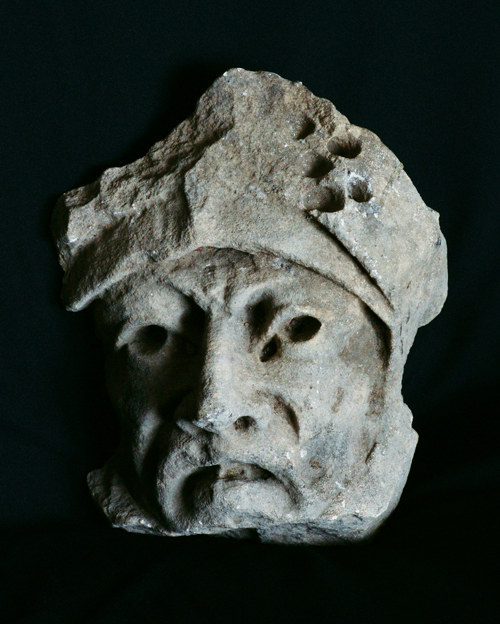
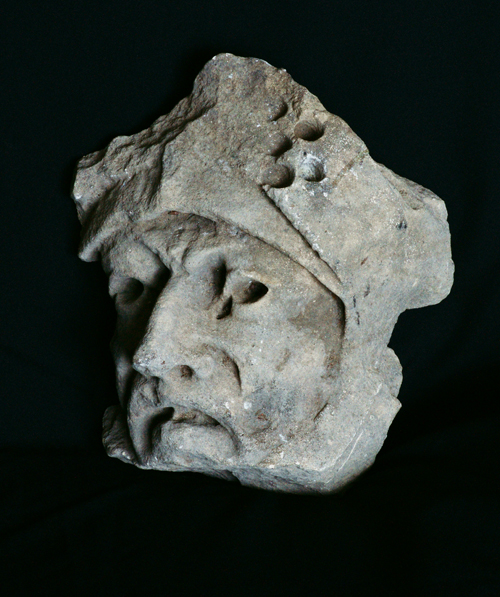
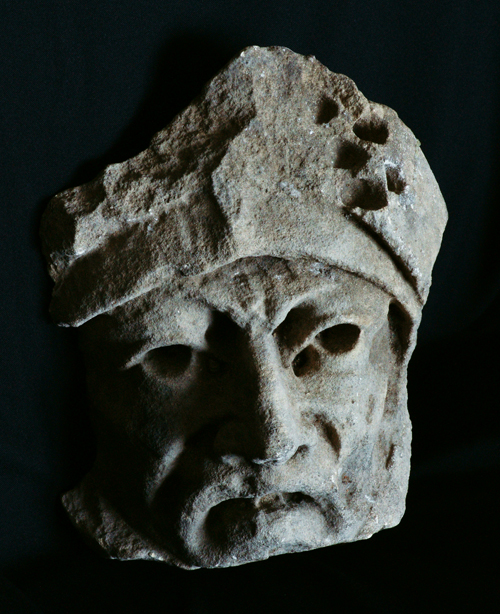
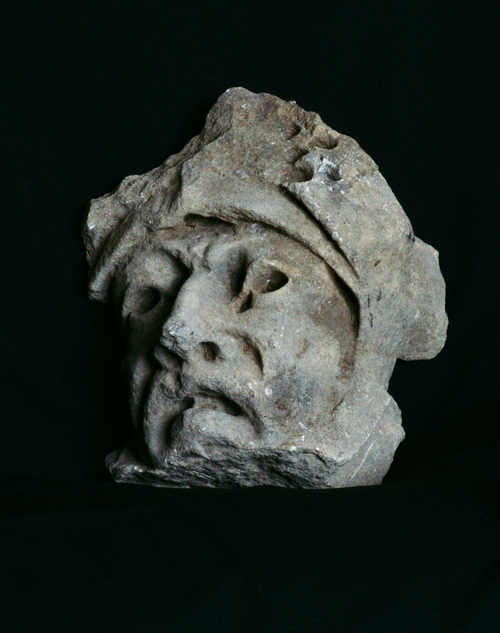
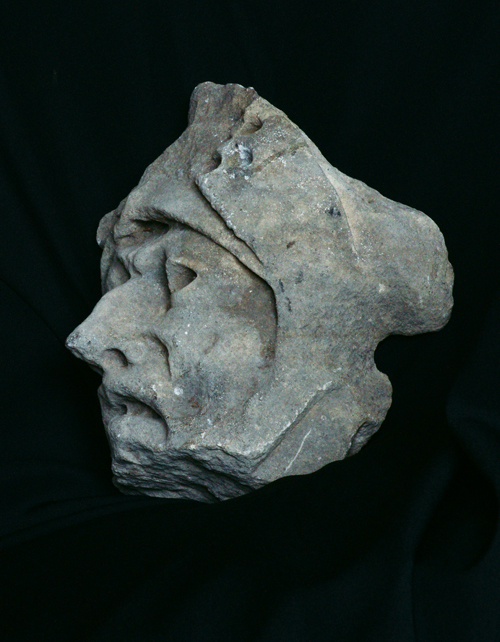
Perhaps this is near as we may ever get, to the face of a “Border Reiver”.
(Photo’s courtesy of F.J.A.G.)
The face of an unknown warrior…. British,
Limestone, circa 1530.
Find site unknown.
A fragment, life size, and carved probably from life, by a master carver.
A battle worn face, helmeted, and with visor raised, carved with an economy of detail… and all the more effective for it.
The weary face of a man who has seen everything…. and done most of it.
Carvings such as this are beyond rare, they are near enough non-existent.
Most sculpture of the era, exists merely to glorify the rich, or to decorate their tombs.
But this man, stares back at us… haunting us with his memories.
In all probability he was hacked off a larger sculpture shortly after he was carved. Sometime between 1536 and 1541. During Henry V111’s “Dissolution of the Monasteries,” an era when a massive amount of British sculpture perished.
The style of helmet, could just be English, and possibly Greenwich.
So far, I have been unable to locate any other depictions of a British knight, carved in this style.
And he may well be unique.
His face, however, reminds me strongly of the prints of Albrecht Durer, and the drawings of Leonardo da Vinci, More “Gothic,” than “Renaissance.”
Scotland has a rich cultural heritage that is unique in its own way. To know more about Scottish people, their food and culture read on.
First and foremost I must commend one of our own with this beautiful tartan. I wont mention any names as of yet but those who know him know that he is truly an amazing man. He has so graciously opened up the following tartan to all those associated with the Carruthers family world wide.
Scottish Kilt is known as : The National Dress of Scotland
Red Carruthers Tartan STR11700
The Perth based THE HOUSE OF EDGAR is the official tartan weavers of the Red Carruthers tartan and producers of all our highland wear: Kilts, Sock Flashes, Trews, Ties, Ladies Sashes as well as various kilt jackets, waistcoats and socks.
It is the longest running family owned commercial weavers in Scotland and the Clan Carruthers Society-International are proud to have links with them, as producers of our tartan.
NOW ON TO SCOTLAND !
Scotland is situated in the Northern part of Great Britain. The country is surrounded by many islands, and the mainland is a part of the island of Great Britain. Scotland’s first inhabitants were known as Picts, a Celtic tribe. There are over 300 castles in Scotland. Every place in Scotland has some history behind it, and is well-known for its scenic beauty. There are many historic sites like burial chambers, standing stones, sepulchers, and castles of Stone Age, Bronze Age, and Iron Age.
Callanish Standing Stones
Dating back over 4000 years, the Callanish Standing Stones is a cross-shaped setting of stones. It is one of famous stone circles of late neolithic and early bronze age.
A twisted yew, is the oldest living tree in Scotland which has been around for 3000 years.
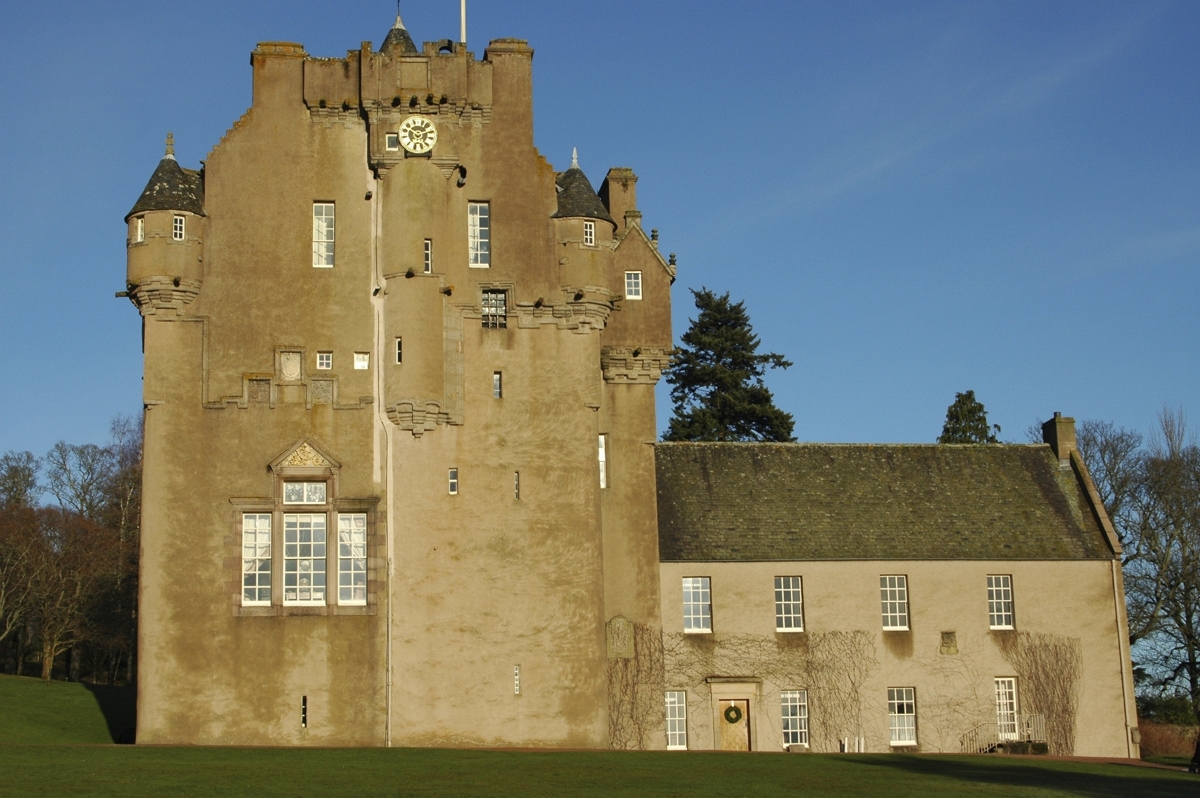
Crathes Castle
The beautiful castles in Crathes village in Aberdeenshire, Bothwell (Glasgow), and Palace of Holyroodhouse in Edinburgh (the British monarch’s official residence in Scotland), are some examples of the rich heritage of Scotland.
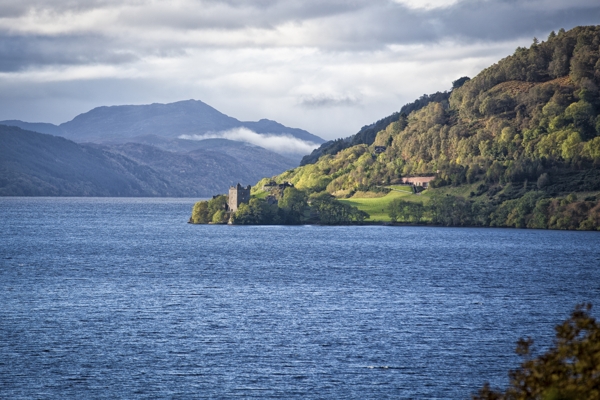
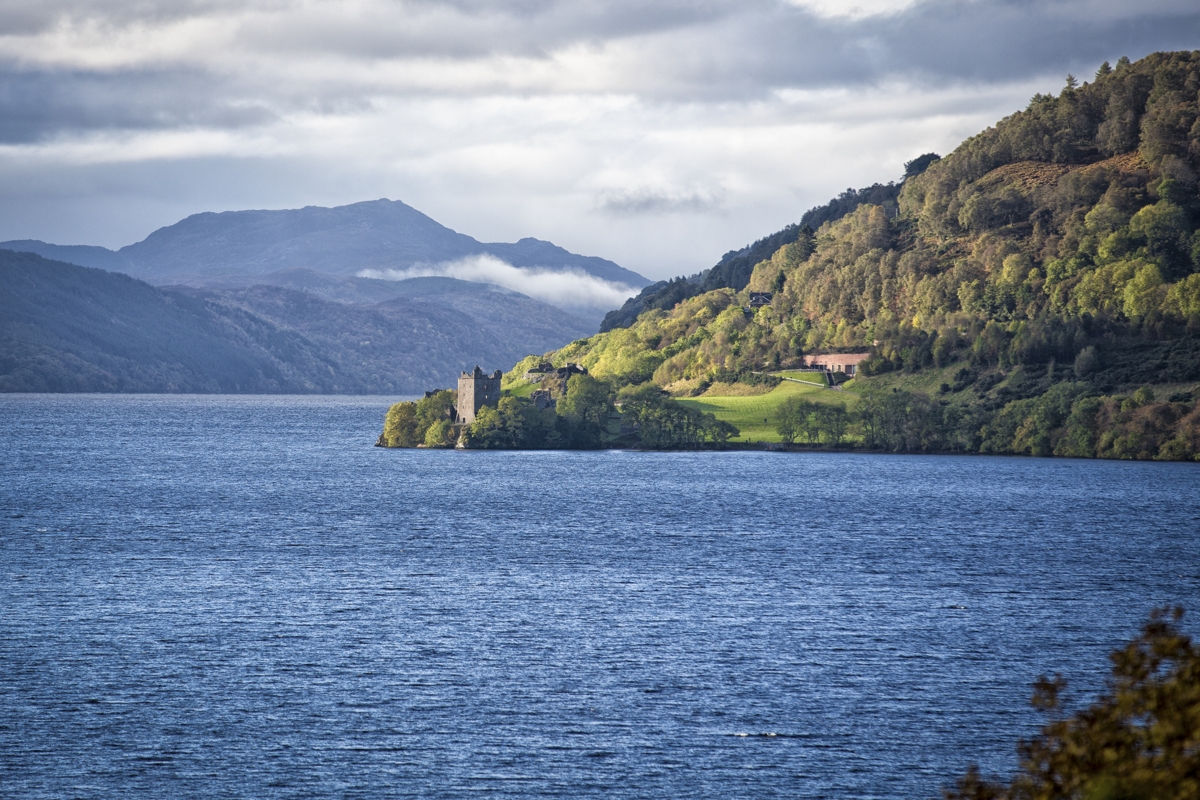
Loch Ness
Scotland has about 600 square miles of freshwater lakes. Loch Ness is the largest (by volume) freshwater lake and the most visited place in Scotland, where visitors love to explore the natural beauty, wildlife, and catch a glimpse of Nessie, the famous Loch Ness monster. Scotland’s climate is seldom hot, varying between the rainy and cold seasons.
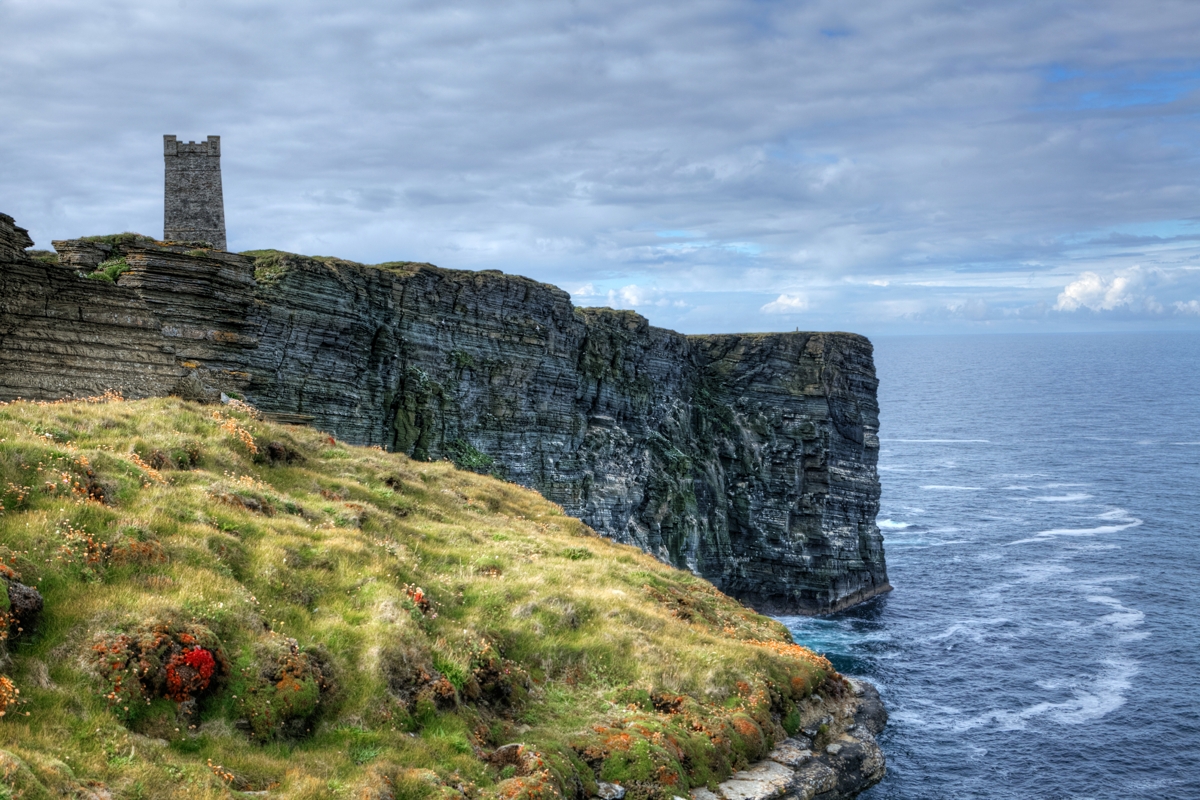
Orkney Island
Scotland occupies about 790 offshore islands and includes island groups such as Orkney, Shetland, and the Hebrides.
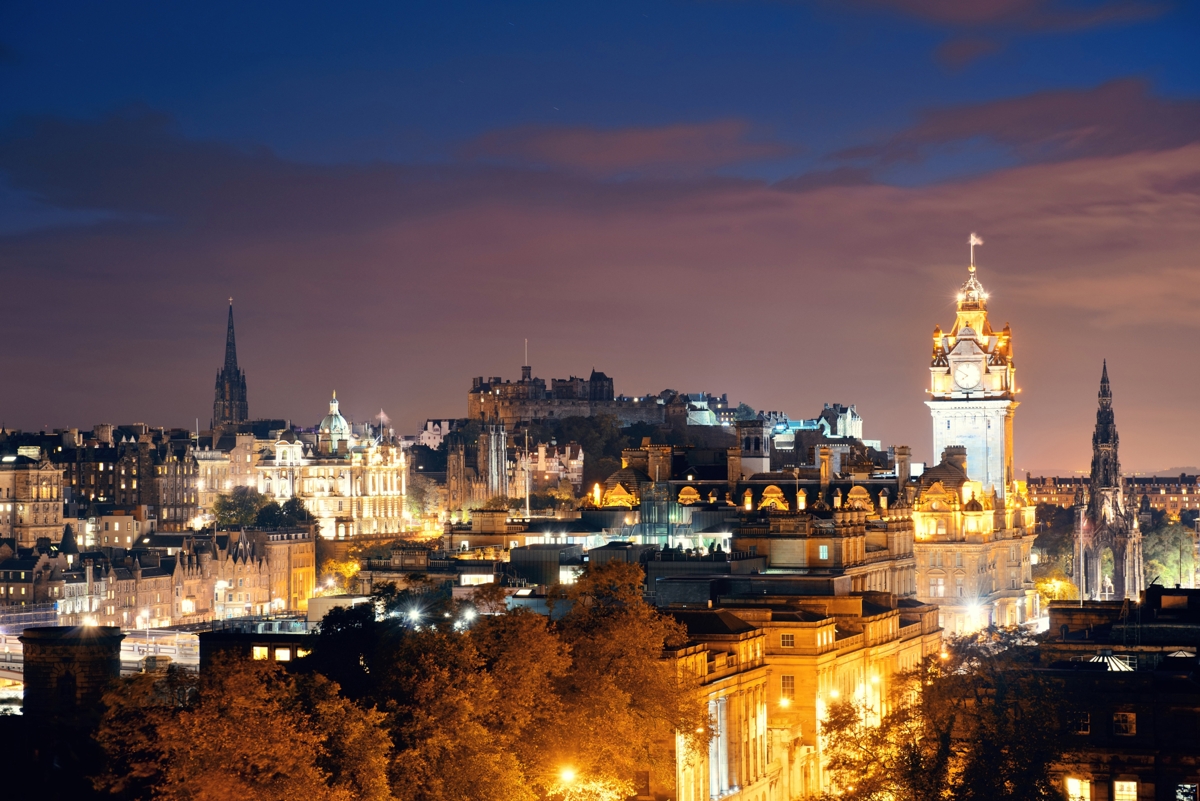
Edinburgh
Edinburgh, the capital of Scotland, is one of the largest financial centers of Europe. Glasgow is the country’s second largest and also one of the largest industrial cities in the world. The Scottish economy is dominated by heavy industries, such as steelmaking, shipbuilding, and coal mining.
Scottish People
Scottish people or Scots are an ethnic group indigenous to Scotland. Even today, the vibrant Scottish people proudly uphold their strong traditions. Farmers or crofters, as they are called, live in Highlands and islands of Scotland, which include the Northwestern hilly regions of Scotland. The Scots are very warmhearted and known to have a great sense of humor.
Scottish Clothing
Scottish Kilt Costume
The basis of Scottish clothing is tartan and kilt. A kilt is a traditional dress made of tartan patterns (interlocked horizontal and vertical stripes in multiple colors). The Scottish kilt is worn by both men and women, as a formal dress on special occasions or at Highland games or events.
Scottish Language and Religion
Historically, Scottish people are associated with many different languages such as Pictish, Norse, Norman-French, and Brythonic, but today none of these are in use. Today, Scottish English, a dialect of the English language, is widely spoken.
Advertisement
Judaism was followed in Scotland during the Middle Ages. Most Scottish people follow Christianity; but in recent times, other religions such as Islam, Buddhism, Sikhism, and Hinduism are also practiced, mainly through immigration.
Scottish Food
Oats, barley, and dairy products are considered as pillars of the rural and urban diet of Scotland. Scottish people are fond of good food. Usually, Scottish people grow their own vegetables and prepare a wide variety of soups and stews; porridge is their staple breakfast. The Scots love to drink tea. The women are known for their cooking and baking skills.
Dundee Cake
A list of a few traditional Scottish recipes would include, Dundee Cake, the Black Bun (traditional Scottish cake served at New Year), Scotch Pie (double-crust meat pie), shortbread oatcakes, and smoked salmon.
Haggis On A Silver Platter
Haggis made from sheep’s pluck, is another traditional delicacy of Scotland.
Scotland is renowned all over the world for its famous cheese, shellfish (lobsters and oysters), dairy products, Aberdeen-Angus, a breed of beef cattle known for its rich and tasty meat, and Scotch Whisky. The latter is famous all over the world and brings huge income to Scotland.
Arts and Crafts
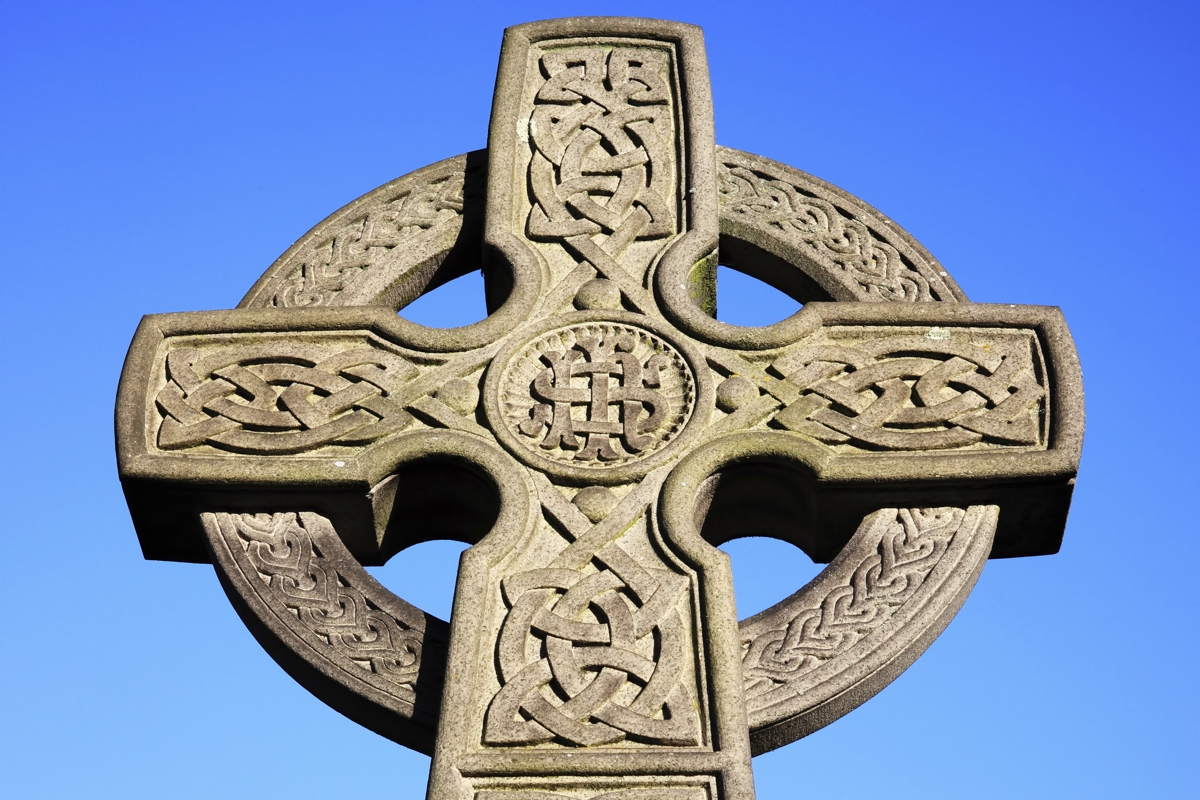
Celtic Cross
Scotland is known for Celtic art, in the form of jewelry, artworks, and silverwork. A celtic cross is a creative symbol of a cross combined with a ring surrounding the intersection. On the Isle of Iona (Scotland’s west coast) fantastic, carved stone monuments and crosses were made in the golden age of Celtic art in the early 20th century.
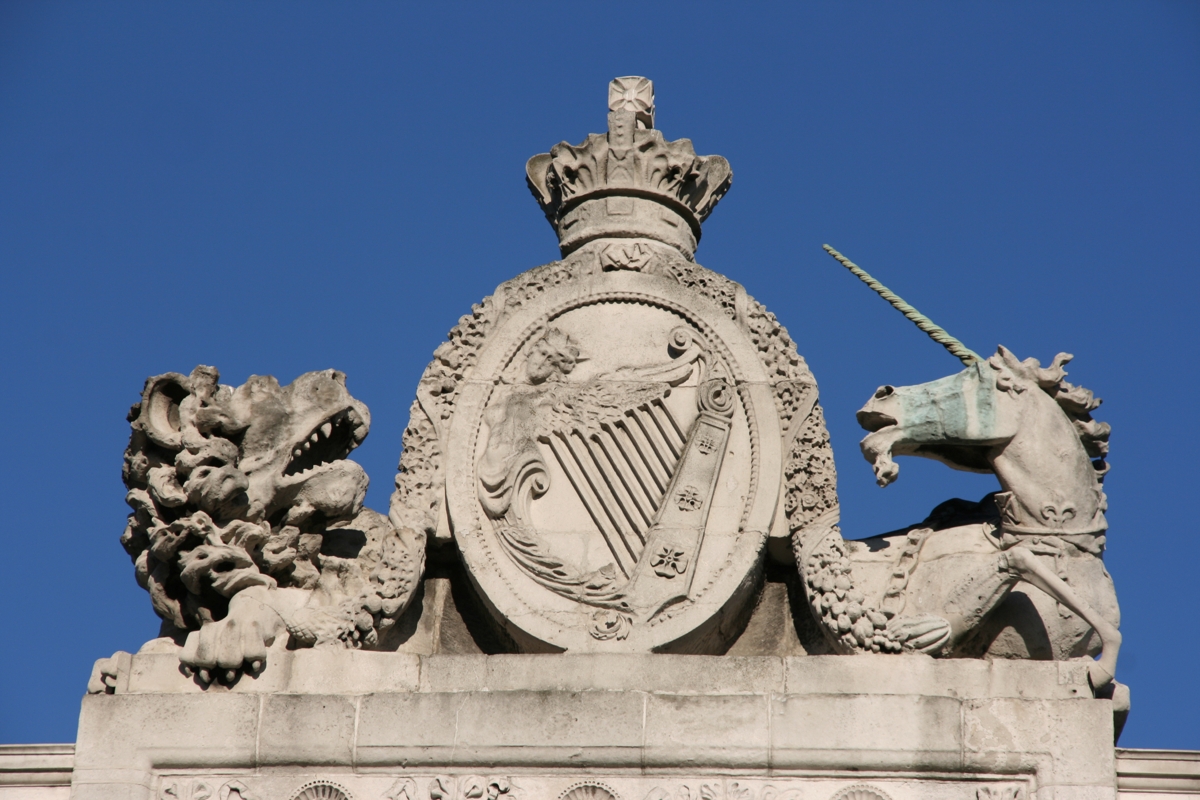
The Lion and the Unicorn
The unicorn represents Scotland and the lion represents England. The shield symbolizes the Scottish Royal Arms.
The National Museum of Scotland in Edinburgh, known for its fabulous art collections, houses 4000-year-old carved stone balls belonging to the Bronze Age, carvings, and artifacts, ornamental gold objects and religious carvings and illuminated manuscripts from medieval times.
Scotland is famous for its contemporary arts, crafts, sculptures, paintings, and landscapes. The Scottish National Gallery of Modern Art in Edinburgh is home to an outstanding collection of paintings, sculptures, prints, and recent works of artists. The Red Rag, a leading art gallery in UK, promotes the finest art collections of Scottish artists.
Music and Dance
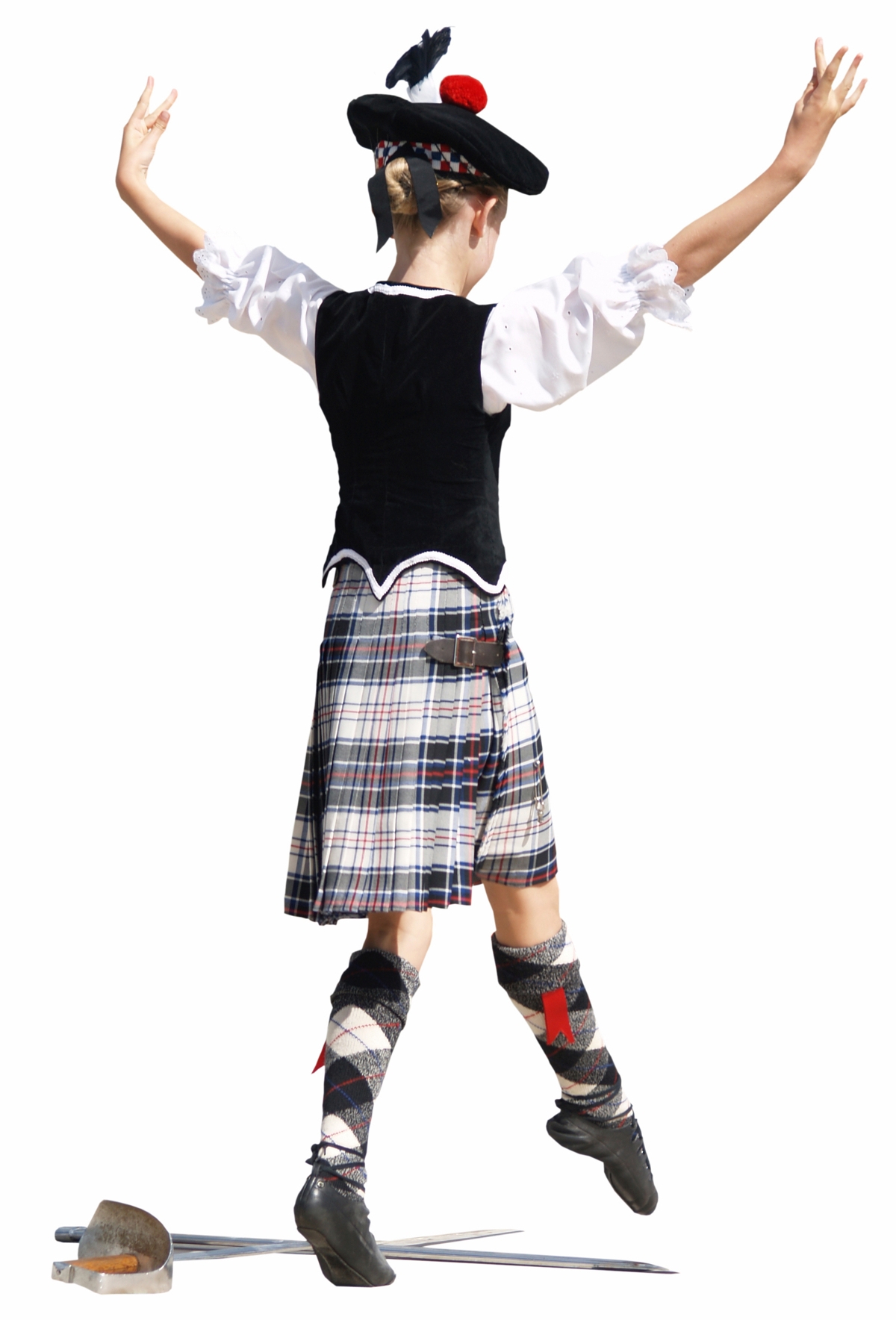
Bagpipers and dancers are a delight to watch at gatherings in Scotland. Highland dances are more difficult to perform and require great stamina and skill. The Highland dances have their base in the ancient folk customs and were earlier performed by only Scottish men; but now they are performed by women as well.
Sword Dance
The Highland Fling and the Sword dance are the oldest traditional Highland dances of Scotland. Male warriors performed the dances to celebrate their victory after returning from war. Now, they are performed at national events and dance competitions. One can take a glimpse of Scottish culture at the annual festival called Scottish Highland games.
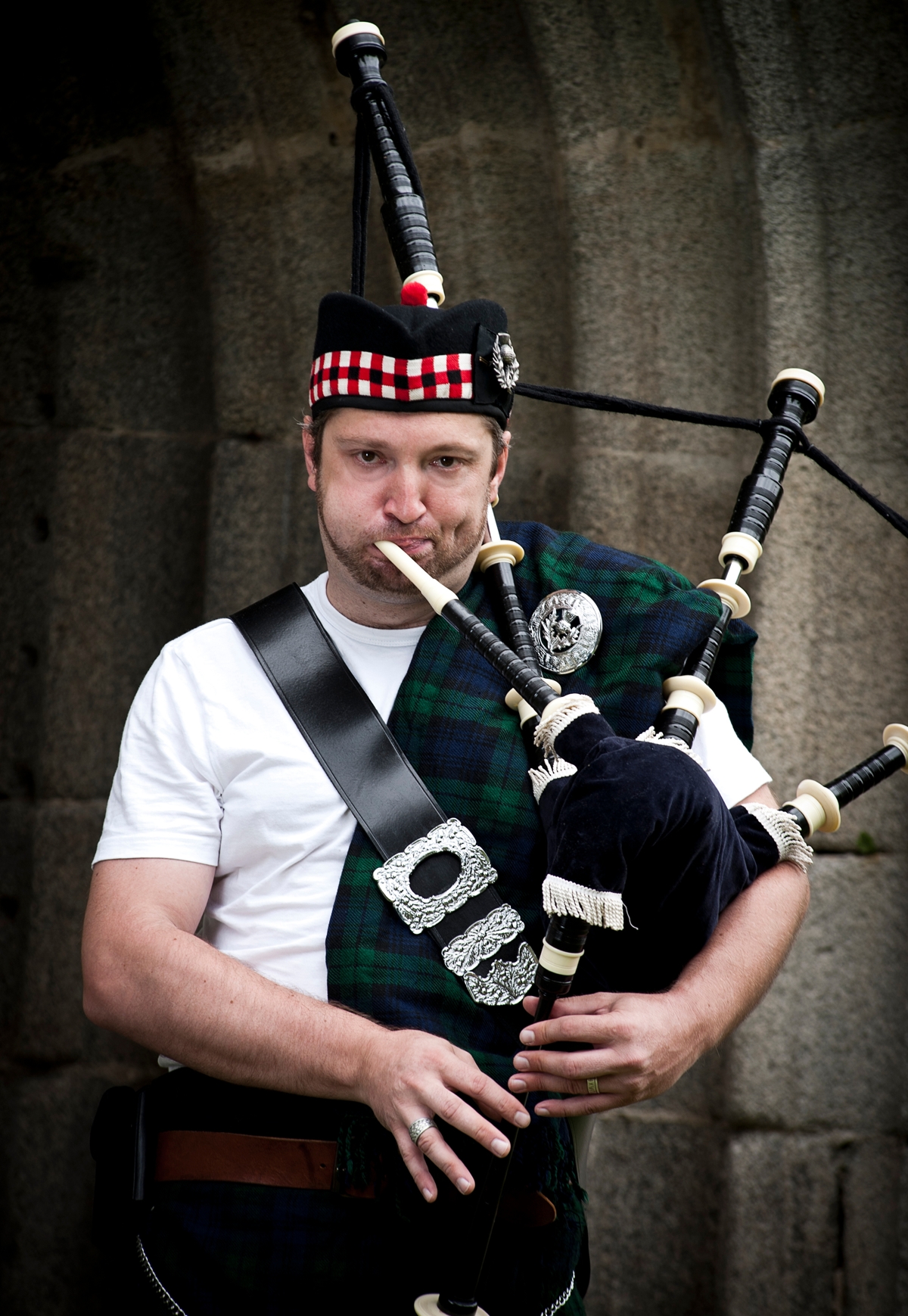
Bagpiper
Scotland is known for its traditional folk music and has influenced music across the globe. Their music ranging from bagpipers to contemporary folk music is truly amazing, and it continues to entertain people.
Scotland has made many contributions to the world of music. MacUmba is a unique group of musicians based in Scotland, who fuse the traditional sounds of Scottish bagpipes with musical rhythms of Brazil. They have played at many events and festivals across the globe, and continue to entertain the audience all over the world. Scottish rock bands like Runrig and Wolfstone, famous for fusion of Celtic folk with rock rhythms, have made a mark on the global map.
Scotland hosts the International Festival of Music and Drama at Edinburgh every year. The music and drama festival has come a long way since it was started in 1947; and today, it is one of the world’s largest cultural events.
Every year, Scotland celebrates the Burns an’ a’ that! festival on the 25th January, the birth anniversary of the national poet of Scotland, Sir Robert Burns. During this festival, fantastic food, dancing, traditional music, literary, and poetry events are organized. The Scottish opera and Scottish ballet are two companies which perform the art traditions in Scotland as well as across the world.
Sports
Golf
Scottish people are very fond of sports, and it forms a very essential part of their culture. Scots are passionate about the golf, so great sports facilities are provided across the country. There are very famous golf courses in the country. Scotland is renowned as the ‘home of golf’.
Football
Scottish people also follow football with great passion. Scotland has its own national team and represents in the international football. England is their favorite football opponent.
Recently, Tennis has become a popular sport in Scotland. The famous Scottish tennis player Andy Murray has made the country proud by winning major tennis championships. Scots also enjoy traditional sports like hammer throwing, tossing the pole, light and heavy athletics, and Scottish wrestling which is performed at clan gatherings.
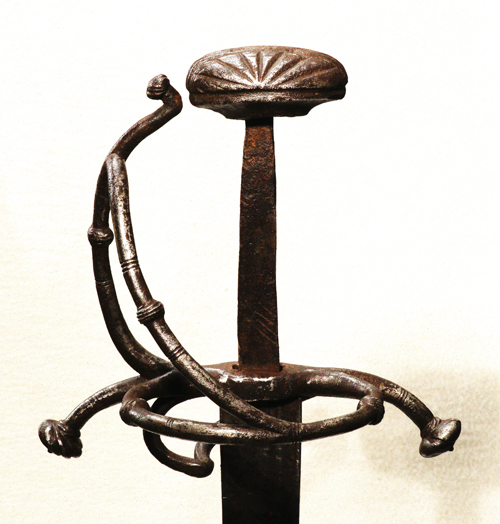
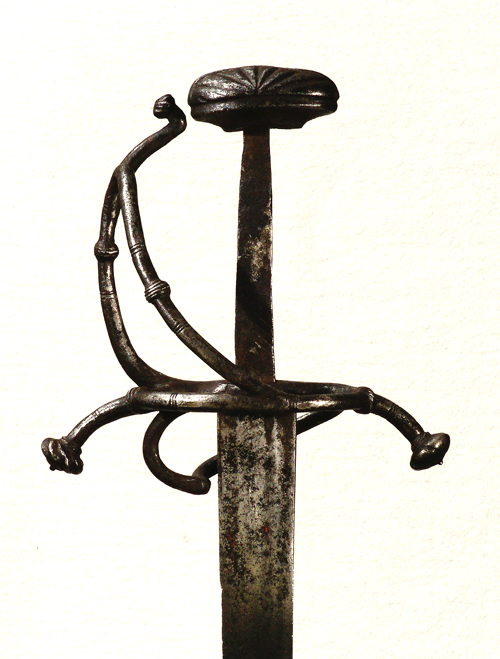
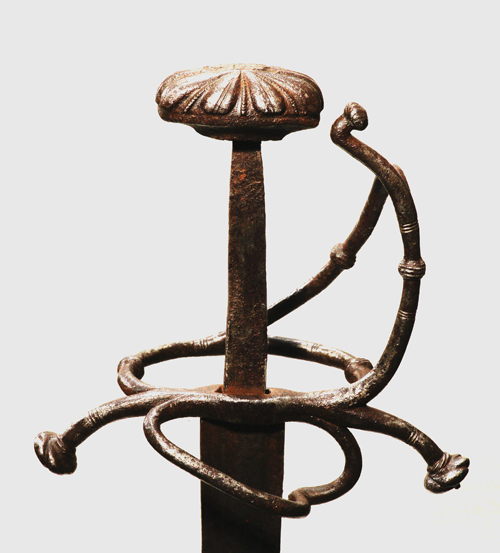
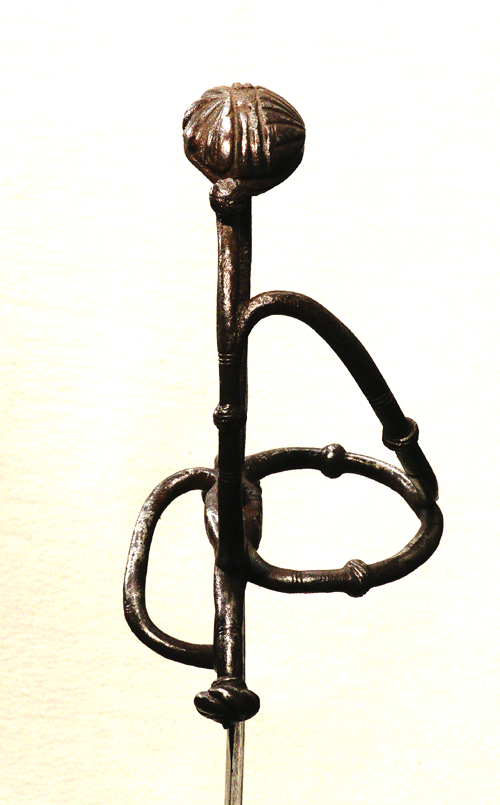
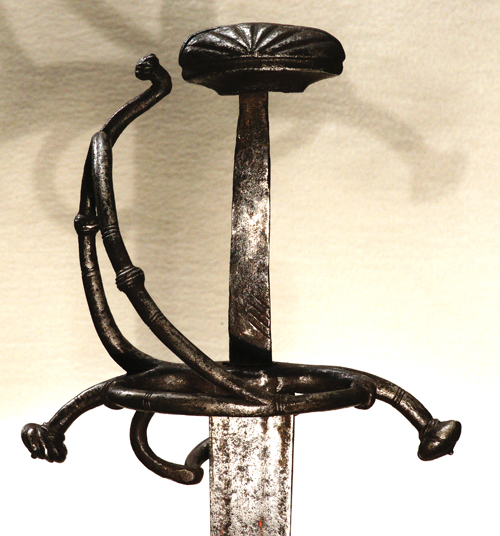
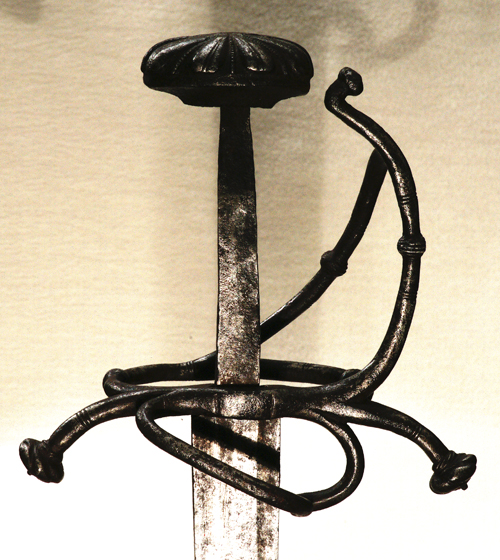
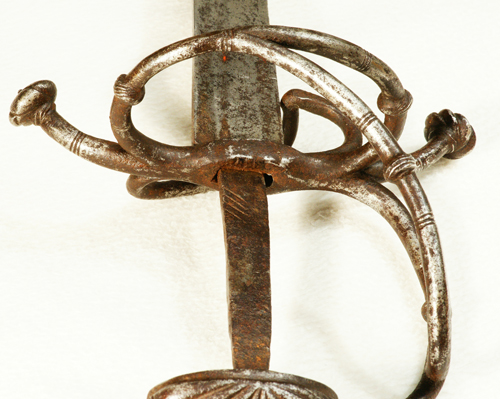
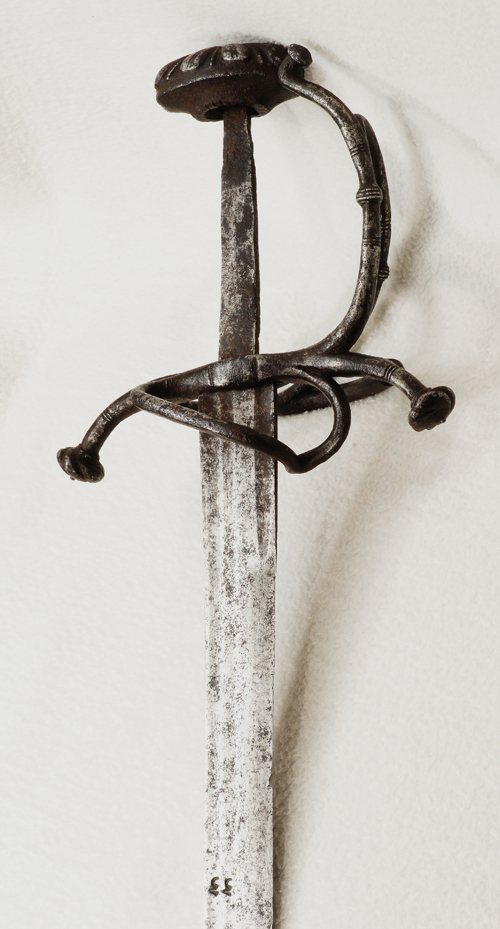
“Number 33.” “The “Amen” Sword?” A German Military backsword of Landsknecht form, circa 1525.
A rare German backsword of “Landsknecht” form. Circa 1525.
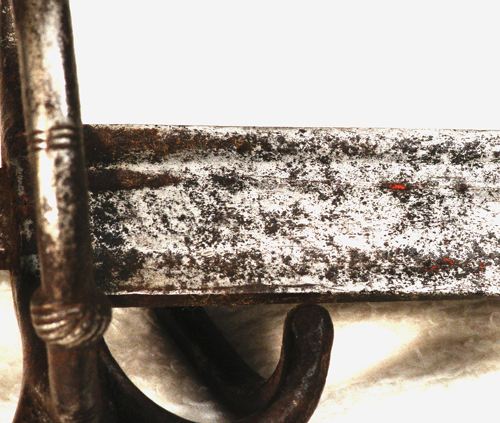
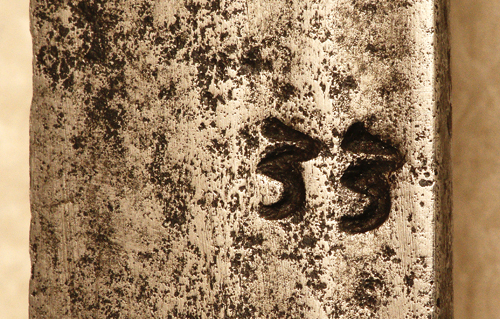
Blade marked with the number “33.”
(Photos courtesy of F.J.A.G.)
Dimensions :-
Backsword, with ricasso, and twin fullers as far as the double edged tip.
Overall Length :- 40 and one half inches.
Blade Length :- 35 and one sixteenth inches.
Ricasso :- 2 and one quarter inches.
blade width 1 and one eighth inches at ricasso tapering to 7 eighths of an inch at point where blade becomes double edged.
Back edged for 11 and three quarter inches.
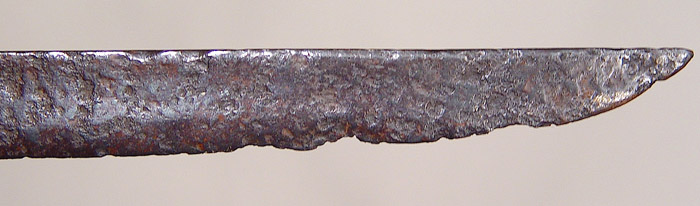
Notched once (maybe twice) on each side just above the back edge.
Point of Balance:- 5 and one half inches below the “cross.”
Weight:- 1 pound 15 ounces
Outside of hand.
Inside of hand.
Front view.
Rear view.
Below are a number of “detail” views.
“Assembly Marks” on Tang, Guard……
…. and Pommel. (four notches on each.)
Traces of red paint… probably from an old “Armoury” number.
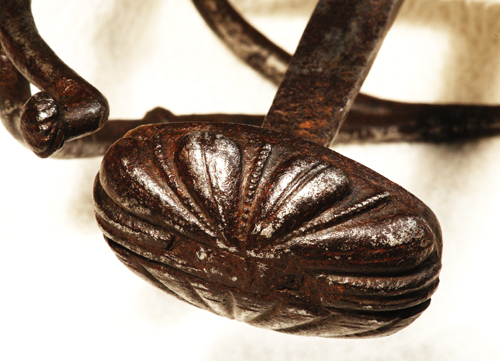
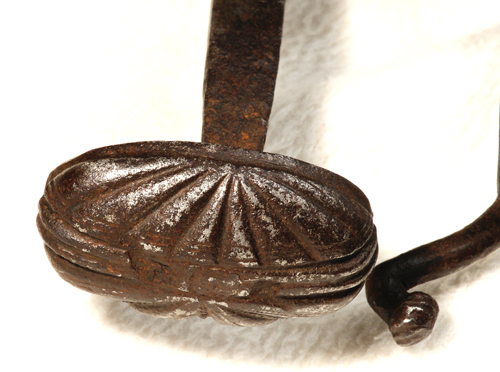
Pommel detail inside of hand.
(different on either side.)
Pommel detail outside of hand.
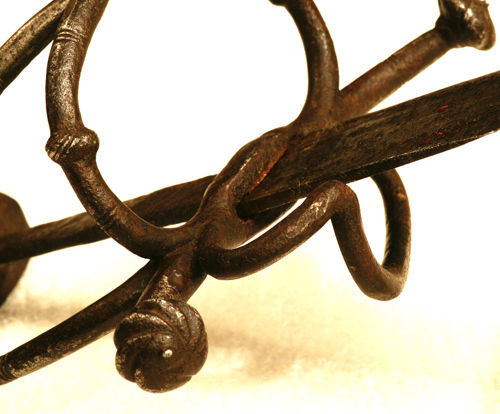
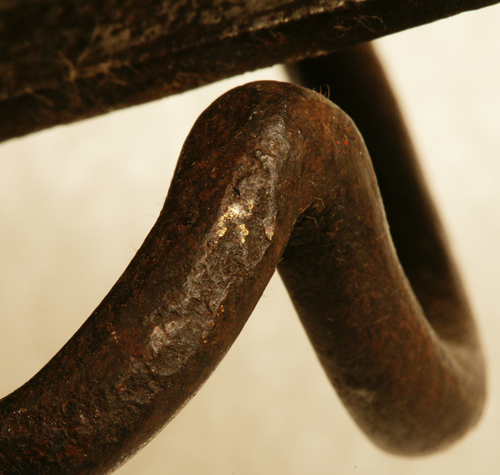
Note… Just where the lower guard almost touches the ricasso, there is a tiny fleck of gold. This may come from a contact knock, or it may be that the hilt, which has been heavily corroded, was once gilded.
Closer detail of “gilding” on lower guard.
On the back of the blade, just before it becomes “double edged” is a small”notch (perhaps two) on either side. I have commented on these in he past, and still have not managed to find any writing on their purpose. (See my posting of 13/12/13, detail below.)
There they are again…. but why?
(And, I’ve another excellent example to photograph with similar notches, when I have time out to travel.)
So…? What about the “Number 33″….?
Good question too!…. Well I’ve said it before… but there is very little on swords, and on blades in particular that has no meaning at all. And they are frequently inscribed with religious symbols, crosses, orbs… invocations to the Almighty for help in combat.
Many years ago I was the proud possessor of a blade, crudely inscribed with a crucifixion, and the words “Consummatum Est,”
Christ’s last words on the cross…. “It is finished.”
But in the case of the sword… this also has a double meaning….
i.e…. It, (the duel, or combat) is over, and the enemy is vanquished.
(Unfortunately… way back, I fell upon hard times… and sold that blade… the tang was stuck with a double H, one on top of the other… and if you find it… I’d be interested in buying it back!)
But I digress… So back to the “Number 33.”
And Yes, it could be no more than an Armoury number.
But…. Symbolically the number “33” can represent the word “Amen!” which just like Consummatum Est…. marks “The End”…
“It is over”…. “It is finished”… Or perhaps, more correctly “So be it.”
What you do is add up the numbers of all of the letters.
1 – 13 – 5 – 14… which equals…. 33.
If you don’t believe me… give it a whirl on the web… It’s quite well known in “certain circles.”
The Freemasons with their 33 degrees (no I’m not one!) get quite excited about it an’ all.
But it is much more than that…. because the number also represents the Seal of Solomon, which you perhaps know better as “The Star of David.” Which is in fact an ancient “cabalistic” and magical symbol, which has only become Jewish in the last couple of hundred years.
How that works is that the “star” is actually two interlinked triangles, each triangle with it’s three sides, representing “3” so, two triangles represents “33.”
Now that is seriously weird stuff… way back to the good old Knights Templars… (if you want believe all of that stuff.)
But back in the day… well perhaps folk did believe it…
And the Seal of Solomon would be quite a thing to have on your sword blade….
Which, (or “Witch?”) is why this is Andrew’s sword in my forthcoming “The Watchers of Enoch.”
Position, and orientation of “33” symbol on the sword.
And it may be worth commenting, that in this position, the blade could be intended to be viewed point up. Which may indicate that the sword was intended to have a secondary (or primary?) ceremonial role.
Rule of thumb I know… decoration to be read thus :- point up… ceremonial… point down… a fighting blade….. bit of a dodgy theory, and not one of my own…. but it is interesting, because observation indicates that it is quite frequently true.
Close up of “33” symbol on the blade.
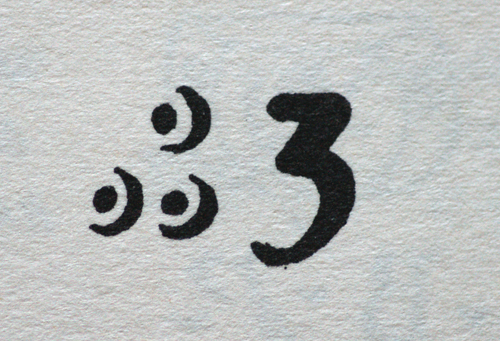
This is the only “similar” blade mark I can find… It’s from Dudley S. Hawtrey Gyngell’s “Armourers Marks,” of 1959, and is said to be “Italian, 16th century.”
It may, or, more likely, may not be connected, but whatever… it still reads 33.
Feel free to speculate… Mr Gyngell gives no further information as to the location, or to the type, of the sword which bears this mark… frustrating isn’t it?
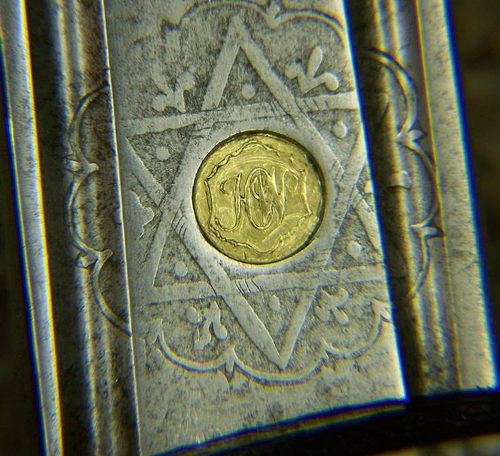
“Seal of Solomon”… “Star of David…”
Curiously, this symbol still exists as the “Proof Mark” on swords… right through to modern times!
That’s it on an 1855 Wilkinson blade….
And, to the best of my knowledge, it still goes on!
I mean, where did it come from… Now surely that’s worth a bit more research!
Here below is a starting point.
But do have a care…’cause this is entering seriously odd territory.
And it’s quite capable of destroying the very best of reputations.
Perhaps it ought to be left well alone… or to our old friend “Dan Brown.”
That second reference, was apparently published, (29th October 2013)…. in anticipation of Halloween?…. or at least I hope so… Folk certainly can be strange!
My own take on it all?…
Well, the triangle is a powerful symbol, and can be seen to represent “strength.” (since it is difficult to distort a triangle.)
Two interlocked triangles, should represent strength and unity, which is a nice concept, and one which in this day and age is oft forgotten. Therefore it would make a good “proof mark.”
All of which fits in nicely with my own “Three Commandments” :-
Be Nice to Folk…
Keep it Simple…
And…. If it ain’t broke… Don’t fix it!
(Plus…Laugh a lot… because it’s good for you.)
What it all meant, back in the 16th century… Well, who knows…. But all one should expect to see, if one goes peering into dark mirrors… is dark reflections. By: Brian Maffatt
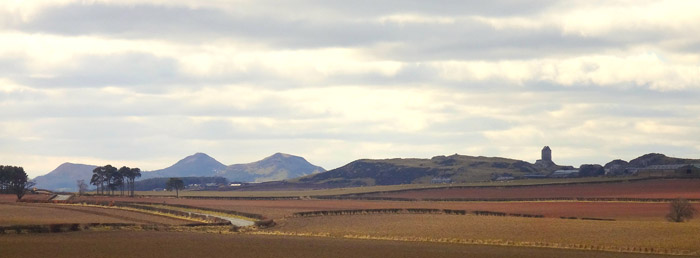
This is a view of the Eildon Hills, near Melrose, with the Pringle Tower of Smailholm in foreground.
It was taken from just west of Kelso on the road to St Boswells.
The Eildons are one of the most important sites in the Borders, and though the obvious archeology has been at least partially investigated, much yet remains to be done.
The North hilltop is surrounded by ramparts over three miles long, enclosing an area of 40 acres which contains the rock cut platform bases of at least 300 houses.
The site has been occupied since at least 1000 BC and at the peak of its occupation the population is believed to have been three to six thousand, the largest bronze age population known in Scotland.
In the 1st Century AD, the Roman Army built the massive fort of Trimontium (Three Mountains) at the foot of the hills, on the banks of the River Tweed. They also constructed a signal tower with a tiled roof in the centre of the hillfort.
There is evidence that the Eildons have always been regarded as a holy place, and a probable site of ceremony, and there are several holy springs around the base of the hills.
Arthur and his knights are said to be sleeping in a chamber within the hills, the rock of which was by repute, cleft into three by the wizard Michael Scot.
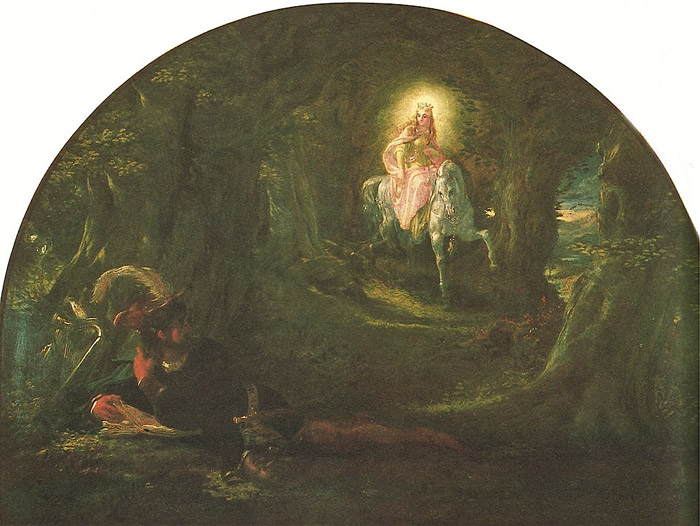
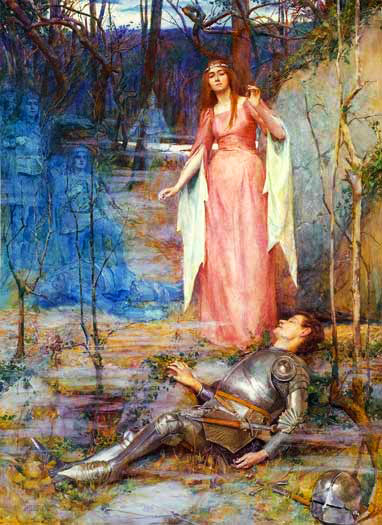
La Belle Dame Sans Merci.
The Story of Thomas Rhymer.
Sir Joseph Noel Paton.
And of course…..The Eildon Hills are where Thomas the Rhymer met the Queen of Faerie.
Sir Thomas Learmonth, of Erceldoune, (modern Earlston) circa 1220 – 1298, was a genuine historical personage, better known as Thomas the Rhymer, who according to legend, met with the Queen of Faerie (Elfland), near “Huntlie Banks,” on the Eildon Hills.
The Queen of Faerie, appears as a beautiful lady, mounted on a fine horse.
Thomas kisses the lady, (or has sex with her,) as a result of which she loses her beauty, and is transformed into an ugly hag.
He is then transported with her to “Elfland” via long and torturous paths. They pass three roads, the path of righteousness, the path of wickedness, and the path to “Elfland,” which they take.
Upon her arrival in Elfland the ladies beauty is restored.
Although Thomas believes that he has resided in Elfland for only a small number of days, in fact, three or seven earthly years, have passed ( depending upon which version of the ballad is consulted,)
After the passing of seven years, Elfland must pay a “Teind” i.e. a fee to the Devil, the teind being the most handsome man available, and the Queen fearing that Thomas will be chosen, returns him to the real world, having first granted him the gift of prophecy. He is thus obliged to speak the truth. Hence his other title of “True Thomas.”
A similar tale is associated with the well at Carterhaugh near Selkirk, and forms the basis of the ballad of “Tam Lin,” a young knight who falls from his horse, and is transported to Elfland by the Queen of Faerie.
Tam Lin lurks by the well, appearing when a young girl plucks a double rose. He then demands either a possession, or the virginity of the young lady in question.
Thus he succeeds in getting Janet (or Margaret depending on the version) pregnant. When her father questions her about who the father of the child may be, she returns to Carterhaugh, plucks a second rose, and when Tam Lin appears, she questions him, and learns of his plight.
Once again as in the ballad of Thomas the Rhymer, Tam is to be a sacrifice to Hell, having resided in Elfland for almost seven years. However, he can be rescued and returned to mortal form, and if Janet performs the correct procedures as the Faerie procession passes by on Halloween, he will return to earth.
If she does this he promises to marry her.
All proceeds according to plan, and after he has been turned into a number of beasts, and a finally, a burning sword, which Janet casts into the well, he is restored.
The Queen of Faerie is angered, but Janet wins her Knight.
These stories are ancient, and in antiquity the Faerie were far from being small winged creatures who lived at the bottom of the garden. They were much more sinister, indeed, in witchcraft ceremonies the principal female participant actually bore the title of “The Queen of Faerie.” (See Margaret Murray, “The Witch Cult in Western Europe,”) and bearing this in mind, perhaps it is not impossible that Thomas the Rhymer did indeed go off for some time with the “Queen of Faerie,” or at least with a “Queen of Faerie.”
Now that would certainly provide a new slant on the legend.
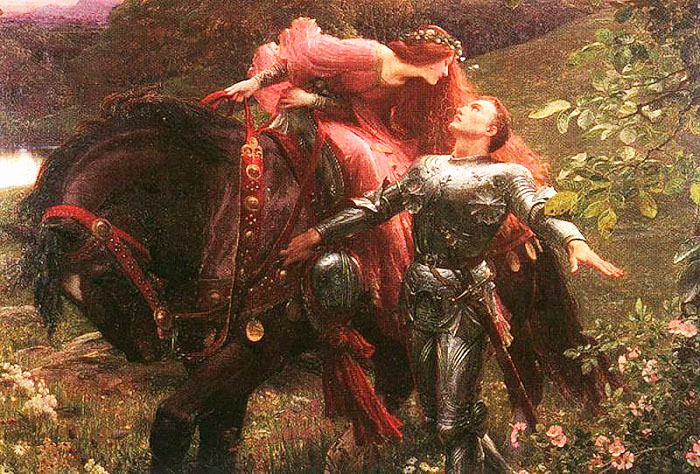
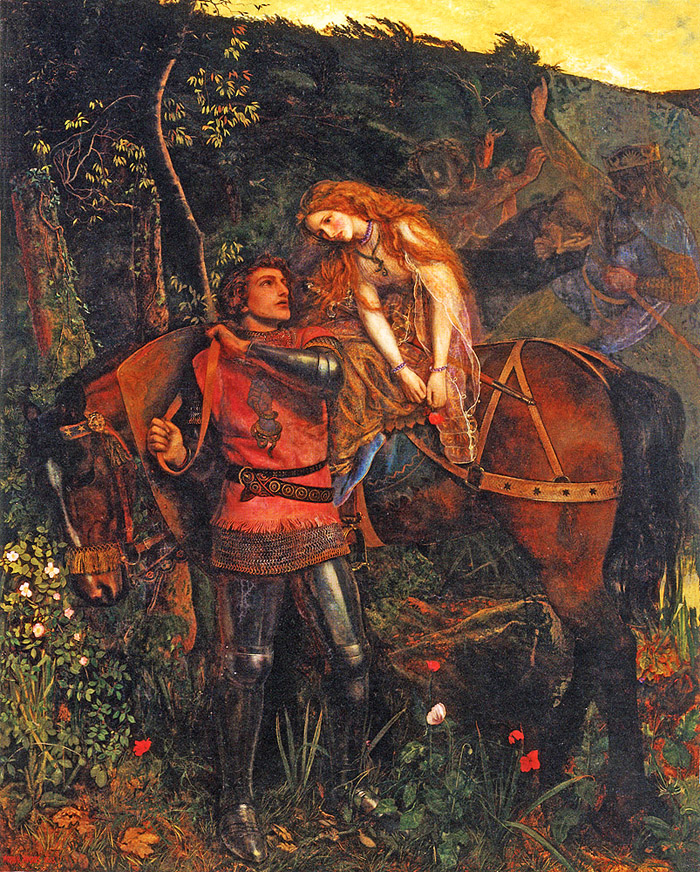
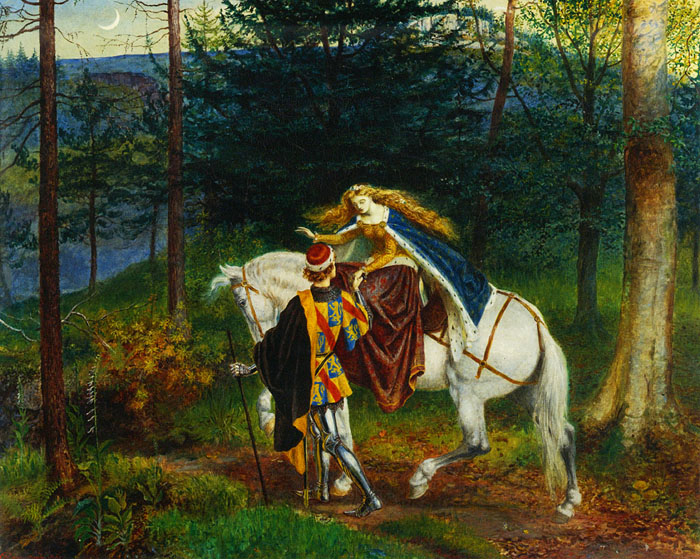
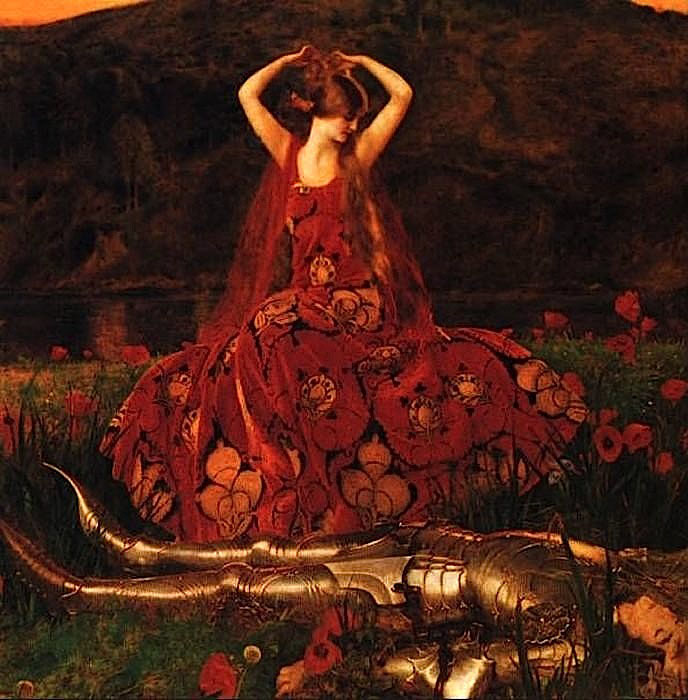
However….. In 1819 the entire subject received a huge boost in popularity when Keats, apparently using “Thomas the Rhymer” and “Tam Lin” as his models, produced the ballad “La Belle Dame sans Merci.” a.k.a. “The Queen of Faerie.”
From that date on, the subject became one of the most popular themes for artists, and in particular for those artists associated with the Pre Raphaelite brotherhood.
Here are a few……
Frank Dicksee, “La Belle Dame sans Merci.”
John William Waterhouse, “La Belle Dame sans Merci.”
Arthur Hughes, “La Belle Dame sans Merci.”
(Note the ghostly figures she’s already carried off, in the background!)
Walter Crane, “La Belle Dame sans Merci.”
Henry Meynell Rheam, “La Belle Dame sans Merci.”
(Note, once again, see the spectral onlookers?)
Frank Cadogan Cowper, “La Belle Dame sans Merci.”
And finally, my own “personal favourite” artist….
Sir William Russell Flint, “La Belle Dame sans Merci.”
Those above, are just part of the influence of “Thomas the Rhymer,” and “Tam Lin” on the art and thought of the 19th into the early 20th Century.
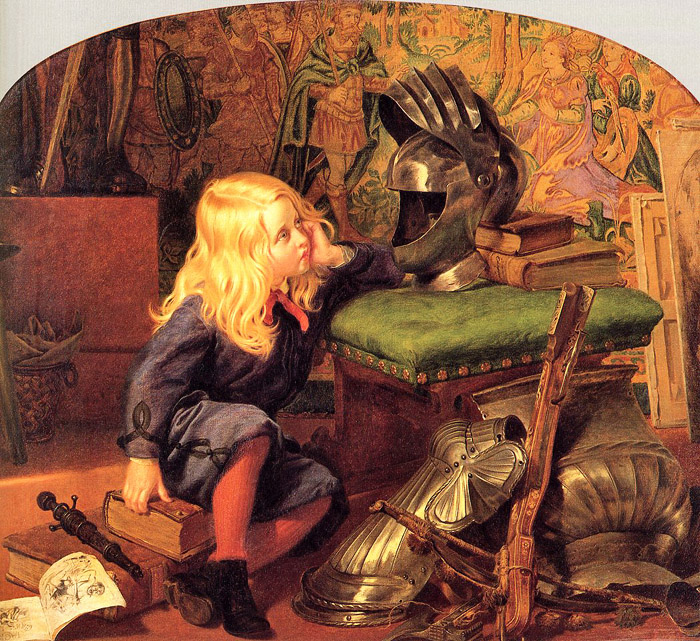
As for poor old Sir Joseph Noel Paton….. These days he is listed (dismissed?) as “a painter of Fairies,” as in the little winged variety. Yet in his own day he was more renowned than the Pre-Raphaelites.
Further, he was a collector of arms and armour, and many of his paintings are full of authentic detail.
Sir Joseph Noel Paton, “I wonder who lived in there.”
He illustrated the ballad “The Dowie Dens of Yarrow,”……..full of swords and daggers.
And he produced at least one oil painting for the engravings for this book, but so far I have only been able to locate a single example.
Sir Noel Joseph Paton deserves better recognition than he has as yet received.
He left his arms and armour collection to the Nation, and until recently it was displayed in two cabinets on the rear stairway of Chambers Street Museum up in Edinburgh, but since the so called “modernisation” of the Museum I’m informed that it is now somewhat harder to find.
Why not ask to see it if you’re up there!
Our legends are disappearing rapidly.
Last year I ended up in Borders General Hospital, (recovered now, thank you) which is built on the slopes of the Eildons.
Nurses kept asking how I was, and I told them I would be O.K. as long as no beautiful ladies arrived on dapple grey horses. They all thought I was mad…… No-one knew what I was talking about!
Strangely, Dingleton Mental Hospital is also on the site, although part of its function has now been transferred to Huntly Burn House. (Huntlie Burn!)
Where Thomas the Rhymer went away with the Faerie!
What a bizarre (and hopefully unintentional?) sense of humour officialdom does seems to have!
And now the local Council seem Hell bent on allowing building on the slopes of the Eildons. But believe me…… not everything is known about that site, and no developer ought to be allowed anywhere near there.
The Eildons are quite probably as important to Scotland as the pyramids are to Egypt, but of course our so called”archeologists,” along with our ever popular “television personality” historians, much prefer to work abroad and in the sunshine…… and so our own history gets ignored.
And, even in the 21st century our very own ancient folk beliefs are still pretty much a taboo subject. Never were any “Witches,” or “Queens of Fairie” here….. Much safer to stay with the Egyptians, Incas, Native Americans etc.
And …..that’s the reason that one day, if we are not careful, some developer will be allowed to build on what ought to be our “Sacred Mountains.”
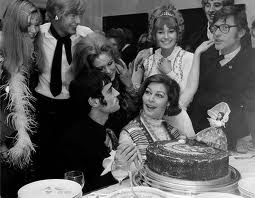
Strangely, there are fewer illustrations of Tam Lin, but a very odd movie was made of the story back in 1970. It starred Ava Gardner, and Ian McShane, and was directed by Roddy McDowell.
So…….. here’s a little “Lovejoy” from the movie.
And here’s the cast, at Ava’s birthday party.
And in 1974, Steeleye Span took Thomas the Rhymer into the charts, but that was back when Folk was still “Pop.”
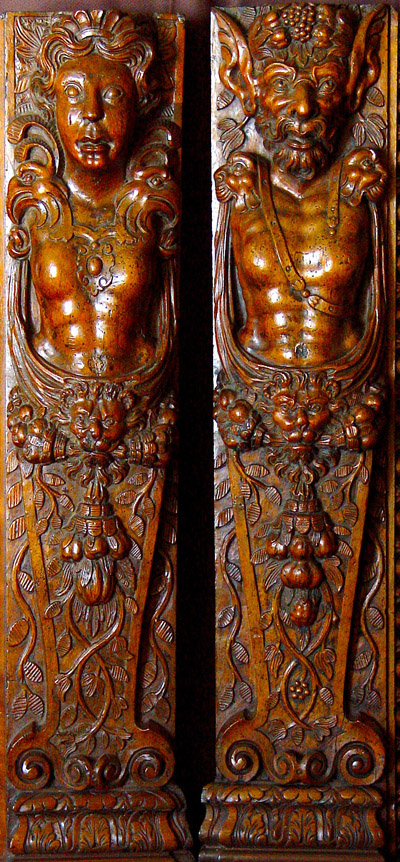
The images above are all well and very good………..But this below is how the King and Queen of Faerie were actually depicted in Shakespeare’s era…….
Photo courtesy of FJAG
These magnificent walnut carvings date from the very early years of the 17th century, and by extreme good fortune they survived the demolition of a large country house, where they had been incorporated into a fireplace surround!
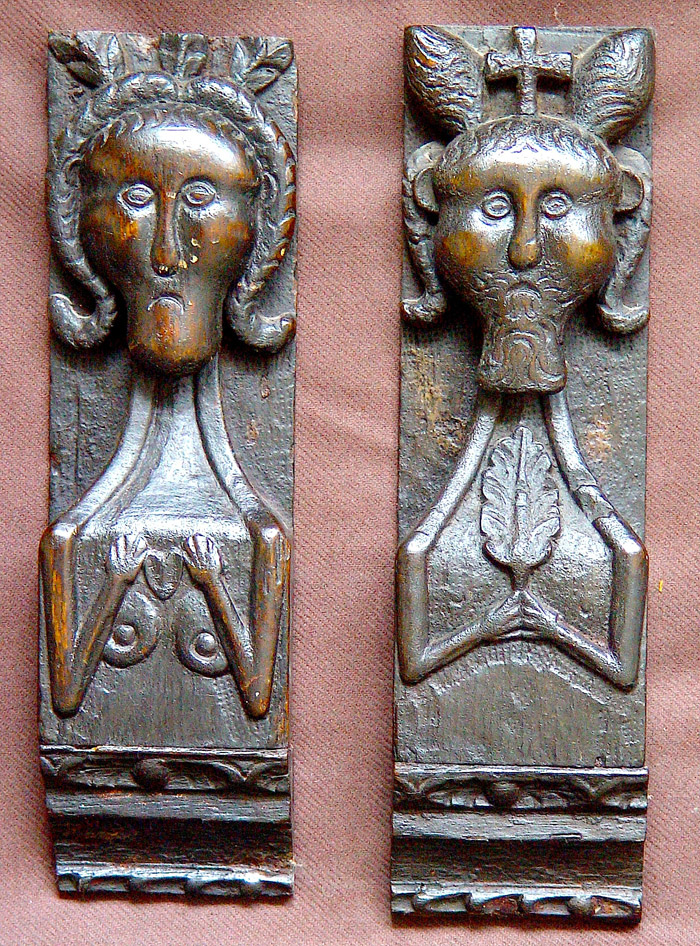
But some things, so far, defy identification. For instance……..
Photo courtesy of FJAG.
What are we to make of this pair? A naked lady wearing three leaves on her head, and clasping a heart between her hands, and a bearded man holding an (oak?) leaf, and crowned with a Christian cross and what appear to be a pair of asses ears…..
(Addendum…. With regard to the lady with the heart… see my posting of 28th July 2015.)
….The carvings appear to be fragments of a court cupboard probably dating to the second quarter of the 17th century. It would be fascinating to know what the rest of the decoration consisted of.
But they were, it seems bought in an antique shop, and their previous history is unknown.
So far…… the best explanation is that the Lady is the Queen of Faerie, and that it is a parody of some description on the conflict between the old and “new” religions.
This is the problem. I know for certain that most of our early “folk carvings,” and in particular those of a “secular” nature, are hidden away in the basements of our public museums, both the large and the small. And…..little attempt has been made to catalogue them.
What is worse, is that our public museums now have authority to sell off items from their (usually reserve) collections to raise funds. As a result much of our as yet unclassified national heritage is under threat. And quite frankly, no-one seems to be aware of it.
Our auction houses have little knowledge of “folk Art,” or “folk Religion,” since most of their experts have suffered a classical education, and whilst they are well versed in Greek and Roman Mythology, anything outside of that simply passes them by.
Our secular art, at least what of it has survived the ravages of both Church and State, is carved into the fabric of our buildings, and our furniture. It is engraved, etched and inlaid into our arms and armour.
It is a fertile field for study, and those who wish to make a start would do well to equip themselves with a cheap paperback copy of Sir James Frazer’s “The Golden Bough,” and perhaps, with a more expensive 5 volumes of the Child Ballads. (Now, thankfully available in paperback from Dover Publications.)
It’s all out there to be found, and written about! So……Why not venture forth!….and find some goodies before everyone else does! By: Brian Moffatt
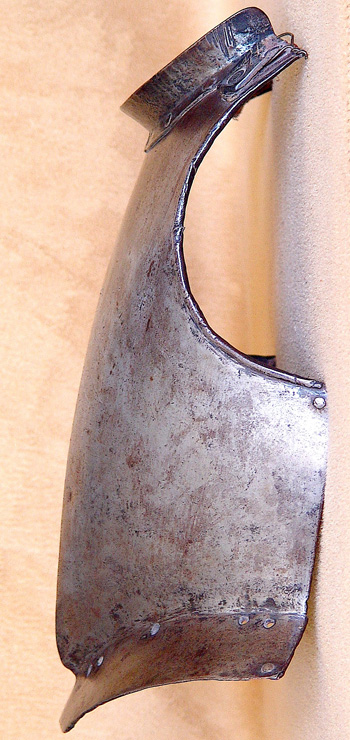
A fine battered and battle scarred breastplate of the late 16th century.
I have often been asked just what kind of armour the Border Reivers wore, and apart from the upper echelons of society the answer must always be the same…..Whatever they could get their hands on!
“Scottish” armour near enough does not exist. Some was made in the 15th and 16th centuries, mostly by French armourers in Royal employment, but none appears to survive, and of the rest…. well, if it does exist, then it has as yet to be positively identified.
And so the “Reivers” made do with their “jacks,” and whatever other pieces of English or continental armour (mainly “German”) that they could beg, borrow, or more likely…… steal.
But this below is as near as I have ever seen to the battered and adapted armour which must have been in use in this area in the late 16th Century,
This is Christie Armstrong’s breastplate
Photograph’s courtesy of FJAG
I have never seen another like it. It has more sword cuts, and lance damage than any other, and the riveted reinforce at the neck is almost unique. It has been added to stop sword cuts upwards to the neck, and to prevent a lance glancing upwards from the surfaces of the breastplate.
This is detail of just some of the damage, we tried to count the blows, and the types of weapon, but eventually we just had to give up!
And this is a side view, just to illustrate the profile. I will return to the subject of the development of the breastplate in future postings.































 CLAN CARRUTHERS SOCIETY (USA)